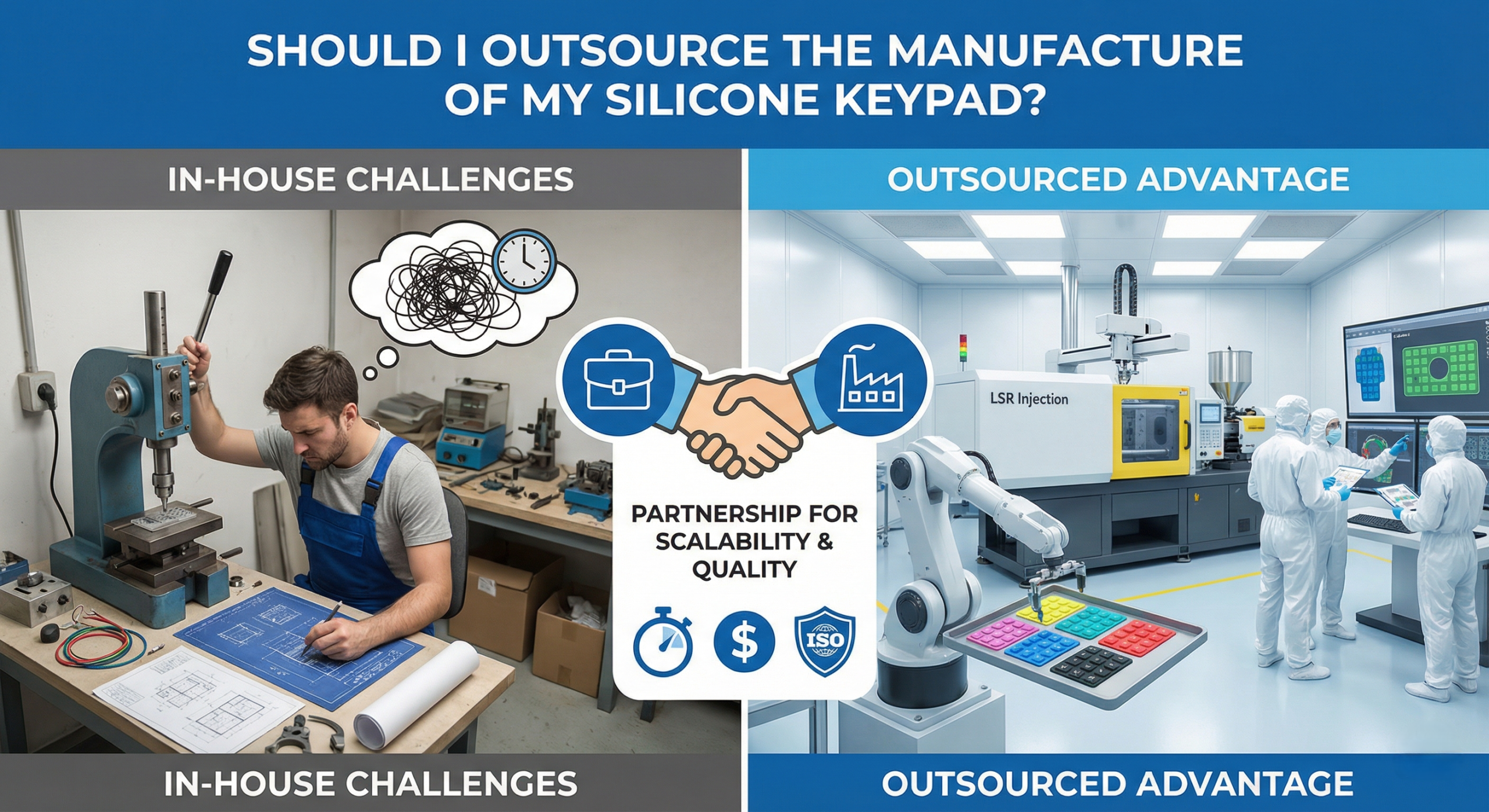
Yes, outsourcing the manufacture of your interface components to a specialized partner is the most efficient strategy for achieving high-precision results at scale. Many engineering teams struggle with the hidden complexities of material science and tactile engineering when attempting to produce a Silicone Keypad in-house.
Small errors in snap ratios or material durometer can ruin entire batches, causing launch delays and damaging your market reputation. These technical bottlenecks often lead to wasted capital and inconsistent product quality that frustrates end-users. By partnering with an expert facility like Hualin Silicone, you gain access to advanced Liquid Silicone Rubber (LSR) technology and rigorous ISO quality standards without the capital risk.
Why is outsourcing more cost-effective?
Outsourcing eliminates the need for massive capital investment in specialized LSR machinery and cleanroom infrastructure. Maintaining a dedicated facility for a Silicone Keypad requires constant overhead that often outweighs the unit cost savings of domestic production.
How do material costs change?
Professional manufacturers purchase raw silicone in massive quantities, which significantly lowers the per-part cost for your project. They also minimize waste through automated dosing systems that ensure every gram of material is utilized efficiently.
Here is the kicker:
- Bulk purchasing power reduces raw material overhead.
- Automated systems minimize costly material waste.
- Lower labor costs for manual assembly and inspection.
Key Takeaway: Outsourcing converts high fixed costs into manageable variable costs, allowing for better budget allocation across your product development.
| Cost Factor | In-House Production | Outsourced Manufacturing |
|---|---|---|
| Initial Investment | Extremely High | Low to None |
| Material Pricing | Retail/Small Batch | Wholesale/Industrial |
| Maintenance | High Internal Cost | Included in Unit Price |
The data below illustrates the immediate financial advantages of leveraging an external production partner for your elastomer components.
Does it improve technical performance?
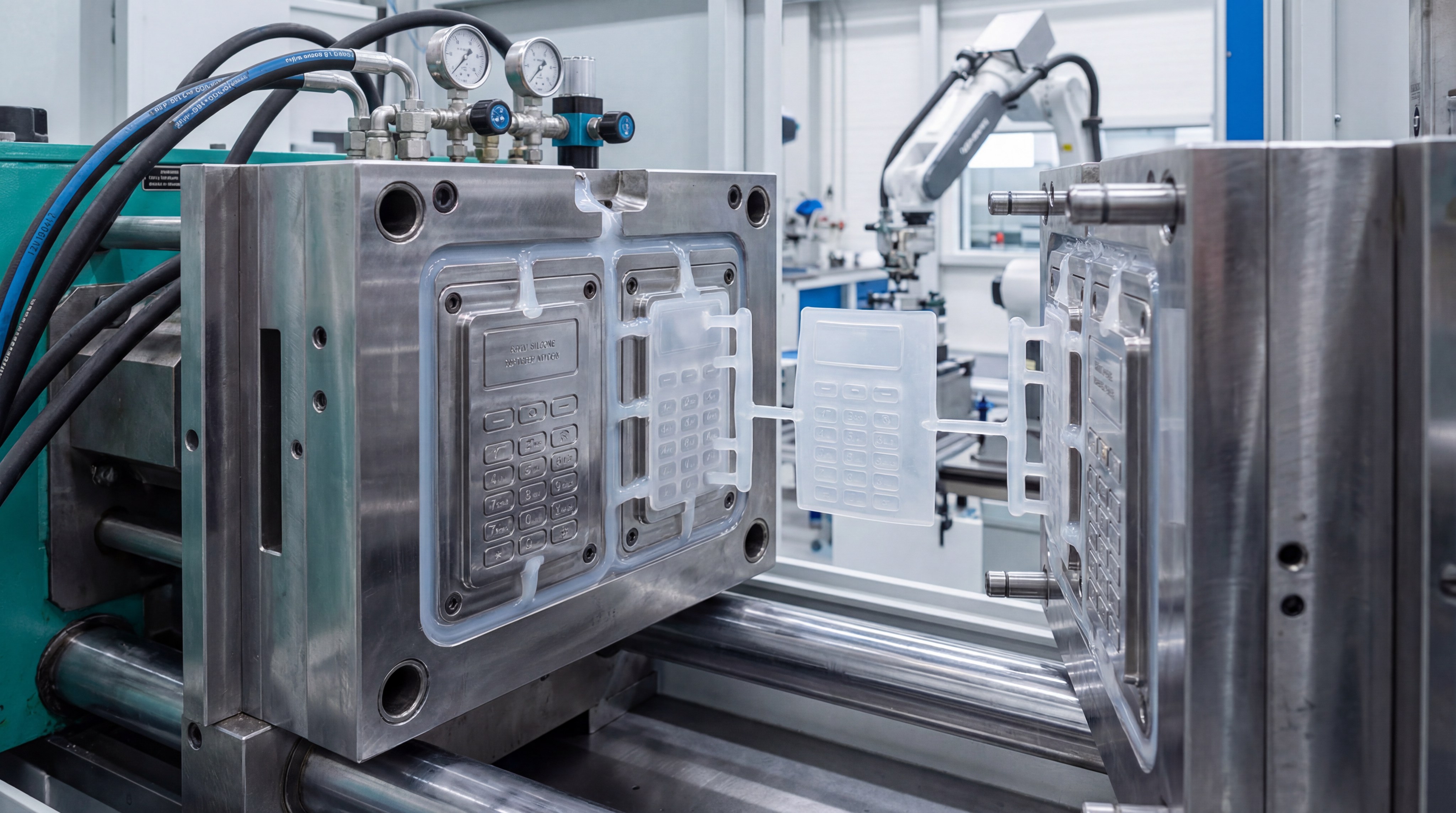
Yes, experienced manufacturers apply Design for Manufacturability (DFM) principles to optimize the tactile feedback and durability of every Silicone Keypad. They understand the subtle nuances of snap ratios and travel distances that define the user experience.
What is snap ratio optimization?
Manufacturers use specialized software to predict how a button will respond based on its webbing geometry and material hardness. This ensures that every press provides a crisp, satisfying “click” that meets your exact specifications.
But that’s not all:
- Precise control over actuation force (g).
- Consistent travel distance (mm) across all keys.
- Elimination of “mushy” or unresponsive button feel.
Key Takeaway: Technical performance is guaranteed through advanced engineering analysis that prevents common molding defects before they occur.
| Metric | Basic Design | Optimized DFM Design |
|---|---|---|
| Actuation Consistency | +/- 30g | +/- 10g |
| Tactile Response | Variable | High-Precision |
| Failure Rate | Moderate | Near Zero |
The following table compares standard designs against those optimized by professional manufacturing engineers.
Can you ensure medical-grade quality?
Professional outsourcing partners maintain ISO 13485 certifications and Class 100,000 cleanrooms to ensure the highest safety standards for your Silicone Keypad. This environment prevents contamination from dust and airborne particles that could compromise medical device integrity.
Why is biocompatibility critical?
Medical-grade silicone must pass strict USP Class VI and FDA testing to ensure it is safe for skin contact and resistant to harsh disinfectants. Manufacturers provide full material traceability, allowing you to track each batch back to its raw source.
Make no mistake:
- Certified medical-grade raw materials.
- Resistance to 70% IPA and bleach cleaning.
- Hypoallergenic and antimicrobial properties.
Key Takeaway: Outsourcing to a certified medical manufacturer ensures your product complies with global healthcare regulations and patient safety standards.
| Feature | Industrial Grade | Medical Grade |
|---|---|---|
| Environment | Standard Factory | Class 100,000 Cleanroom |
| Biocompatibility | Not Guaranteed | USP Class VI / FDA |
| Chemical Resistance | Low to Moderate | High (Sterilizable) |
The table above summarizes the differences between standard industrial parts and specialized medical-grade components.
Is the production lead time shorter?
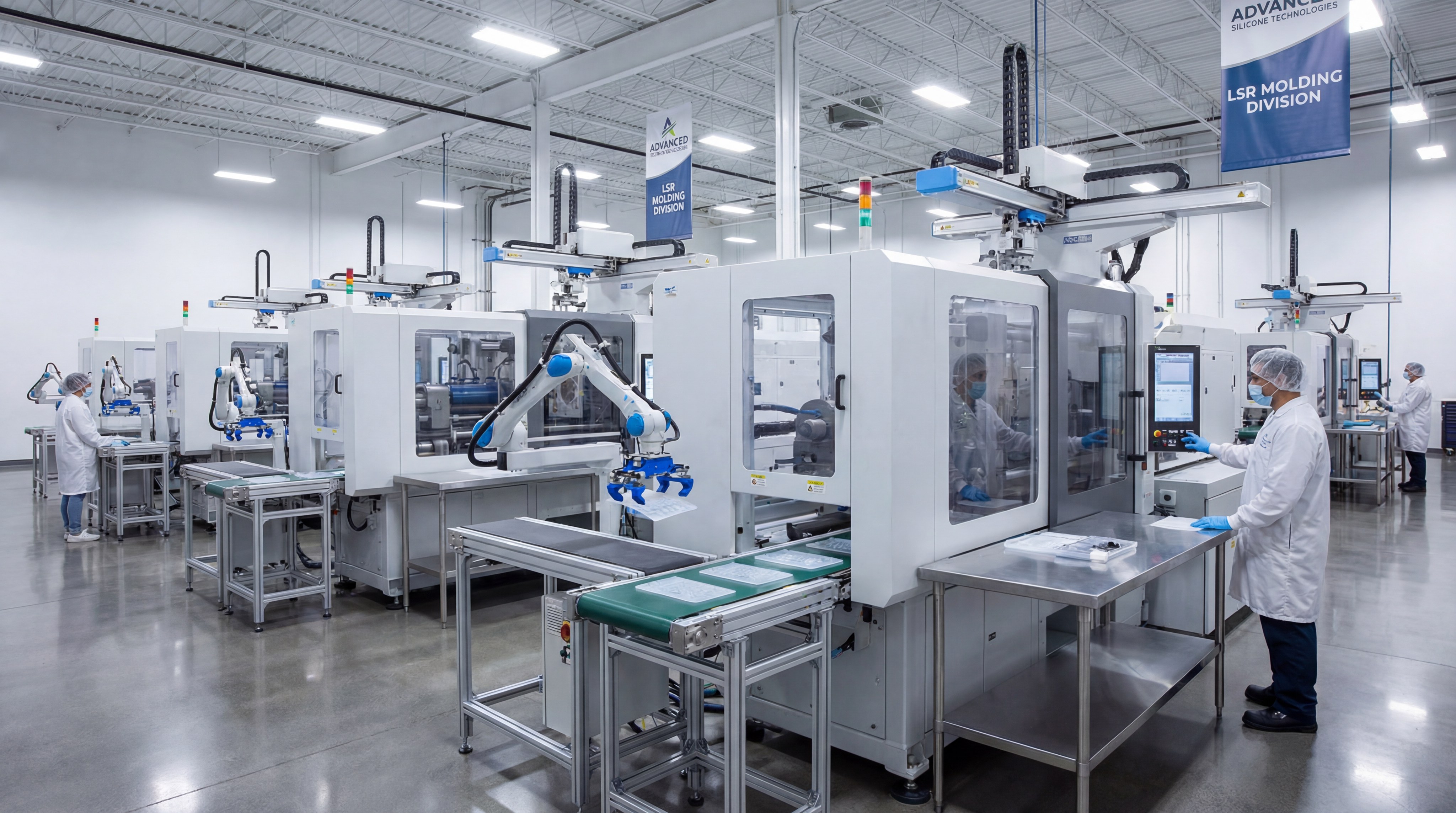
High-capacity facilities utilize 24/7 automated shifts to move from prototyping to mass production faster than most domestic shops can handle a Silicone Keypad. By leveraging in-house tooling centers, these partners can create molds in days rather than weeks.
How fast is the prototyping phase?
A Silicone Keypad prototype can often be delivered in under two weeks using soft-tooling or rapid CNC techniques. This allows your team to test the physical interface and make adjustments before committing to high-volume molds.
The best part?
- 24-hour turnaround on technical DFM reviews.
- Accelerated tooling cycles using in-house CNC.
- Flexible production schedules to meet launch deadlines.
Key Takeaway: Speed to market is significantly improved when you utilize a partner with dedicated equipment and around-the-clock operations.
| Project Phase | Internal Estimate | Outsourced Timeline |
|---|---|---|
| Tooling Design | 10-14 Days | 2-3 Days |
| Sample Production | 3-4 Weeks | 7-10 Days |
| Mass Production | 6-8 Weeks | 2-4 Weeks |
This timeline comparison shows how specialized manufacturing hubs accelerate your entire product development cycle.
What custom finishes are available?
Manufacturers offer a suite of secondary operations including PU coating, laser etching, and epoxy caps to enhance the aesthetics of your Silicone Keypad. These finishes protect the printed legends and provide a premium feel that differentiates your product.
Is laser etching more durable?
Laser etching removes a top layer of opaque coating to reveal a translucent base, creating high-contrast icons that never wear off. This method is the industry standard for backlit applications where durability and visibility are paramount.
Believe it or not:
- PU coatings extend legend life to 1M+ cycles.
- Epoxy caps provide a hard, plastic-like feel.
- Laser etching allows for complex, backlit icons.
Key Takeaway: Custom finishes allow you to tailor the interface to your specific market while ensuring long-term reliability in harsh environments.
| Finish Type | Durability | Best For |
|---|---|---|
| Silk Screen | Moderate | High-volume, low cost |
| Laser Etching | Permanent | Backlit / Industrial |
| Epoxy Coating | Extreme | Premium / Medical |
Review the finishing options below to determine which process best suits your product’s environmental requirements.
How is durability testing managed?
Factories use life-cycle testers and RCA abrasion equipment to guarantee the performance of every Silicone Keypad under extreme conditions. They simulate millions of actuations to ensure the webbing does not tear and the conductive contacts remain reliable.
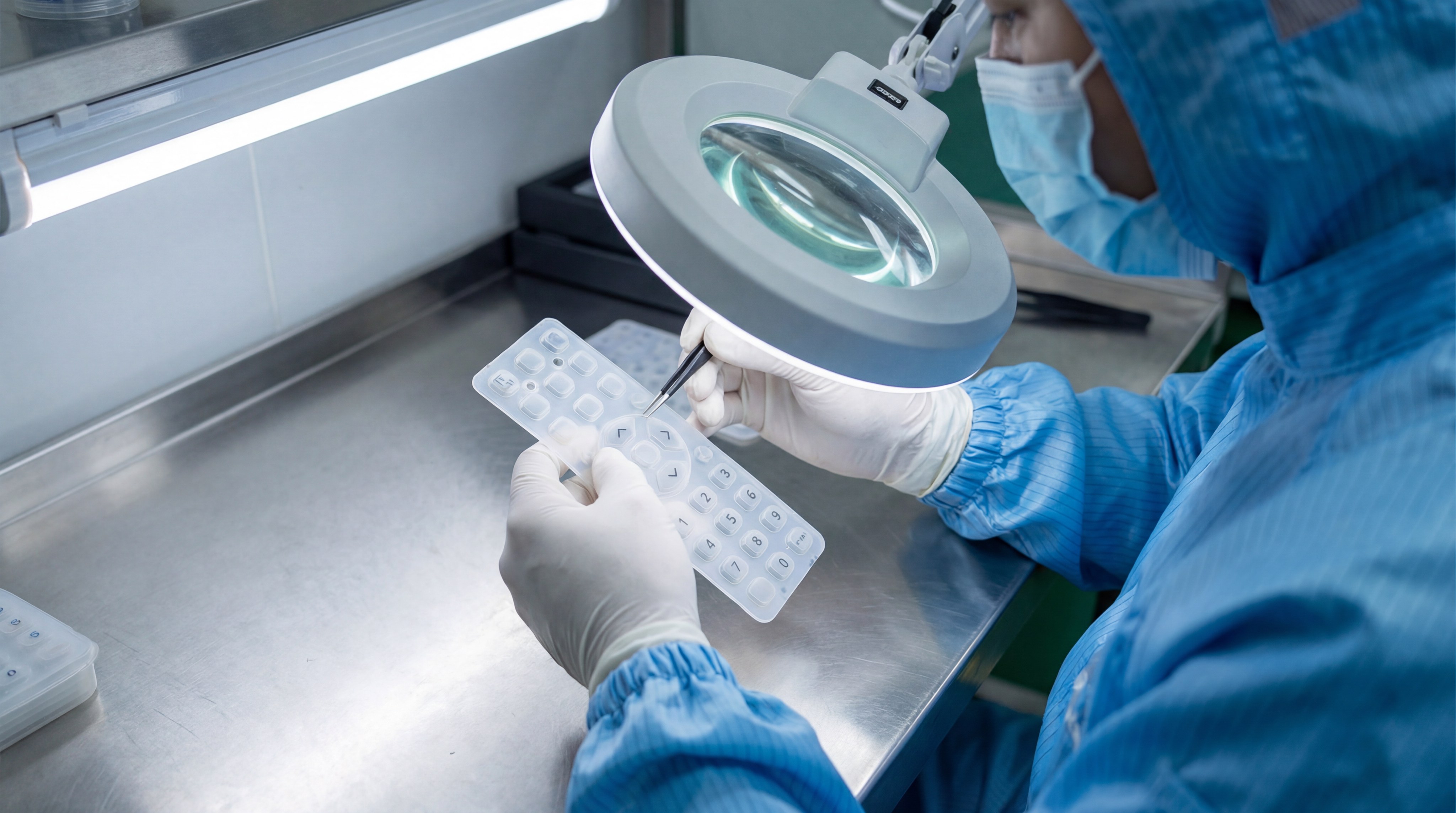
How do they measure contact resistance?
Engineers use precision meters to verify that conductive carbon pills or gold-plated contacts meet your resistance requirements (usually <200 Ohms). This testing ensures that the keypad interacts perfectly with your PCB every single time.
Think about it:
- Life-cycle testing up to 10 million presses.
- Environmental testing for heat and humidity.
- 100% visual inspection for cosmetic defects.
Key Takeaway: Rigorous testing protocols provided by the manufacturer reduce the risk of field failures and expensive product recalls.
| Test Parameter | Standard Benchmark | High-Precision Target |
|---|---|---|
| Cycle Life | 1,000,000 cycles | 10,000,000+ cycles |
| Contact Resistance | < 500 Ohms | < 100 Ohms |
| Legend Abrasion | 50 RCA cycles | 200+ RCA cycles |
The quality metrics listed above are standard for top-tier manufacturing partners specializing in elastomer components.
Does outsourcing help with scalability?
Outsourcing allows you to transition seamlessly from low-volume prototypes to millions of units without needing to restructure your internal Silicone Keypad team. Professional facilities are designed to scale production rapidly as your market demand grows.
Can small batches be profitable?
Many partners offer flexible Minimum Order Quantities (MOQs) for the prototyping phase, allowing you to validate your design with real parts. Once validated, they can switch to multi-cavity molds that produce thousands of units per hour.
It gets better:
- Rapidly scale from 500 to 500,000 units.
- Access to automated LSR injection for high volume.
- Minimal lead time increases for larger batches.
Key Takeaway: Scalability ensures that your manufacturing partner can grow with your business, from initial startup to global market leader.
| Capacity Level | Prototype Stage | Mass Production Stage |
|---|---|---|
| Tooling Type | Single Cavity / Soft Tool | Multi-Cavity Steel Mold |
| Process | Compression Molding | LSR Injection Molding |
| Volume | 10 – 1,000 Units | 10,000 – 1M+ Units |
This capacity breakdown illustrates how a single partner can manage every stage of your product’s lifecycle.
Is technical design support included?
Most partners provide comprehensive engineering reviews to ensure your Silicone Keypad fits perfectly and functions reliably within your device housing. They identify potential issues like air trapping or thin walls that could lead to structural failure.
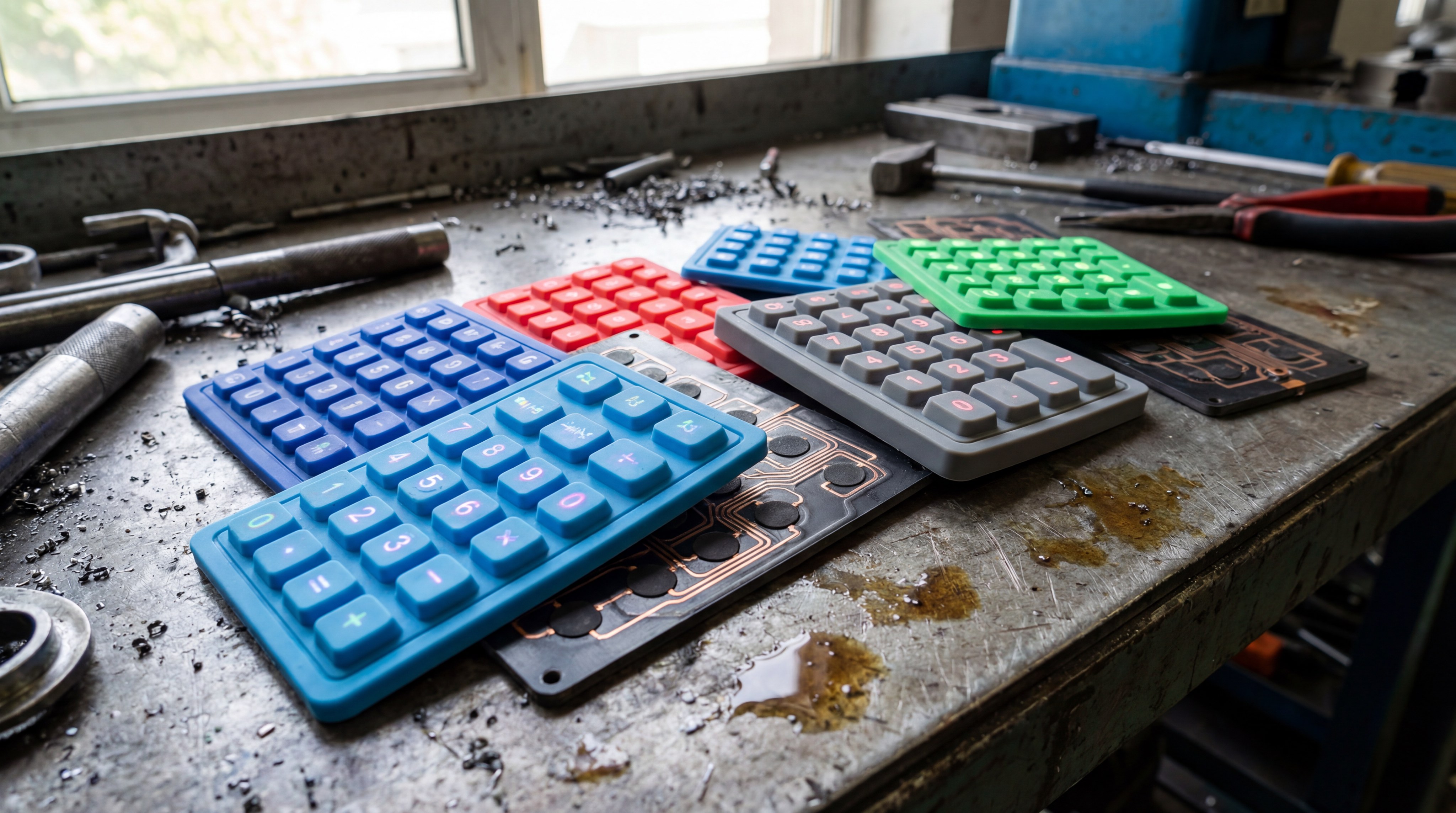
What does a DFM review look like?
During a Design for Manufacturability (DFM) review, engineers analyze your 3D files to suggest improvements in the snap ratio and parting lines. This collaborative process ensures the final product is both easy to manufacture and high-performing.
Here is the deal:
- Detailed feedback on wall thickness and radii.
- Suggestions for better conductive contact alignment.
- Optimization of parting lines for a cleaner look.
Key Takeaway: Utilizing the manufacturer’s technical expertise during the design phase prevents costly tooling changes and project delays.
| Support Service | Impact on Design | Long-term Benefit |
|---|---|---|
| DFM Review | Identifies structural risks | Prevents mold rework |
| Material Advice | Selects optimal durometer | Better user experience |
| Prototype Analysis | Validates tactile feedback | Guaranteed performance |
The following table highlights how early design support contributes to the overall success of your engineering project.
Are the logistics handled for you?
Specialized manufacturers manage the entire shipping process, including customs documentation and protective packaging for your Silicone Keypad during international transit. They use custom trays and moisture-controlled bags to ensure the parts arrive in pristine condition.
Is air freight worth the cost?
While sea freight is the most economical, air express is often the preferred choice for keypads because they are lightweight and pack densely. This allows you to receive your shipment in just a few days, keeping your assembly lines moving.
Look at this:
- Real-time tracking of global shipments.
- Expert handling of import duties and tariffs.
- Protective packaging to prevent deformation.
Key Takeaway: Professional logistics management removes the complexity of international trade, making global outsourcing feel like a local service.
| Shipping Method | Estimated Transit | Cost Efficiency |
|---|---|---|
| Air Express | 3-5 Days | Low (Fastest) |
| Air Freight | 7-12 Days | Moderate |
| Sea Freight | 3-5 Weeks | High (Bulk) |
Review these logistics options to plan your inventory management and production schedules effectively.
Should you choose a certified factory?
Selecting a factory with ISO 9001 and IATF 16949 certifications ensures that your Silicone Keypad meets global industrial benchmarks. These certifications guarantee that the manufacturer follows a repeatable process for quality control and continuous improvement.
What does traceability offer?
Traceability allows the factory to track every component back to the specific raw material batch and the operator who managed the machine. This is essential for highly regulated industries like automotive and aerospace.
Think about it:
- Guaranteed consistency across every production run.
- Documented quality reports for every shipment.
- Standardized workflows that minimize human error.
Key Takeaway: Certification is the ultimate proof of a manufacturer’s commitment to quality, reliability, and technical excellence.
| Certification | Industry Focus | Key Requirement |
|---|---|---|
| ISO 9001 | General Manufacturing | Quality Management |
| ISO 13485 | Medical Devices | Safety and Traceability |
| IATF 16949 | Automotive | Defect Prevention |
The certifications listed above represent the gold standard for global manufacturing partners in the elastomer industry.
FAQ
Can I get a prototype before mass production?
Yes, you can order high-quality samples to verify the tactile feel and fit of your design before investing in mass production tooling.
What is the best material for medical keypads?
Medical-grade Liquid Silicone Rubber (LSR) is the standard due to its biocompatibility, sterilization resistance, and high-precision molding capabilities.
Can I customize the color of my buttons?
Yes, you can specify any Pantone or RAL color, and manufacturers can create multi-colored keypads using advanced overmolding or printing techniques.
What is the typical lifespan of a silicone keypad?
A professionally manufactured keypad is typically rated for 1 million to 10 million actuations, depending on the material and application environment.
Can I add backlighting to my design?
Yes, using translucent silicone and laser-etched coatings allows for crisp, backlit icons that are easily visible in low-light conditions.
Conclusion
Outsourcing the manufacture of your interface components is the most strategic way to ensure high quality, lower costs, and faster delivery. By partnering with an expert, you solve common problems such as inconsistent tactile feedback, material contamination, and high overhead costs. Our team at Hualin Silicone provides the advanced LSR molding, cleanroom environments, and DFM support needed to bring your vision to life. If you are ready to optimize your production and secure a reliable supply chain, contact us today to start your project.