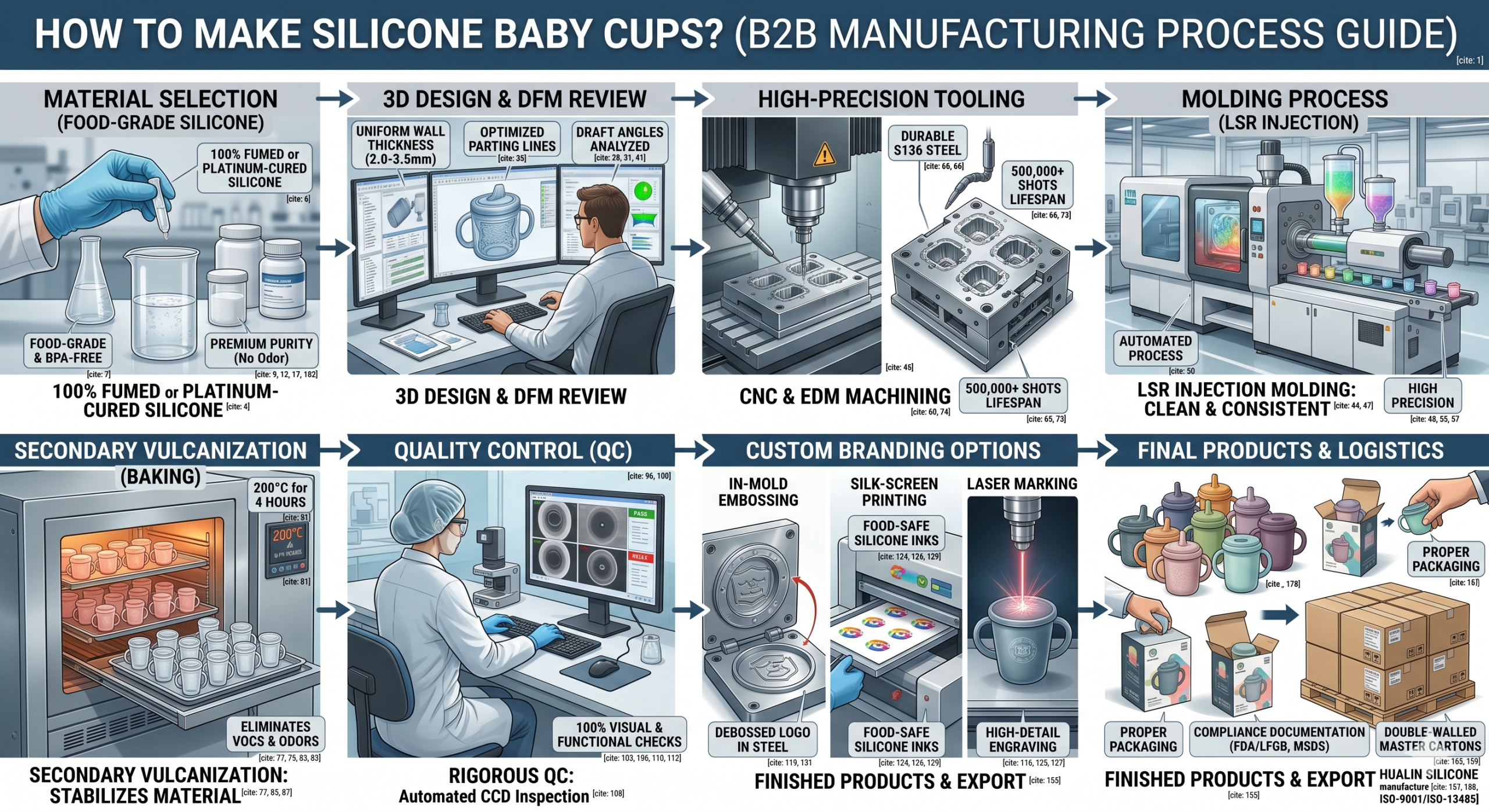
The process of making a silicone baby cup involves high-precision molding, food-grade material selection, and rigorous safety testing to ensure the product is safe for infant use. Finding a reliable manufacturer who understands international safety standards is often a significant hurdle for B2B buyers looking to enter the childcare market. This struggle often leads to inconsistent batch quality, lingering chemical odors, and potential product recalls that can devastate a brand’s reputation. By understanding the technical stages of production, from initial 3D design to the final curing process, you can ensure your silicone baby cup is safe, durable, and market-ready.
Why is food-grade material essential for production?
Food-grade material is the absolute foundation of infant product safety and regulatory compliance. When you select raw materials for a silicone baby cup, you must prioritize 100% fumed or platinum-cured silicone to avoid leaching.
These materials are non-toxic, BPA-free, and capable of withstanding extreme temperatures without degrading. Using inferior industrial-grade silicone results in products that fail safety inspections and pose health risks to babies.
What are the fumed silicone benefits?
Fumed silicone is widely considered the gold standard for premium infant drinkware because of its superior clarity and physical strength. This material offers high tear resistance, which is vital for products that babies might chew on.
- High transparency for a premium look.
- Excellent elongation and tensile strength.
- Odorless and tasteless properties.
Think about it:
Parents will immediately notice if a cup has a chemical smell, which is why choosing high-purity fumed silicone is a non-negotiable step for high-end brands.
Ensuring FDA and LFGB compliance
Meeting international standards like FDA (US) or LFGB (Europe) ensures your products can be legally sold in major global markets. Manufacturers must provide material traceability reports for every batch of silicone used.
- Traceability documentation for raw materials.
- Regular heavy metal and phthalate testing.
- Compliance with food-contact safety protocols.
But wait, there is more:
The LFGB standard is often stricter than the FDA, requiring more intensive testing for sensory and chemical migration.
Key Takeaway: High-quality fumed or platinum silicone is the industry standard for producing premium, safe, and odorless baby feeding products.
| Material Type | Purity Level | Best Use Case |
|---|---|---|
| Fumed Silicone | Extremely High | Premium Baby & Medical Products |
| Precipitated Silicone | Standard | General Consumer Goods |
| Platinum Cured | High | High-Precision Components |
The selection of fumed silicone ensures that the product remains durable and safe throughout its entire lifecycle in a household environment.
How does the 3D design phase impact quality?
Precise 3D design dictates the functional success and manufacturing efficiency of your product during the mass production stage. A high-quality silicone baby cup requires a rigorous Design for Manufacturing (DFM) review to identify potential molding flaws before the steel is cut.
Engineers focus on optimizing parting lines and wall thickness to ensure the cup can be demolded without tearing. Without a professional 3D design phase, you risk expensive mold modifications and inconsistent product dimensions.
Utilizing DFM to reduce risks
A DFM review is a collaborative process where engineers analyze the 3D model to ensure it is optimized for the selected molding process. This step helps in deciding the best injection points and cooling lines for the mold.
- Analysis of draft angles for easy removal.
- Identification of potential “sink marks” in thick areas.
- Optimization of parting lines for aesthetic appeal.
Here is the kicker:
A single millimeter of difference in wall thickness can cause the cup to collapse or fail to hold liquid properly.
Why does wall thickness matter?
Uniform wall thickness is critical for even cooling and curing during the molding process. If the walls are too thin, the cup may lack structural integrity; if they are too thick, it increases material costs and curing time.
- Standard range of 2.0mm to 3.5mm for cups.
- Reinforcement at the base for stability.
- Flexible rims for comfortable drinking.
But wait, there is more:
Variable wall thickness can lead to warping as the silicone cools, which creates uneven surfaces that look unprofessional.
Key Takeaway: Early-stage engineering and DFM support reduce the need for costly mold revisions and significantly speed up your time-to-market.
| Design Element | Impact on Quality | Manufacturing Recommendation |
|---|---|---|
| Parting Line | Visual Aesthetics | Place in non-contact or hidden areas |
| Draft Angle | Ease of Demolding | Minimum 0.5 to 1 degree for silicone |
| Suction Base | Functional Performance | Ensure precise geometry for airtight seal |
Professional 3D design creates a blueprint that ensures every batch of silicone cups meets the exact specifications required for safety and functionality.
What molding method is best for a silicone baby cup?
The choice between Liquid Silicone Rubber (LSR) and compression molding depends entirely on your specific production volume and precision requirements. For a high-end silicone baby cup, LSR injection molding is often preferred for its cleanliness and consistency.

Compression molding remains a cost-effective alternative for simpler designs and smaller batches. Understanding these methods allows you to balance initial tooling investment with the final unit price.
Is LSR better than compression?
LSR molding uses a closed-loop system that injects liquid silicone into the mold, resulting in high precision and minimal manual labor. This method is ideal for complex geometries and thin-walled parts that require a soft, premium feel.
- High-speed production for large orders.
- Minimal flash and wastage of raw material.
- Automated process reduces human error.
Think about it:
While the tooling for LSR is more expensive, the lower labor costs and higher precision often make it cheaper for long-term production.
Using compression for simpler designs
Compression molding involves placing a pre-measured piece of solid silicone into a heated mold cavity. This traditional method is highly effective for thick-walled items or when starting with lower initial volumes.
- Lower initial tooling investment.
- Simple setup for multi-color marbled effects.
- Effective for large, sturdy silicone bases.
But wait, there is more:
Compression molding usually leaves a larger parting line “flash,” which requires manual trimming and can affect the final finish.
Key Takeaway: LSR injection molding provides the highest precision and consistency for premium baby products, while compression molding offers a lower entry cost.
| Feature | LSR Injection Molding | Compression Molding |
|---|---|---|
| Tooling Cost | High | Low to Moderate |
| Precision | Excellent | Standard |
| Mass Production | Highly Efficient | Moderate Efficiency |
Choosing the right molding method involves evaluating your target market’s quality expectations against your available development budget.
How is high-precision tooling developed?
Tooling development is the most critical technical phase, as the steel mold defines the final texture, shape, and durability of your product. When manufacturing a silicone baby cup, the factory uses CNC milling and EDM machining to carve the mold cavities into high-grade steel.
The precision of these molds ensures that every cup produced is identical to the approved prototype. High-grade steel prevents the mold from deforming over thousands of production cycles, ensuring long-term batch consistency.
Selecting steel for mold longevity
Using high-grade hardened steel is essential for molds that need to produce hundreds of thousands of units without loss of detail. Lower-quality aluminum molds are only suitable for prototyping and will wear out quickly under heat and pressure.
- S136 or NAK80 steel for high-gloss finishes.
- Hardened steel for multi-cavity mass production.
- Corrosion resistance for long-term storage.
Here is the kicker:
A mold made from premium steel can last for over 500,000 shots, providing a much higher return on your initial investment.
Testing prototype molds (T1 Samples)
Before moving to mass production, a “T1” trial is conducted to produce the first samples from the new mold. These samples are used to verify dimensions, surface finish, and the functionality of features like suction bases or handles.
- Dimensional inspection against 3D drawings.
- Testing of draft angles and demolding success.
- Functional testing of lid fit and suction.
But wait, there is more:
It is common to adjust the mold slightly after the T1 phase to perfect the texture or parting lines before mass production begins.
Key Takeaway: Investing in high-quality in-house tooling ensures your product maintains its precision and aesthetic appeal across years of production.
| Tooling Phase | Equipment Used | Primary Objective |
|---|---|---|
| CNC Milling | 3-Axis / 5-Axis CNC | Carving the main mold cavity |
| EDM Machining | Electrical Discharge | Creating intricate, deep details |
| Polishing | Manual/Automated | Achieving matte or gloss textures |
Precision tooling eliminates the risk of assembly issues and ensures that lids or straws fit perfectly every single time.
Why is secondary vulcanization critical for safety?
Secondary vulcanization is a post-molding baking process that is mandatory for achieving the highest safety standards for infant products. After a silicone baby cup is removed from the mold, it is placed in a specialized oven at high temperatures for several hours.
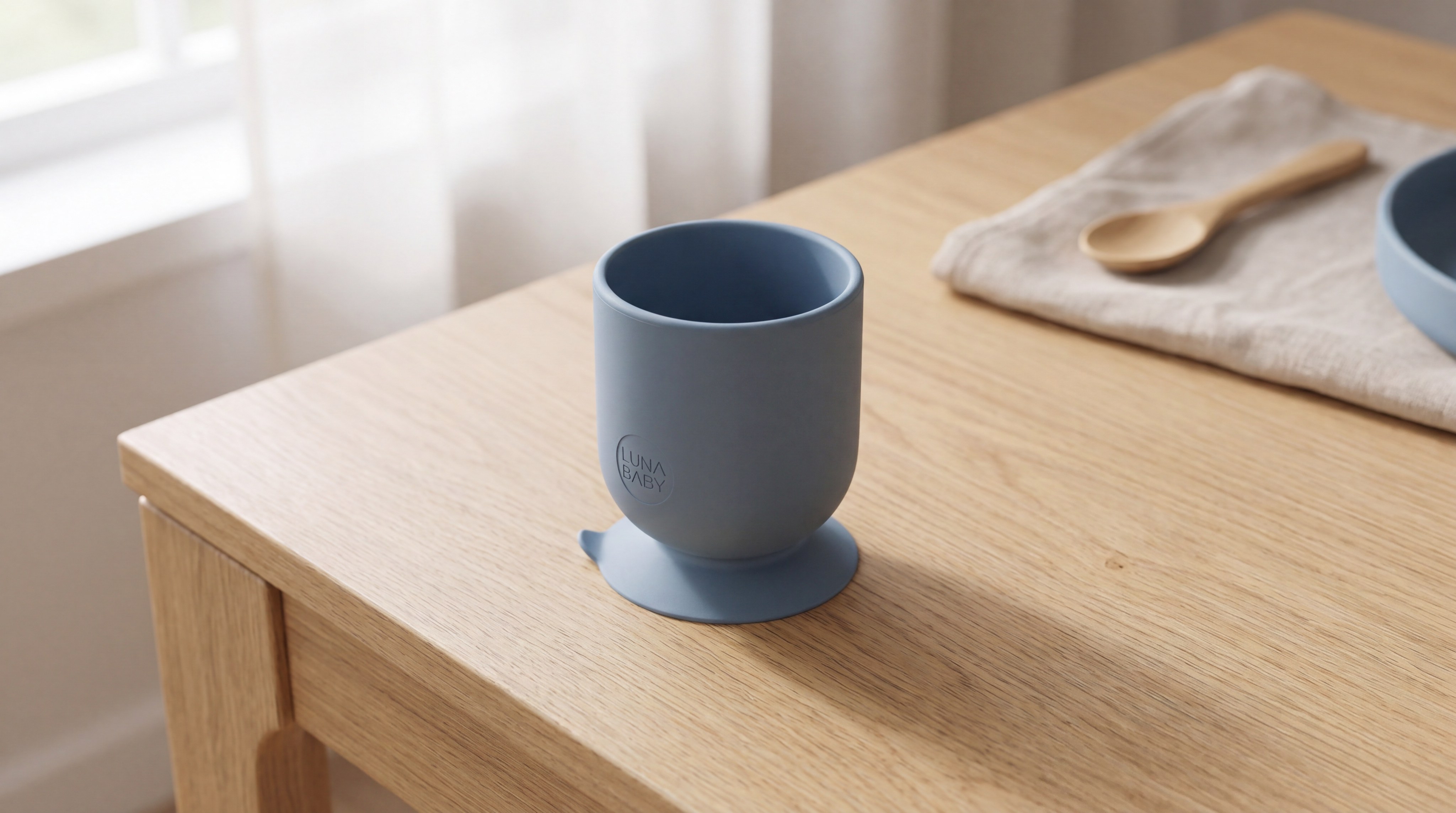
This process evaporates any residual volatile organic compounds (VOCs) and stabilizes the material’s physical properties. Without this step, silicone products may retain a chemical smell and fail food-contact migration tests.
Eliminating odors through baking
Baking the cups at 200°C for 2 to 4 hours ensures that catalysts used during molding are completely neutralized. This is the process that makes silicone “food grade” and safe for a baby’s mouth.
- Removal of residual odors and tastes.
- Ensures the cup is safe for hot liquids.
- Prevents chemical leaching during sterilization.
Think about it:
If your samples arrive with a slight smell, it is a clear sign the manufacturer skipped or shortened the secondary vulcanization stage.
Stabilizing physical properties
Beyond safety, vulcanization improves the physical characteristics of the silicone, such as its tensile strength and compression set. This makes the cup more resilient to repeated boiling, microwaving, and dishwasher cycles.
- Improved resistance to tearing and biting.
- Stabilized dimensions for airtight lid fits.
- Enhanced durability for long-term household use.
But wait, there is more:
This process also ensures that the colors remain stable and do not bleed or fade when the product is heated.
Key Takeaway: Secondary vulcanization is a non-negotiable step for ensuring your silicone products are odorless, safe, and fully compliant with global regulations.
| Parameter | Recommended Value | Expected Result |
|---|---|---|
| Temperature | 200°C (392°F) | Full evaporation of VOCs |
| Time Duration | 4 Hours (Standard) | Material stabilization |
| Post-Process | Cooling & Cleaning | Odorless, safe finish |
By ensuring full curing through secondary vulcanization, you provide parents with a product they can trust for daily feeding.
What quality control stages ensure batch consistency?
Quality control (QC) is a multi-stage system that prevents defective products from reaching your warehouse or the end consumer. For a high-performance silicone baby cup, a factory must implement Incoming, In-Process, and Final Quality Control protocols.

These stages involve everything from testing raw material purity to using CCD visual inspection systems for surface defects. Rigorous QC ensures that your brand avoids the costs associated with customer returns and negative reviews.
In-process inspection during molding
Patrol inspectors regularly check the molding machines to ensure the temperature and pressure settings remain constant. This prevents issues like under-filling the mold or scorching the silicone material.
- Monitoring of curing times for each cycle.
- Dimensional checks for consistent sizing.
- First-article approval at the start of each shift.
Here is the kicker:
Caught early, a minor machine calibration error can save thousands of units from being scrapped.
Final visual and functional checks
Before packaging, every cup undergoes a 100% visual inspection to remove any units with surface bubbles, black spots, or excess flash. Functional tests are also performed to ensure lids fit tightly and suction bases adhere correctly to surfaces.
- Verification of color consistency across the batch.
- Testing for airtight seals on sippy cup lids.
- Checking for smooth edges to ensure baby safety.
But wait, there is more:
Automated CCD cameras can now detect microscopic surface defects that are invisible to the human eye, ensuring near-perfect batch quality.
Key Takeaway: A robust, multi-stage quality control system is the only way to guarantee that 100% of your order meets safety and aesthetic standards.
| QC Stage | Primary Responsibility | Critical Tools |
|---|---|---|
| IQC | Raw Material Verification | Durometer / Lab Tests |
| IPQC | Molding Stability | Calipers / Temp Sensors |
| FQC | Final Shipment Approval | CCD Cameras / Visual |
Systematic quality control transforms manufacturing from a variable process into a repeatable, high-standard production cycle.
How can you customize branding on a silicone baby cup?
Custom branding allows you to differentiate your product in a crowded market and build long-term brand equity. For a silicone baby cup, you can choose between permanent in-mold engraving, laser marking, or colorful silk-screen printing.
Each method offers a different level of durability and visual impact. Selecting the right branding technique depends on your design aesthetic and the expected retail price point of your product.
What is in-mold logo embossing?
The most durable way to brand a silicone product is to engrave the logo directly into the steel mold. This creates a raised (embossed) or recessed (debossed) 3D logo on every cup produced, which will never fade or peel.
- Permanent branding that lasts the life of the cup.
- No ink or chemicals are used in the process.
- Premium, tactile feel that parents appreciate.
Think about it:
While this requires a higher upfront tooling cost, it eliminates the per-unit cost of printing and is much more durable for sterilized products.
Silk screen vs laser engraving
Silk screen printing allows for vibrant, multi-colored logos but requires the use of specialized food-safe silicone inks. Laser engraving is a cleaner alternative that uses a high-powered beam to “burn” a high-detail logo into the surface.
- Silk screen: Best for colorful, high-contrast logos.
- Laser: Best for small batches and unique patterns.
- Ink safety: Must be medical-grade and abrasion-resistant.
But wait, there is more:
Silk screen prints must be cured in an oven to bond permanently to the silicone, otherwise, they may peel off during boiling.
Key Takeaway: In-mold branding is the most cost-effective and durable solution for high-volume production of premium baby feeding items.
| Branding Method | Durability | Color Flexibility | Per-Unit Cost |
|---|---|---|---|
| In-Mold | Permanent | None (Texture Only) | $0.00 (After Tooling) |
| Silk Screen | High | Multi-Color | Moderate |
| Laser Engraving | Permanent | Grayscale/Texture | Low to Moderate |
Strategic branding choices enhance the perceived value of your products and help your brand stand out on retail shelves.
What are the typical costs for custom manufacturing?
B2B pricing for custom production is influenced by volume, material grade, and the complexity of the mold. For a professional silicone baby cup, unit prices typically range from $1.29 to $3.19 depending on your specific requirements.
Understanding the breakdown of these costs helps you manage your budget and set realistic retail prices. Initial investments in high-quality tooling often pay for themselves through lower per-unit costs during mass production.
Analyzing tooling and setup fees
The mold is your largest upfront expense, with costs varying based on the number of cavities and the complexity of the design. A single-cavity prototype mold is much cheaper than a four-cavity mass production mold.
- Single-cavity molds: Best for market testing.
- Multi-cavity molds: Essential for high-volume orders.
- Setup fees: Covers machine calibration and material mixing.
Here is the kicker:
A multi-cavity mold can double or triple your production speed, which is vital for meeting sudden spikes in market demand.
How volume discounts affect pricing
Like most manufacturing processes, the unit price for silicone cups drops significantly as the order volume increases. This is because the setup costs and machine time are spread across a larger number of finished products.
- MOQ usually starts at 1,000 to 3,000 units.
- Significant discounts at 5,000 and 10,000 units.
- Material waste is minimized in larger, continuous runs.
But wait, there is more:
Maintaining a steady production schedule with your manufacturer can often lead to further “partnership” discounts over time.
Key Takeaway: Higher upfront investment in multi-cavity molds leads to the lowest long-term unit price and faster production turnaround for scaling brands.
| Order Volume | Estimated Unit Price | Manufacturing Strategy |
|---|---|---|
| 1,000 Units | $2.50 – $3.19 | Market entry / Niche testing |
| 5,000 Units | $1.75 – $2.25 | Growth stage / Retail expansion |
| 10,000+ Units | $1.29 – $1.60 | Mass market / High-volume scale |
Detailed cost analysis allows you to optimize your supply chain and ensure your product remains competitive in the global marketplace.
How to manage logistics and export for silicone cups?
Efficient logistics and export management are the final steps in bringing your silicone baby cup to the global market. Manufacturers in hubs like Dongguan are experienced in handling international shipping documents, custom packaging, and compliance certificates.
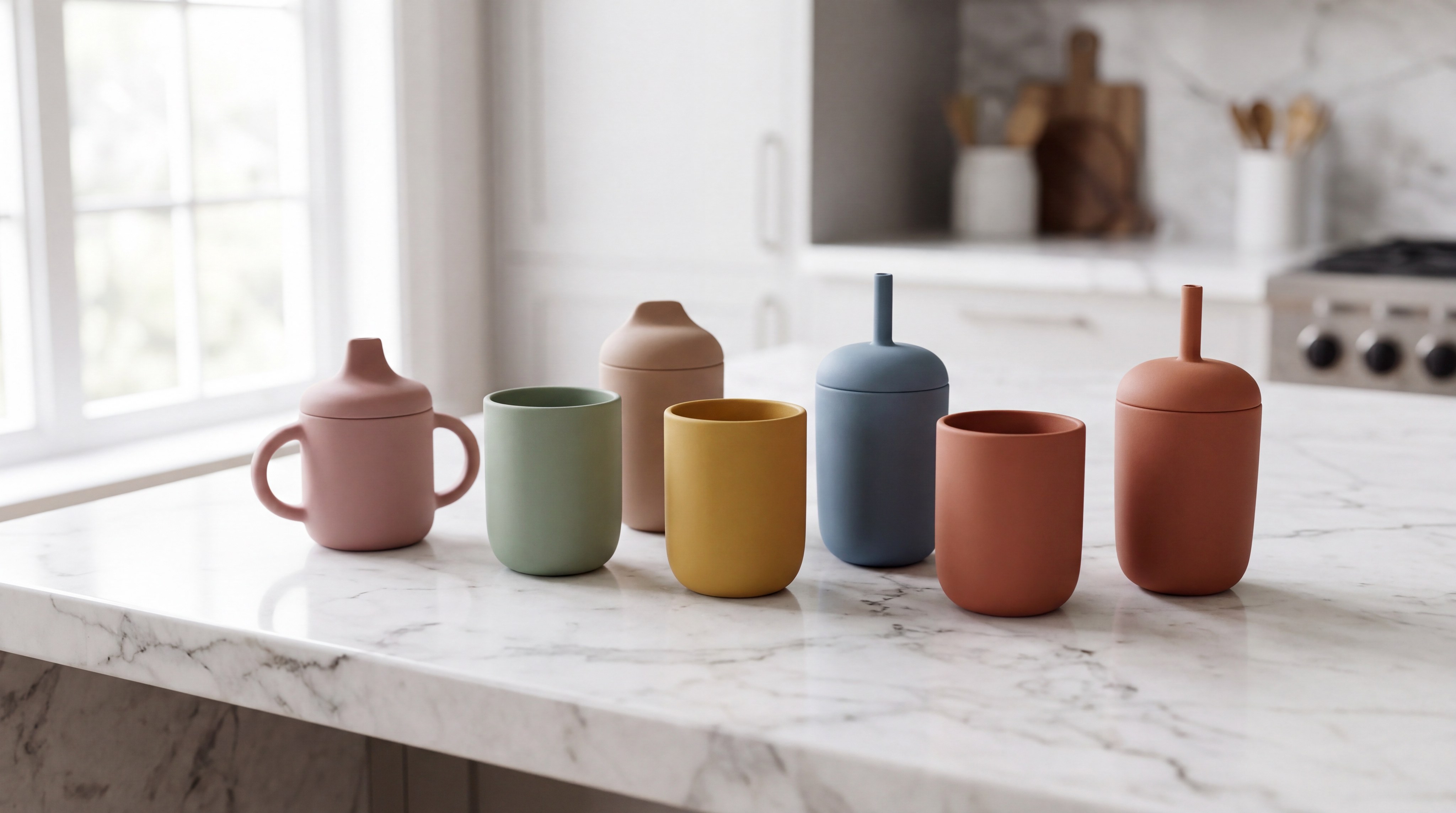
Proper packaging is vital to prevent deformation during sea transit, while accurate documentation ensures smooth customs clearance. Working with a factory that offers one-stop export services simplifies your entire supply chain.
Packaging for international transit
Silicone cups are durable but can be squashed if packed too tightly in large shipping containers. Using individual retail boxes or protective polybags inside sturdy master cartons prevents surface scuffs and maintains product shape.
- Double-walled master cartons for extra protection.
- Moisture-resistant packaging for sea freight.
- Custom palletizing for efficient warehouse unloading.
Think about it:
Damaged packaging is the first thing a retail buyer sees, so investing in high-quality shipping materials is essential for your brand’s image.
Navigating customs and compliance
Every export shipment must be accompanied by the correct HS codes, commercial invoices, and safety certificates. Failure to provide a certificate of origin or material safety data sheet (MSDS) can lead to expensive delays at the port.
- Accurate HS code classification for silicone.
- Provision of FDA/LFGB testing reports to customs.
- Preparation of Bill of Lading and packing lists.
But wait, there is more:
Many manufacturers can ship directly to Amazon FBA warehouses, handling all the specialized labeling and appointment scheduling for you.
Key Takeaway: A manufacturer with extensive export experience reduces the administrative burden on your team and ensures your products arrive on time and in perfect condition.
| Shipping Method | Typical Lead Time | Cost Impact |
|---|---|---|
| Air Freight | 5 – 10 Days | High (Best for urgent restock) |
| Sea Freight | 30 – 45 Days | Low (Best for mass production) |
| Courier (FedEx/UPS) | 3 – 5 Days | Very High (Best for samples) |
Mastering the logistics of silicone manufacturing ensures that your high-quality products are delivered to your customers efficiently and affordably.
What are the common questions about manufacturing?
Can I recycle silicone baby products?
No, silicone is not currently accepted in most curbside recycling programs, but it can be sent to specialized facilities for industrial downcycling. Judgment: While not traditional plastic, silicone is highly durable and lasts much longer, reducing the overall environmental impact of single-use items.
What’s the best way to clean a silicone cup?
Yes, silicone is naturally resistant to bacteria and can be cleaned in a standard dishwasher or sterilized in boiling water. Judgment: Because silicone can withstand temperatures up to 200°C, it is one of the most hygienic materials available for infant feeding.
How do I know if the material is real food-grade?
Directly inspect the product for chemical odors and perform a “pinch test”; if the silicone turns white at the fold, it may contain cheap fillers. Judgment: Authentic food-grade silicone stays the same color when pinched and should have zero scent after professional secondary vulcanization.
Can I request a custom Pantone color?
Yes, most manufacturers can match any color using Pantone or RAL codes by mixing food-safe pigments into the raw silicone base. Judgment: Color matching is standard in B2B manufacturing, though you should always request a physical color sample for final approval.
How long does the tooling process take?
Typically, mold design and manufacturing take between 15 and 25 days, followed by 5 days for sample production and approval. Judgment: This timeframe is the industry standard for creating high-precision steel molds that are ready for mass production.
At HuaLin Silicone, we believe that safety and precision should never be compromised in the production of infant care products. Our vision is to empower global brands by providing transparent, ISO-certified manufacturing solutions that prioritize health, durability, and innovation. We are committed to using only the highest grade materials and advanced LSR molding technology to ensure every part we make exceeds international standards. Ready to bring your next product to life with a partner you can trust? Contact us today to receive a comprehensive DFM review and start your manufacturing journey with confidence.