
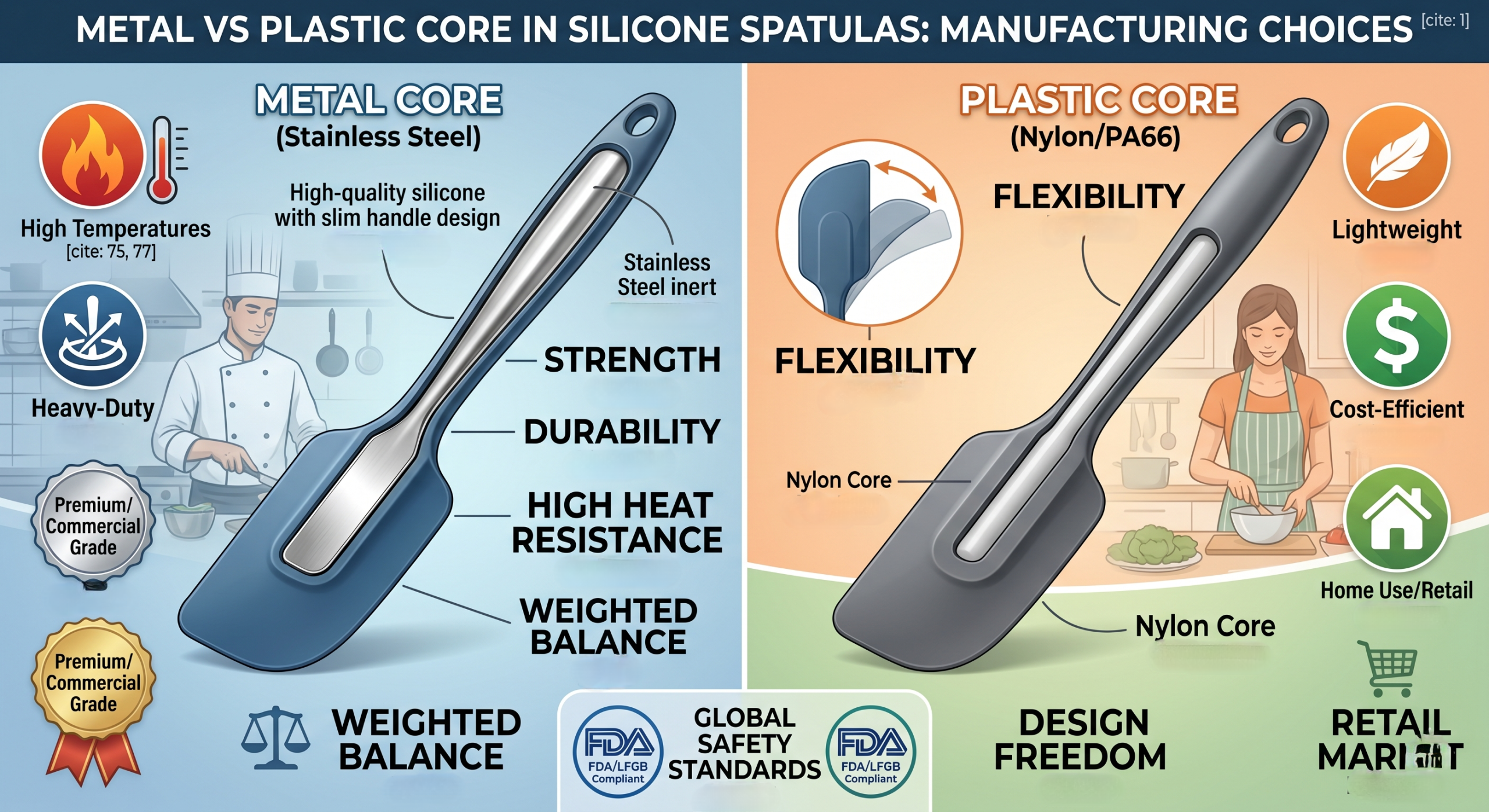
The internal core material dictates whether your product is a professional-grade tool or a disposable retail item, and metal is generally superior for high-torque commercial applications while plastic offers better cost-efficiency for home use. Many manufacturers struggle with “invisible” failures where handles snap or silicone heads detach due to poor internal engineering. You risk eroding your brand’s reputation if these hidden skeletons fail during high-heat cooking or heavy mixing. By choosing the right core, you provide a durable solution that ensures structural integrity and consumer safety in every batch of Silicone Spatulas.
Why does the internal core matter for silicone spatulas?
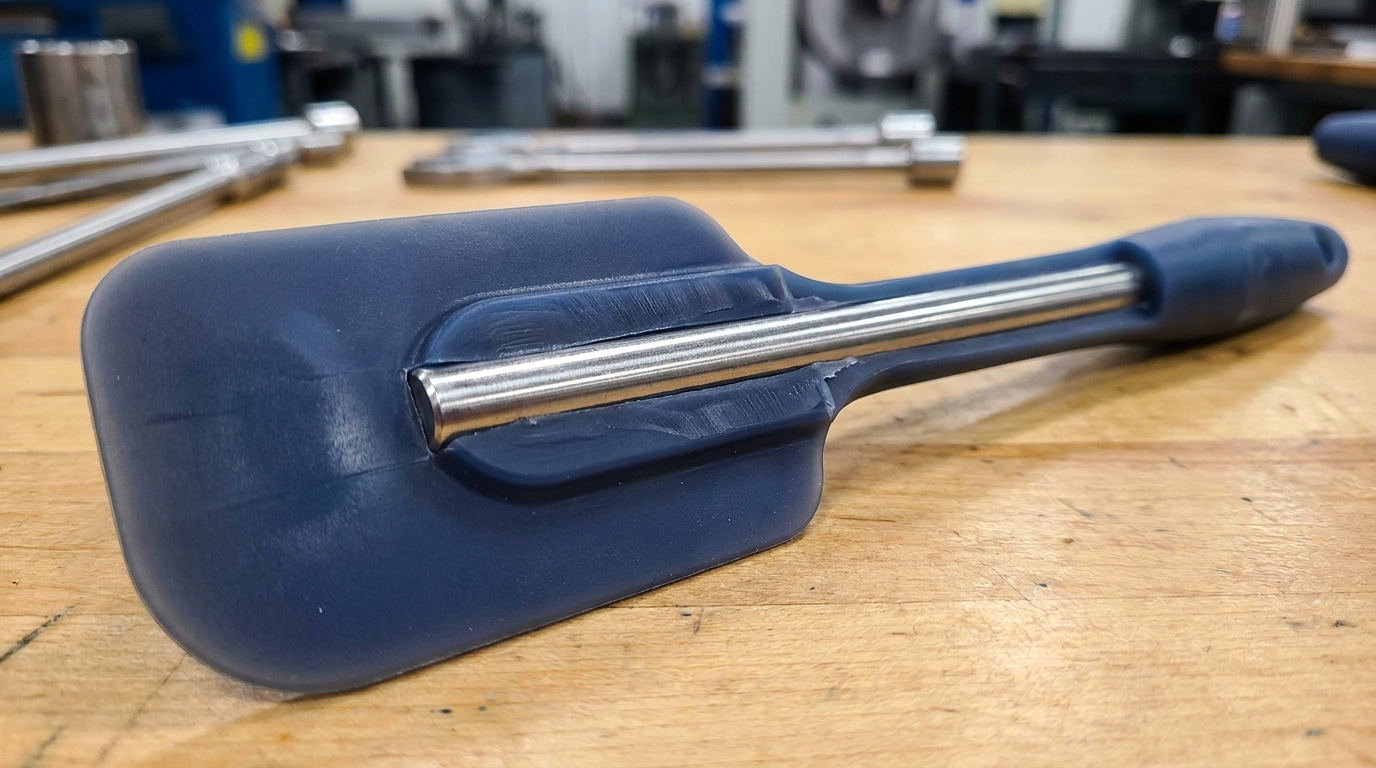
The internal core serves as the structural backbone that determines the functional limits and lifespan of your kitchen tools. Without a robust core, Silicone Spatulas lack the necessary leverage to scrape thick mixtures or resist permanent bending. The bond between this skeleton and the outer skin is the most frequent point of failure in high-volume production.
Understanding structural integrity in kitchenware
Structural integrity ensures the tool remains rigid enough to provide force without snapping at the neck. If you use a weak core, the head will simply flop when meeting resistance.
- Internal rigidity prevents silicone tearing.
- Proper core geometry supports the tool’s leading edge.
- Reinforcement reduces the risk of handle fatigue.
Here is the kicker:
A poorly designed core can lead to internal “poking” where the structure pierces through the soft silicone exterior during use.
How internal support defines tool flexibility
Flexibility must be engineered precisely to allow the tool to conform to bowl curves while remaining stiff at the handle. You must calculate the deflection point based on the intended culinary application.
- Baking spatulas require higher tip flexibility.
- Heavy-duty scrapers need a rigid central spine.
- Variable thickness allows for multi-functional zones.
Think about it:
The core is effectively the “muscle” that allows a thin piece of silicone to behave like a powerful lever.
Why core material is critical for durability
Durability is the primary metric by which B2B buyers judge your manufacturing quality and long-term value. Using high-grade materials prevents the core from becoming brittle after repeated thermal cycling or physical stress.
- High-grade cores prevent permanent handle warping.
- Quality materials resist chemical degradation in dishwashers.
- Superior bonding surfaces prevent head delamination.
Now consider this:
A single failure in a professional kitchen can lead to the return of an entire wholesale order.
Key Takeaway: The internal core is the primary determinant of a spatula’s lifecycle and functional utility, dictating whether it is classified as a professional-grade tool or a disposable consumer good.
| Factor | Impact on Manufacturing | Consumer Benefit |
|---|---|---|
| Structural Rigidity | Determines mold design and silicone thickness | Improved scraping efficiency |
| Bonding Affinity | Affects the choice of primers and overmolding temps | Prevents head detachment |
| Flexibility Control | Allows for specialized product SKU development | Task-specific performance |
What are the primary benefits of using a metal core?
Stainless steel cores provide the highest level of tensile strength and perceived value for premium Silicone Spatulas on the market. This material allows you to manufacture thinner handle profiles that remain indestructible under heavy industrial loads.
The strength of stainless steel inserts
Stainless steel inserts, typically 304 or 430 grade, offer unparalleled resistance to bending and snapping. You can create tools for the most demanding environments without worrying about material failure.
- Resists corrosion even if the silicone skin is breached.
- Maintains structural integrity in high-torque mixing.
- Provides a rigid foundation for high-pressure scraping.
The bottom line?
Metal is the only choice for tools meant to last a lifetime in a commercial setting.
Preventing handle breakage under heavy loads
Metal does not suffer from “creep,” meaning it won’t permanently deform even after being used to stir heavy dough for hours. This ensures your product remains perfectly straight for its entire service life.
- Zero risk of handle snapping under human force.
- Elastic recovery ensures the tool returns to shape.
- High yield strength prevents permanent handle curves.
But wait, there is more:
The strength of metal allows for thinner designs that feel more refined and professional in the hand.
Can metal cores improve weighted balance?
Weight distribution is a key indicator of quality for many professional chefs who prefer a tool with a solid heft. You can shift the center of gravity by adjusting the core’s thickness and length.
- Heavier tools provide better tactile feedback.
- Weighted handles feel more balanced during use.
- Metal creates a “premium” sensory experience for the user.
Believe it or not:
A slightly heavier tool is often perceived as significantly more durable by the end consumer.
Key Takeaway: Metal cores are the industry standard for premium, “pro-sumer” and commercial-grade kitchenware due to their superior strength-to-weight ratio and perceived value.
| Feature | Technical Specification | Business Value |
|---|---|---|
| Tensile Strength | High (Stainless Steel) | Zero breakage claims |
| Weight Distribution | Customizable via core thickness | Premium market positioning |
| Deformation | Elastic recovery | Long-term shape retention |
When is a plastic core the better manufacturing choice?
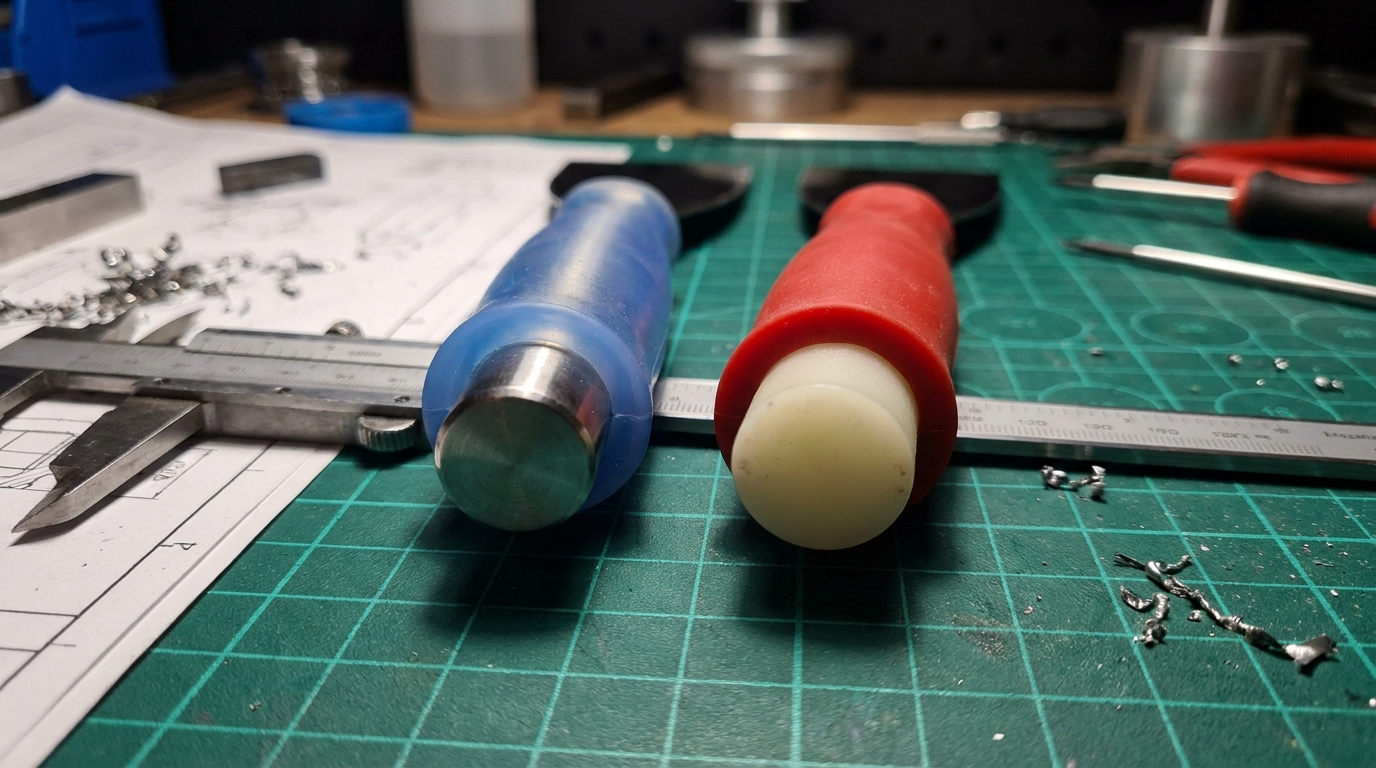
Plastic cores, particularly those made of nylon or PA66, are ideal for high-volume retail markets where weight and cost are the primary considerations. These cores allow for complex geometries and variable flex patterns that are difficult to achieve with metal inserts.
Lightweight advantages of nylon and PA cores
Nylon cores are significantly lighter than their metal counterparts, which reduces hand fatigue for domestic users. You can target the home baking market where ease of use is often prioritized over brute strength.
- Reduced shipping costs due to lower mass.
- Easier handling for elderly or home-cook demographics.
- Lower inertia makes the tool feel “faster” in the hand.
The kicker is:
Many home users actually find metal-core tools too heavy for simple daily tasks like flipping eggs.
Flexibility requirements for pastry tools
Plastic cores can be engineered with specific “flex zones” by varying the thickness of the injection-molded insert. This allows you to create a spatula that transitions from a stiff handle to a very flexible tip seamlessly.
- Enables delicate folding of batters and foams.
- Custom taper profiles allow for hyper-specific use cases.
- Plastic offers a softer “rebound” than rigid metal.
Here is the deal:
For specialized baking tools, the “give” of a plastic core is often a functional requirement rather than a drawback.
Is plastic more cost-effective for mass markets?
From a B2B perspective, plastic cores dramatically lower the Bill of Materials (BOM) and landing costs. You can achieve high production speeds through automated overmolding without the manual labor of metal insert placement.
- Lower raw material costs per unit.
- Faster cycle times in high-speed manufacturing lines.
- Lower energy consumption during the molding process.
Make no mistake:
If your goal is price-competitiveness in big-box retail, plastic is the winning strategy.
Key Takeaway: Plastic cores offer the highest degree of design flexibility and cost-efficiency, making them ideal for high-volume retail and specialized baking applications.
| Feature | Technical Specification | Business Value |
|---|---|---|
| Mass Density | Low (Nylon/PA) | Reduced shipping/logistics costs |
| Design Freedom | Injection molded shapes | High customization potential |
| Production Speed | Fast cycle times | Lower wholesale price points |
How do core materials affect heat resistance?
While the silicone exterior is heat-stable, the internal core often acts as the thermal bottleneck in the assembly of Silicone Spatulas. You must ensure that your choice of core can withstand the high temperatures of commercial pan rims without softening.
Thermal stability of metal vs. nylon inserts
Metal is essentially heat-immune in any culinary context, maintaining its shape even if the tool is left inside a hot skillet. Nylon and other plastics, however, have specific melting points that can be exceeded if the silicone skin is too thin.
- Metal handles temperatures well above 1000°F.
- Nylon can soften and warp around 400°F (210°C).
- Thermal conductivity is higher in metal cores.
Think about it:
If the core softens inside the silicone, the tool will permanently lose its straight shape.
Preventing core warping at high temperatures
Warping occurs when the internal plastic core reaches its heat deflection temperature while under physical pressure. Metal cores prevent this entirely, making them safer for sautéing and high-heat stir-frying applications.
- Metal retains its “spring-back” at extreme heats.
- Reinforced plastics require expensive additives to resist heat.
- Thermal expansion is more predictable with metal.
Here is the kicker:
A warped handle is a “dead” product that results in immediate consumer dissatisfaction and returns.
Which material protects the silicone bond better?
The bond between silicone and the core can be stressed by the different expansion rates of the two materials. Metal generally has a lower coefficient of thermal expansion than plastic, providing a more stable substrate.
- Prevents “bubbling” of silicone during high-heat cycles.
- Reduces stress on the adhesive or primer layer.
- Extends life through thousands of dishwasher heat cycles.
Now consider this:
A stable core bond is the only thing preventing the silicone from sliding off the handle like a sock.
Key Takeaway: For high-heat applications, metal cores provide a safety margin that prevents structural failure, whereas plastic cores require careful material selection to survive.
| Core Material | Max Operating Temp (Core) | Risk Factor |
|---|---|---|
| Stainless Steel | >1000°C | High heat conductivity to handle |
| Nylon (PA66) | ~210°C | Softening/Bending under heat |
| Reinforced Plastic | ~240°C | Brittleness after repeated heating |
Does the core type impact FDA or LFGB compliance?
Global safety standards like LFGB and FDA require every component of your Silicone Spatulas to be non-toxic and food-safe. Even though the core is encapsulated, it must meet these standards in case the exterior silicone is breached during use.
Material safety for food-contact applications
In high-stakes manufacturing, the purity of every layer is vital to prevent chemical leaching into food. Metal cores simplify this because stainless steel is inherently inert and widely recognized as the safest material for kitchens.
- Stainless steel is naturally non-reactive with acids.
- Metal doesn’t require complex chemical stabilizers.
- Encapsulation acts as a secondary safety barrier.
The bottom line?
Using certified metal cores reduces the regulatory burden on your compliance department.
Ensuring BPA-free plastic core standards
If you choose plastic, you must provide documentation that the resins are 100% BPA-free and contain no harmful phthalates. Any breach in the silicone shell could expose the consumer to the internal plastic.
- Requires strict supply chain auditing for resins.
- Migratory testing is often necessary for global export.
- Plastics may release VOCs if overheated.
Think about it:
B2B buyers today are hyper-sensitive to chemical safety and require “clean” material certifications.
Why stainless steel is the gold standard for safety
Stainless steel (304 grade) meets almost every international food safety requirement by default without additional testing. This makes it the easiest path for manufacturers looking to export to strict markets like Germany or Japan.
- No risk of plasticizer migration.
- Naturally anti-microbial and easy to sanitize.
- Simplifies the “technical file” for regulatory audits.
But wait, there is more:
A metal-core spatula often allows you to market the product as “Medical Grade” or “Professional Grade” more convincingly.
Key Takeaway: Metal cores simplify the path to global regulatory compliance, while plastic cores require more rigorous documentation to prove they are free of hazardous additives.
| Standard | Metal Core Requirement | Plastic Core Requirement |
|---|---|---|
| FDA/LFGB | 304 Grade or higher | BPA-Free / No phthalates |
| Heavy Metals | Lead-free certification | REACH compliance |
| Leaching | Non-reactive | Migration testing required |
Which core provides superior ergonomic performance?
Ergonomics determines how long a chef can use your tool without discomfort, and the core material directly influences the handle’s diameter and tactile feedback. Choosing the right core for your Silicone Spatulas is a matter of balancing stiffness with the soft-touch feel users love.
Grip comfort and pressure distribution
Metal cores enable a very slim handle design while maintaining extreme rigidity, which is often more comfortable for smaller hands. Plastic cores require more bulk to achieve the same strength, which can lead to a clumsy or “fat” grip.
- Slim handles provide better maneuverability.
- Metal allows for precise control of handle taper.
- Consistent stiffness reduces hand fatigue during long shifts.
The bottom line?
A thinner, stronger handle is almost always preferred by professional-tier users.
Does weight affect professional chef preference?
Professional chefs often look for tools that feel like an extension of their arm, often preferring the “heft” of a metal-core tool. However, for a home baker doing 100 cookies in a row, the light weight of nylon might be better.
- Heft suggests high quality and durability.
- Light weight is better for repetitive, low-torque tasks.
- Balance points can be precisely set with metal inserts.
Believe it or not:
A well-balanced tool can make a heavy task feel much lighter than it actually is.
Balancing stiffness and soft-touch feel
The “perfect” spatula has a soft, cushioned exterior with a rock-solid interior. Metal allows you to use a thicker layer of silicone padding without making the overall handle too thick.
- Metal cores allow for more “squish” in the grip.
- Plastic cores often feel “plastic-y” through the silicone.
- Stiffness ensures the user’s force is transmitted to the food.
Now consider this:
If the handle flexes in the user’s hand, they lose confidence in the tool’s ability to do the job.
Key Takeaway: Ergonomics is subjective, but metal cores generally enable sleeker, more balanced designs that appeal to the high-end professional market.
| Metric | Metal Core | Plastic Core |
|---|---|---|
| Tactile Feedback | High / Precise | Moderate / Muffled |
| Handle Diameter | Can be very slim | Needs thickness for strength |
| Fatigue Factor | Better for heavy mixing | Better for light flipping |
How do core selection influence production costs?
The choice between metal and plastic impacts every stage of your factory’s operations, from raw material sourcing to the complexity of the molding cycle. Silicone Spatulas manufactured with metal cores typically have a higher Bill of Materials (BOM) but offer a much higher ROI for premium brands.
Material sourcing and raw material pricing
Stainless steel prices fluctuate based on global market conditions, making it harder to maintain fixed long-term pricing for metal-core tools. Plastic resins are generally cheaper and more stable, allowing for better margins on budget products.
- Metal requires sourcing from specialized steel mills.
- Plastic pellets are easily stored and handled in bulk.
- Recycled plastics can further reduce costs for eco-lines.
Here is the deal:
If you are competing on price alone, metal cores are a difficult sell for your finance team.
Impact on injection molding cycle times
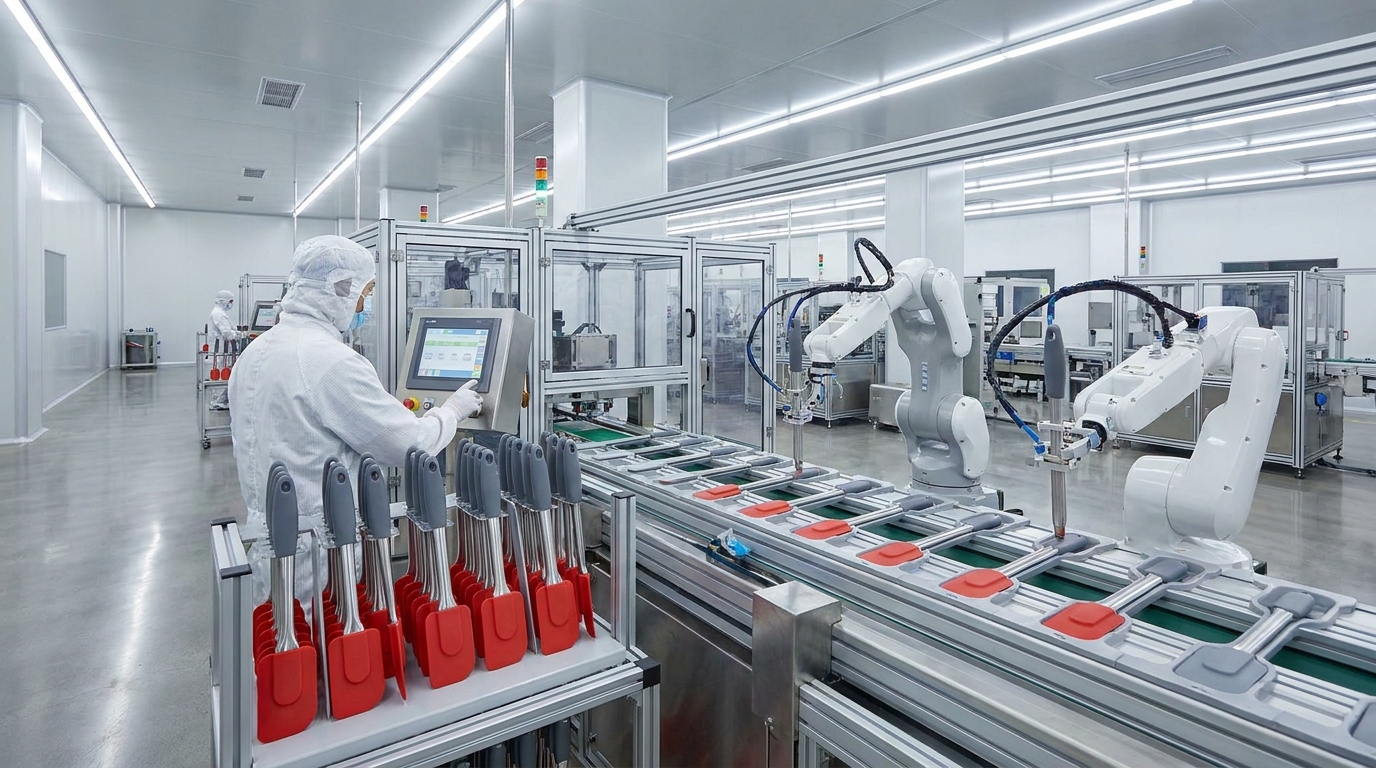
Metal inserts must be precisely placed into the mold, which often requires slower manual labor or expensive robotic arms. Plastic cores can be produced in-house and sometimes molded in a single “two-shot” process to save time.
- Insert molding increases the risk of mold damage.
- Plastic-to-silicone bonding is often faster to cure.
- Metal requires specific surface cleaning before molding.
Think about it:
Every extra second in the mold translates to thousands of dollars in lost production time over a year.
Evaluating total cost of ownership for buyers
While the manufacturing cost is higher for metal, the “lifetime” nature of the product reduces warranty claims and returns. A plastic-core product that snaps in the first month is far more expensive in terms of brand damage.
- Metal tools have a 0% “snap” return rate.
- Plastic tools are susceptible to “softening” returns.
- Premium pricing for metal often offsets the higher BOM.
Now consider this:
The most expensive product you can make is the one that the customer sends back.
Key Takeaway: Choosing a core is a balancing act between upfront manufacturing costs (CAPEX/OPEX) and the long-term cost of warranty claims and brand reputation.
| Cost Center | Metal Core | Plastic Core |
|---|---|---|
| Raw Material | Higher | Lower |
| Labor/Automation | Higher (Insert placement) | Lower |
| Quality Control | Focus on rust/bonding | Focus on warping/melting |
What are the durability differences in high-volume use?
In commercial environments, tools are subjected to hundreds of use cycles per day, and this is where the core material truly shows its worth. If you are targeting the B2B hospitality sector, your Silicone Spatulas must be able to withstand extreme physical and chemical stress without failing.
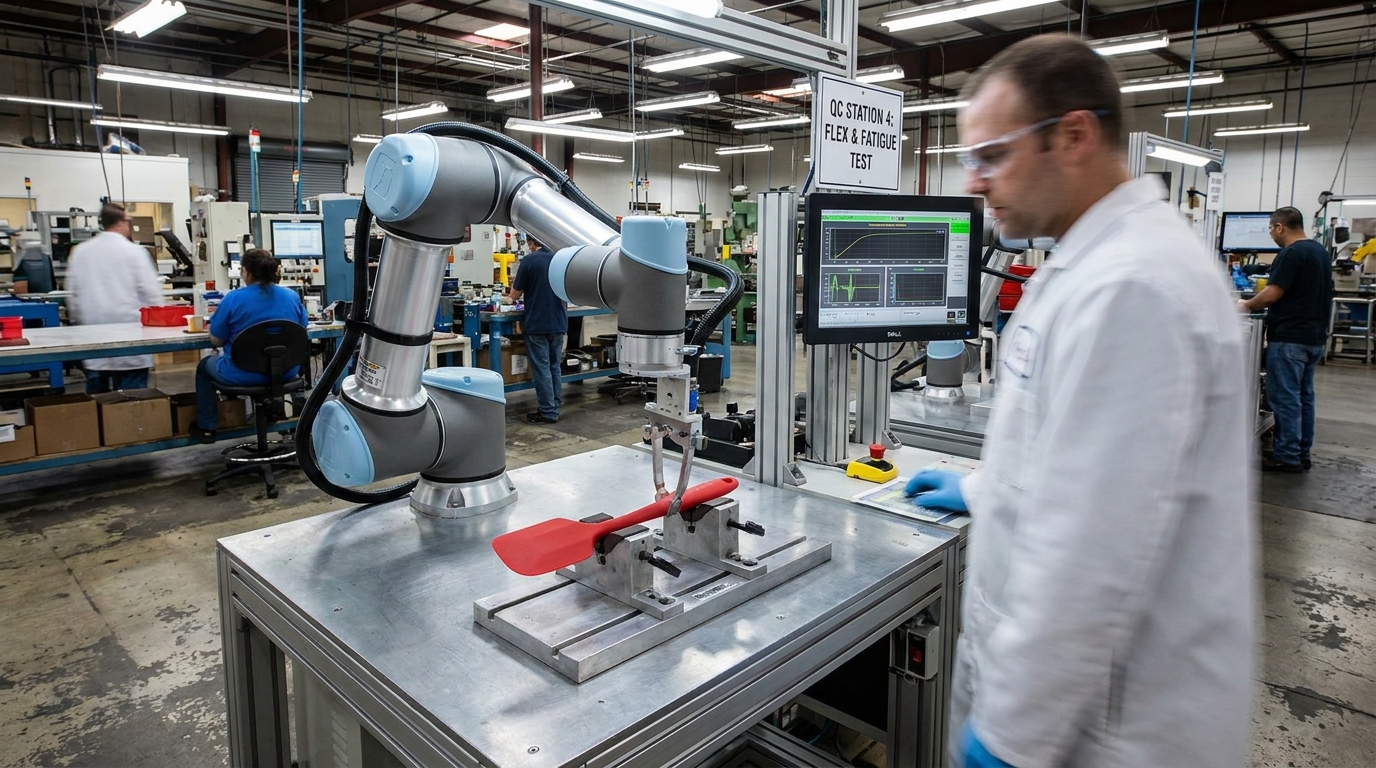
Fatigue resistance in commercial kitchens
Fatigue is the progressive structural damage that occurs when a material is subjected to cyclic loading. Plastic reaches its fatigue limit much sooner than metal, leading to the eventual “snapping” of the handle.
- Stainless steel has a near-infinite fatigue life in kitchens.
- Plastic becomes more brittle with each thermal cycle.
- Metal maintains its springiness over years of use.
The bottom line?
For a tool that will be used 50 times a day, metal is the only logical choice.
Dishwasher safety and long-term degradation
Commercial dishwashers use extremely harsh alkaline detergents and high-pressure steam that can degrade many plastics over time. Stainless steel remains unaffected by these chemicals, ensuring the skeleton doesn’t crumble inside the silicone.
- Dishwasher heat can cause plastic cores to shrink.
- Metal is impervious to standard kitchen chemicals.
- Plastic can leach odors or stains if the skin is breached.
But wait, there is more:
A “dishwasher safe” label is only true for the life of the internal core.
Which core prevents silicone-to-core delamination?
Delamination occurs when the silicone skin separates from the internal core, usually because the core flexed too much or the bond was weak. Metal cores provide a more rigid substrate that minimizes the stress on the adhesive layer.
- Prevents the “sock effect” where the head slides off.
- Rigid cores reduce mechanical shear at the bond line.
- Textured metal inserts can improve physical locking.
Now consider this:
If the silicone head falls off in a commercial mixer, it can ruin thousands of dollars of food.
Key Takeaway: For products marketed as “Commercial Grade” or “Dishwasher Safe,” a metal core is virtually mandatory to ensure the 12-24 month lifespan expected by B2B buyers.
| Test | Metal Core Result | Plastic Core Result |
|---|---|---|
| Flex Cycle Test | 100,000+ cycles | 20,000 – 50,000 cycles |
| Chemical Resistance | Excellent | Varies by resin grade |
| Drop Test | No damage | Potential for internal cracks |
Can core material influence your branding strategy?
Your choice of internal material is a silent communicator of your brand’s values and market positioning. Whether you choose metal for its “indestructible” reputation or plastic for its colorful versatility, you are making a statement about who your Silicone Spatulas are for.
Positioning spatulas for the premium market
A metal core allows you to use marketing terms like “Lifetime Guarantee” or “Commercial Grade,” which justify a significantly higher retail price. This strategy aligns your brand with quality, professionalism, and long-term value.
- Higher MSRP supports better retail margins.
- Attracts professional chefs and serious home cooks.
- Reduces the “disposable” perception of silicone tools.
Believe it or not:
Consumers are increasingly willing to pay more for tools that they won’t have to replace next year.
Customization options for core shapes
Metal cores can be laser-cut into complex internal shapes to provide support exactly where the silicone needs it most. Plastic cores offer even more freedom, allowing for three-dimensional internal structures that can’t be stamped from steel.
- Custom cores can be branded with internal logos.
- Specific flex zones can be patented for a competitive edge.
- Variable weight inserts can create a signature “feel.”
The kicker is:
The internal shape of the core is the “secret sauce” of a spatula’s performance.
Tailoring products for baby care safety standards
When manufacturing for the infant market, safety and “choke hazard” prevention are the only things that matter. A customized metal core that is chemically and mechanically bonded to the silicone provides the ultimate peace of mind.
- Ensures the head can never be pulled off by a child.
- Provides enough weight for the tool to be easily found.
- Meets the strictest “pull-test” requirements for baby toys.
Here is the deal:
In the baby care sector, over-engineering the core is not a cost; it is a safety requirement.
Key Takeaway: Your core choice is a branding statement; it signals to your customer whether you are competing on price or competing on quality and safety.
| Brand Pillar | Recommended Core | Reasoning |
|---|---|---|
| Value / Budget | Plastic (Nylon) | Low price, high volume |
| Professional / Chef | Metal (Stainless) | Performance, weight, durability |
| Eco-Friendly | Metal | Longevity reduces waste |
Frequently Asked Questions about spatula cores?
Are metal cores safe for non-stick pans?
Yes, metal cores are 100% safe for non-stick pans because they are completely encapsulated within a thick layer of soft, food-grade silicone. The metal never touches the pan surface, meaning it cannot scratch Teflon or ceramic coatings while providing the rigidity needed for scraping.
How to identify core material without cutting?
The easiest way is to use a magnet or a weight test; metal-core spatulas are significantly heavier and often have a center-weighted balance point near the neck. You can also try to flex the handle—metal provides a much higher resistance to bending and won’t feel “springy” like thin plastic.
Can I customize the stiffness of plastic cores?
Absolutely, manufacturers can adjust the stiffness of plastic cores by varying the percentage of glass fiber reinforcement in the nylon resin. This allows you to fine-tune the flexibility for specific tasks like delicate pastry folding or heavy-duty dough mixing.
What’s the best core for commercial dishwashers?
Stainless steel is the best choice for commercial dishwashers because it is impervious to the high temperatures and caustic chemicals used in professional kitchens. Plastic cores can become brittle or warp over hundreds of high-heat cycles, leading to structural failure.
Can I request custom core shapes for my brand?
Yes, most manufacturers offer custom core development where you can specify the weight, balance, and flex profile of the tool. If you are ready to develop a unique product line, contact us to discuss your specific engineering requirements and material choices.
*
Strategic Decision Summary
To resolve the core dilemma, you must define your target market: Choose stainless steel cores for premium, professional-grade products that demand high heat resistance and “lifetime” durability; choose nylon or plastic cores for high-volume retail goods where light weight and price-competitiveness are the priority. Investing in the right internal skeleton is the only way to prevent field failures and protect your brand equity. At Hualin, we stand for engineering excellence that goes beyond the surface. We invite you to contact us today to see how our advanced overmolding capabilities can elevate your next manufacturing project.