You can identify 100% LFGB silicone by performing a physical “pinch test” to check for white stress marks and verifying official laboratory migration test reports from the manufacturer. Many B2B buyers struggle with inconsistent material quality that compromises product safety and brand reputation. Using subpar materials can lead to chemical leaching and regulatory non-compliance, putting your entire supply chain at risk. By sourcing certified food grade silicone, you ensure your products meet the highest European safety standards while building long-term consumer trust.
What exactly is LFGB food grade silicone certification?
LFGB certification is the German and European regulatory standard that ensures silicone materials do not migrate harmful chemicals into food during contact. This standard is widely regarded as the most stringent globally, requiring specialized testing for volatile organic compounds.
Is it different from standard European regulations?
While most of Europe follows EC 1935/2004, Germany and France require the specific LFGB testing protocols for food grade silicone to ensure zero toxicity. This involves more intensive laboratory simulation of food contact.
- Mandatory for German and French markets.
- Tests for specific migration of organotin compounds.
- Requires high-purity platinum-cured raw materials.
You might be wondering:
Why does this matter for your brand? It ensures that your products are perceived as premium and safe in the world’s most regulated markets.
Key Takeaway: LFGB is the “Gold Standard” of silicone safety, exceeding basic global requirements through rigorous migration testing.
| Feature | LFGB Requirement | Standard Silicone |
|---|---|---|
| Testing Intensity | High (Strict Migration) | Moderate |
| Market Acceptance | European/Global Premium | US/General |
| Curing Agent | Platinum-based | Peroxide or Platinum |
This data confirms that LFGB compliance acts as a barrier to entry for low-quality competitors in high-end markets.
Why is LFGB considered safer than FDA standards?
LFGB is considered safer because it employs more comprehensive testing methods that focus on the migration of substances rather than just the composition of the material. While both ensure food grade silicone safety, LFGB has lower thresholds for allowable impurities.
What are the testing differences?
The primary difference lies in how the laboratory simulates contact with acidic, fatty, and aqueous foods. LFGB standards are notoriously difficult to pass because they leave no room for chemical “loopholes” that might exist in basic FDA checks.
- FDA focuses on substance extraction limits.
- LFGB monitors the transfer of taste and odor.
- LFGB requires more expensive raw material processing.
Here is the kicker:
Passing LFGB effectively means you have already surpassed FDA requirements, giving you a dual-market advantage with one material.
Key Takeaway: The safety margin of LFGB is significantly wider, making it the preferred choice for sensitive applications like infant care.
| Standard | Primary Focus | Chemical Threshold |
|---|---|---|
| FDA (US) | Compositional Limits | Standard Safety |
| LFGB (DE) | Migration & Sensory | Ultra-Strict |
Manufacturers opting for LFGB provide a higher safety guarantee that minimizes the risk of product recalls.
How can you perform the silicone pinch test at home?
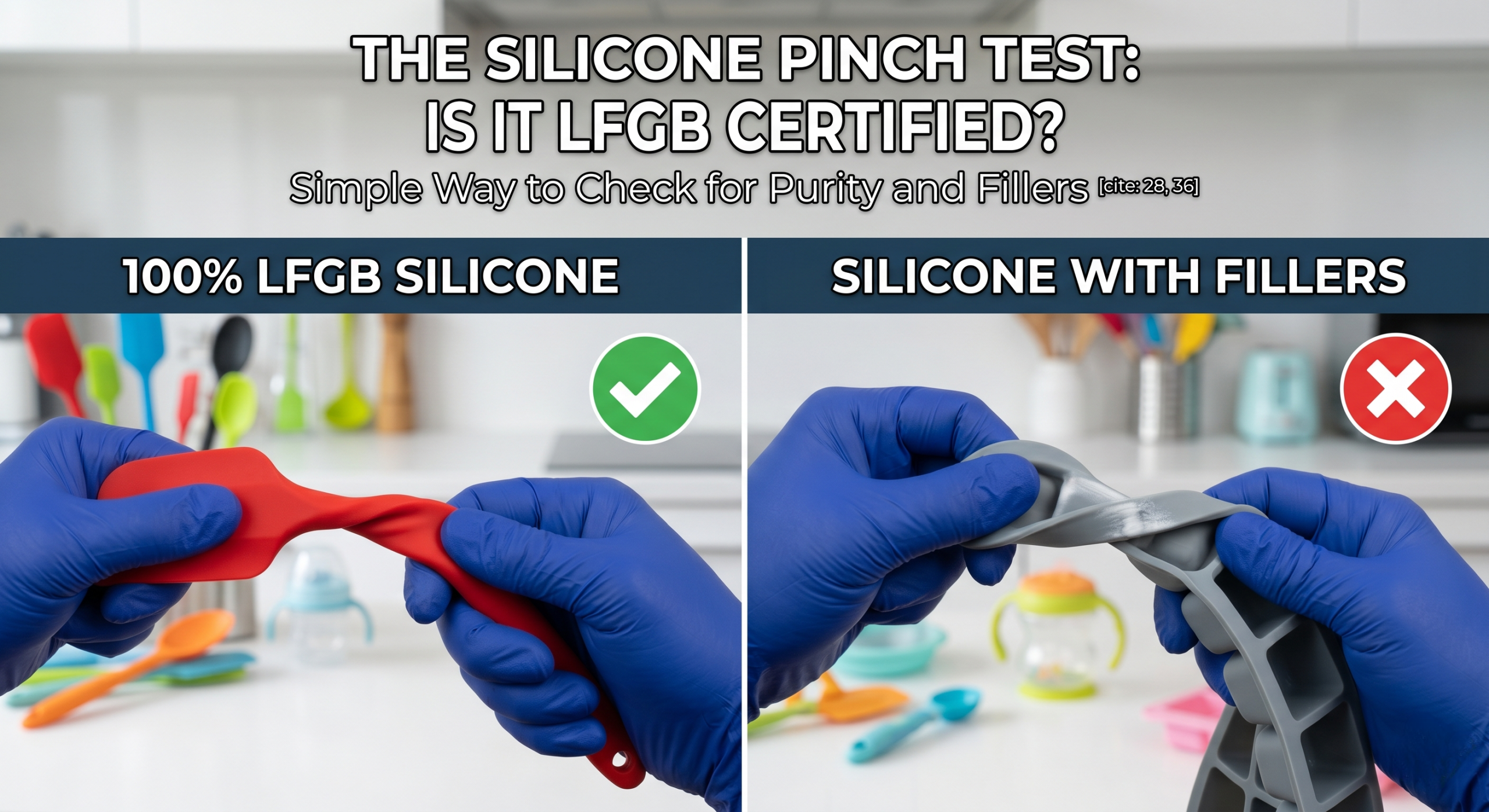
The pinch test involves twisting or stretching a piece of food grade silicone to see if the material turns white at the stress points. If the color remains consistent throughout the stretch, the product is likely 100% pure silicone without fillers.

Why does the material turn white?
When manufacturers add cheap plastic fillers or “extenders” to food grade silicone, these additives lack the elasticity of pure silicone and fracture under pressure. This fracture scatters light, creating a visible white mark.
- 100% Silicone: No color change when twisted.
- Filler-Heavy Silicone: Becomes white or pale.
- High-Density Parts: Require significant force to test.
But wait, there’s more:
While the pinch test is a great quick indicator, it should always be backed up by a legitimate certificate of analysis from the factory.
Key Takeaway: A simple physical stretch can instantly reveal if a supplier has compromised material purity with low-cost chemical fillers.
| Observation | Conclusion | Action Required |
|---|---|---|
| Uniform Color | High Purity Likely | Proceed to Lab Review |
| White Streaks | Fillers Detected | Reject Batch |
This physical verification serves as a frontline quality control measure before expensive laboratory testing is commissioned.
Does 100% LFGB silicone contain harmful plastic fillers?
True 100% LFGB certified food grade silicone does not contain plastic fillers because these substances would fail the migration and sensory tests required for certification. Fillers like calcium carbonate or plasticizers are strictly prohibited in premium grade formulations.
What happens if fillers are present?
Fillers often leach out during high-temperature use or when in contact with fatty foods, which is exactly what LFGB testing is designed to catch. These impurities can also cause the material to develop a sticky surface or unpleasant odor over time.
- Fillers reduce manufacturing costs but compromise safety.
- LFGB testing detects non-silicone volatiles.
- Pure silicone maintains structural integrity longer.
The best part?
By insisting on 100% LFGB material, you are effectively filtering out low-tier manufacturers who rely on “blended” materials to hit lower price points.
Key Takeaway: LFGB certification acts as a chemical gatekeeper, ensuring that only pure, non-toxic silicone reaches the end consumer.
| Component | Pure LFGB Silicone | Filler-Blended Silicone |
|---|---|---|
| Thermal Stability | Up to 230°C+ | Degrades at lower temps |
| Chemical Leaching | Non-detectable | Risk of phthalates/BPA |
Purity in raw materials directly correlates to the longevity and safety profile of the finished industrial or consumer part.
What are the key chemical differences in food grade silicone?
The chemical difference lies in the curing system, where food grade silicone using the LFGB standard typically utilizes a platinum-catalyst system. This eliminates the “blooming” effect and chemical byproducts found in cheaper peroxide-cured alternatives.
What is platinum curing?
Platinum-cured food grade silicone is synthesized without the use of organic peroxides, meaning no volatile acid residues are left in the material. This process results in a clearer, more durable, and completely odorless product.
- No peroxide byproducts (benzoic acid).
- Enhanced clarity and transparency.
- Superior tear strength and elongation.
Think about this:
A platinum-cured part is not just safer; it performs better in mechanical applications where fatigue resistance is critical.
Key Takeaway: The curing method is the fundamental chemical differentiator that separates standard silicone from high-performance LFGB grades.
| Curing Agent | Byproducts | Sensory Profile |
|---|---|---|
| Peroxide | Volatile acids | Possible odor |
| Platinum | None | Odorless/Neutral |
Choosing platinum-cured systems is the only reliable way to ensure a product passes the sensory requirements of LFGB.
Are there specific smell tests for LFGB silicone quality?
Yes, a high-quality food grade silicone product should be completely odorless even when heated for the first time. If you detect a strong chemical or “burnt plastic” smell, the material likely contains unreacted peroxides or low-quality fillers.
Does the smell go away?
While some odors can be “baked out” through post-curing, the presence of a strong smell in a finished product indicates a lack of proper process control. LFGB standards specifically test for “Sensory Evaluation,” ensuring no taste or odor is transferred to food.
- Smell indicates volatile organic compounds (VOCs).
- LFGB products undergo rigorous de-gassing.
- Heat-induced odors suggest high filler content.
Make no mistake:
An odorless product is the signature of a manufacturer who invests in proper post-curing and high-purity raw materials.
Key Takeaway: Sensory neutrality is a mandatory requirement for LFGB, making the “sniff test” a valid field assessment for B2B buyers.
| Scent Profile | Likely Origin | LFGB Status |
|---|---|---|
| Neutral/None | Platinum Cured | Passed |
| Chemical/Acrid | Peroxide/Fillers | Failed |
The lack of odor is a primary indicator of successful volatile removal during the manufacturing and curing stages.
How does high temperature affect LFGB vs FDA silicone?
Both types of food grade silicone are heat resistant, but LFGB silicone maintains its structural and chemical stability much better at sustained high temperatures. At 200°C, low-quality silicone can begin to “outgas” harmful chemicals that LFGB materials do not.
Can it withstand the oven?
LFGB grade food grade silicone is designed to remain inert even during repeated cycles of high-heat exposure in ovens or dishwashers. The lack of fillers ensures the material does not become brittle or lose its non-stick properties over time.
- Maintains flexibility at 230°C.
- No discoloration under high thermal stress.
- Consistent performance in boiling water.
Believe it or not:
Some cheaper silicones can actually melt or deform if the filler content is too high, leading to catastrophic product failure in kitchen environments.
Key Takeaway: LFGB silicone offers superior thermal stability, ensuring the product remains “food safe” even under extreme cooking conditions.
| Temperature | LFGB Response | Low-Grade Response |
|---|---|---|
| 100°C (Boiling) | Perfectly Stable | Minor Softening |
| 200°C (Baking) | Inert/Safe | Outgassing/Odor |
Thermal reliability is essential for products that will undergo repeated sterilization or high-heat food preparation cycles.
Which industries prioritize LFGB food grade silicone parts?
Industries involving infant care, medical devices, and high-end kitchenware strictly prioritize LFGB food grade silicone to avoid any risk of chemical migration. These sectors require the highest level of biocompatibility and safety documentation.
Why is it used in baby products?
For items like pacifiers and teethers, the constant contact with saliva and sensitive mucous membranes makes food grade silicone the only acceptable material. LFGB ensures that no micro-quantities of toxins are ingested by the infant.
- Infant feeding and soothing.
- Medical-grade fluid handling.
- Professional-grade culinary tools.
Here is the kicker:
While it costs more, the reduction in legal liability and insurance risk makes LFGB the more economical choice for these high-stakes industries.
Key Takeaway: In high-risk industries, the LFGB standard is not just an option—it is a mandatory requirement for safety and compliance.
| Industry | Primary Requirement | Preferred Grade |
|---|---|---|
| Infant Care | Oral Safety | 100% LFGB |
| Kitchenware | Heat/Odor Stability | LFGB/FDA |
Targeting regulated industries requires a commitment to the highest material standards to ensure long-term market viability.
How do we verify the authenticity of LFGB test reports?
To verify a report for food grade silicone, you must check that the lab is ISO 17025 accredited and that the report number can be validated on the testing agency’s official website. Authentic reports will clearly list the specific migration results for the tested components.
What should you look for in the fine print?
Check that the product name on the report matches your specific order and that the test date is recent. Fake reports often use generic photos or blurred-out identifying numbers to hide the fact that they are reused from other manufacturers.
- Verification via QR codes or ID numbers.
- Matching company name and address.
- Comprehensive list of tested substances.
It gets better:
Reputable manufacturers will proactively provide these documents with every batch, rather than waiting for you to ask.
Key Takeaway: Documentation is your only legal protection; always cross-reference lab reports with the issuing agency for absolute certainty.
| Checklist Item | Authentic Report | Forged/Old Report |
|---|---|---|
| Lab Accreditation | CNAS/TUV/SGS | Unknown/Expired |
| Report Date | Within 12 months | 2+ years old |
Rigorous document verification prevents your company from unknowingly distributing non-compliant and potentially hazardous products.
What are the long-term benefits of using premium silicone?
Using premium LFGB food grade silicone results in significantly higher product durability, better consumer reviews, and reduced replacement costs for your brand. High-purity silicone resists yellowing and structural degradation far better than standard grades.
Does it affect brand loyalty?
Consumers can feel the difference in texture and see the difference in longevity; a food grade silicone product that stays clean and odorless for years creates a powerful brand advocate. This leads to higher repeat purchase rates and lower customer service inquiries.
- Resistance to environmental staining.
- Higher perceived value at retail.
- Compliance with future safety laws.
You won’t believe it:
The initial cost difference of LFGB material is often offset within the first year by the reduction in returns and quality-related complaints.
Key Takeaway: Premium materials are an investment in brand equity, providing a tangible return through quality consistency and consumer safety.
| Long-Term Metric | Premium LFGB | Economy Grade |
|---|---|---|
| Yellowing | Very Resistant | Frequent |
| Surface Tack | Stays Smooth | Becomes Sticky |
Superior material performance ensures that your products maintain their aesthetic and functional appeal throughout their lifecycle.
*
Conclusion
Verifying that your silicone products are 100% LFGB certified is a critical step in maintaining a safe and professional supply chain. We have solved the problem of material uncertainty by implementing rigorous in-house testing and third-party verification for every batch of food grade silicone we produce. Our facility specializes in high-precision molding and stable mass production, ensuring that your parts are consistent from the first prototype to the final shipment. Whether you need custom baby care items or industrial components, we provide the engineering support and documentation required to scale your brand with confidence.
Ready to secure your supply chain with certified materials? contact us today for a detailed DFM review and a quote tailored to your project requirements. At our factory, our vision is to lead the industry through transparency and uncompromising quality, protecting your reputation as much as our own.
FAQ
How do I know if my product is 100% silicone?
Perform the pinch test; if the material turns white, it contains fillers and is not pure silicone.
Can I use FDA silicone for the European market?
Generally no, as most European markets, especially Germany and France, require the more stringent LFGB testing standards.
What is the best way to clean LFGB silicone?
Use mild soap and warm water; because it is high purity, it resists staining and odors better than low-grade alternatives.
How do I know if a lab report is real?
Scan the QR code on the report or enter the report ID number on the official website of the testing agency (like SGS or TUV).
Can I boil LFGB silicone to sterilize it?
Yes, 100% LFGB silicone is extremely heat stable and will not leach chemicals into water even at boiling temperatures.