
Mouthpieces & Drip Tips
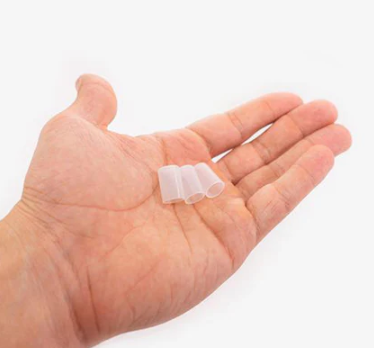
Premium touch-feel silicone components that deliver comfortable, hygienic contact while maintaining odor-free performance throughout extended use.
13,000㎡ facility with 300+ skilled workers manufacturing mouthpieces, sealing rings, caps, buttons, and custom silicone components engineered for leak-free performance and batch-to-batch consistency.
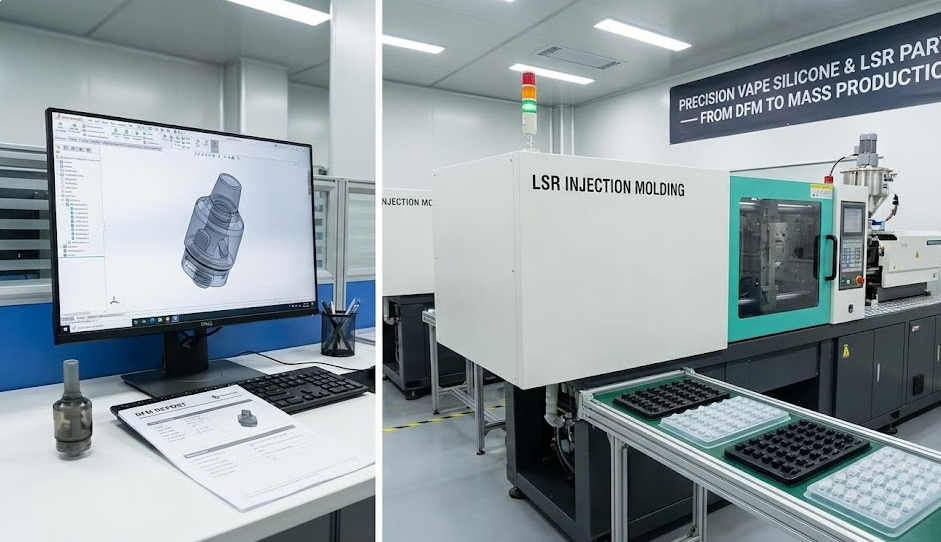
Identify your biggest risk factor and discover our proven solutions to protect your product quality and brand reputation.
Sealing failures cause liquid leakage, user complaints, and warranty returns that damage your brand.
Unpleasant smell from silicone parts affects user experience and raises safety concerns.
Parts degrade, swell, or lose elasticity when exposed to high temperatures and e-liquid oils.
Silicone parts get cut, torn, or deformed during assembly, causing production delays and waste.
Variations in dimensions, hardness, or color between production batches undermine quality control.
Wrong material selection leads to chemical reactions with e-liquids, causing swelling or breakdown.
Tight dimensional requirements are difficult to achieve and maintain across production volumes.
Lack of proper certification and documentation creates barriers to market entry and sales.
Ready to solve your challenge? Let us engineer the right solution for your vape components.
Request Free DFM ReviewComplete component solutions engineered for sealing integrity, tactile precision, protection, and premium user experience.
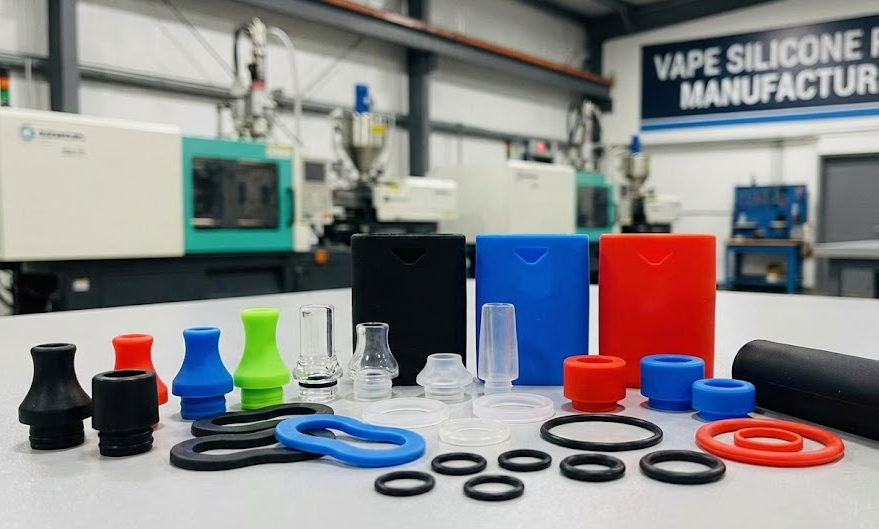
Premium touch-feel silicone components that deliver comfortable, hygienic contact while maintaining odor-free performance throughout extended use.
Precision-molded O-rings and custom gaskets engineered to prevent e-liquid leakage with consistent compression and dimensional stability.
Protective silicone covers that shield charging ports and airflow channels from dust, moisture, and contamination during storage and transport.
Responsive silicone buttons providing precise tactile feedback with long-lasting elasticity and resistance to repeated actuation cycles.
Anti-slip silicone sleeves that protect devices from impact damage while enhancing user grip comfort and device aesthetics.
Integrated silicone-to-plastic assemblies combining multiple functions into single components for streamlined assembly and enhanced reliability.
Need a custom vape silicone component? Upload your design for a free engineering feasibility review.
Get Parts Selection ConsultationChoose the right silicone grade for low odor, sealing stability, and long-term performance — backed by complete compliance documentation.
Platinum-cured liquid silicone rubber engineered for direct user contact and extended e-liquid exposure, delivering minimal extractables and exceptional purity.
Compression-molded solid silicone optimized for protective sleeves, grips, and structural components requiring durability and cost efficiency.
Full compliance certificates for restricted substance regulations
Detailed composition reports and traceability documentation
Biocompatibility, migration, and performance validation data
Batch tracking from raw material to finished goods
Unsure which material fits your application? Request our Material Selection Guide with test data and compliance documentation.
Request Material RecommendationWe review compression ratios, tolerance stack-ups, and assembly protection to eliminate leakage risks before production begins.
Parting lines, gate marks, and surface defects on sealing faces directly cause liquid leakage. Our DFM review identifies critical surfaces and optimizes mold design to maintain uninterrupted sealing contact.
Insufficient compression allows leakage; excessive compression causes permanent deformation and seal failure. We calculate optimal compression percentages based on material hardness and application conditions.
Cumulative dimensional variations across mating parts create unpredictable compression levels. We analyze tolerance chains and recommend dimensional controls to guarantee consistent sealing performance across production batches.
Sharp edges, interference fits, and poor lead-ins cause silicone cutting or tearing during assembly. We incorporate chamfers, tapers, and assembly guides to protect seal integrity throughout installation.
Mold parting lines create microscopic gaps that allow e-liquid to seep through, causing immediate leakage failures.
Under-compressed seals fail to form proper contact pressure, allowing liquid paths to remain open under normal use conditions.
Abrupt assembly interfaces tear or deform silicone seals during installation, creating permanent damage that cannot be reversed.
Unrounded corners and sharp transitions slice through silicone material during compression or thermal cycling, creating leak paths.
Excessive interference forces distort mating parts during assembly, creating uneven compression that leaves gaps in sealing zones.
Using wrong hardness or incompatible silicone grades results in poor sealing performance or material degradation over time.
Prevent costly leakage failures — upload your design for a free DFM sealing review with actionable recommendations.
Upload Drawing for Free DFM ReviewWe recommend the optimal manufacturing process based on your performance targets, tolerance requirements, appearance standards, and production volume.
Automated liquid silicone injection delivers tight tolerances, minimal flash, and consistent batch-to-batch performance for critical sealing and tactile components.
Traditional compression process offers flexibility for larger parts, protective sleeves, and components where moderate tolerances are acceptable at competitive pricing.
Integrated silicone-to-plastic bonding combines multiple components into single assemblies, reducing assembly steps and improving reliability through chemical bonding.
Incoming inspection and material conditioning
Precision injection or compression forming
Heat treatment for odor reduction
Dimensional and visual quality checks
Clean room packing and documentation
Need help selecting the right process? Our engineers provide recommendations based on your specific requirements.
Get Process RecommendationPremium surface treatments engineered to eliminate dust attraction, maintain color stability, and deliver lasting tactile comfort.
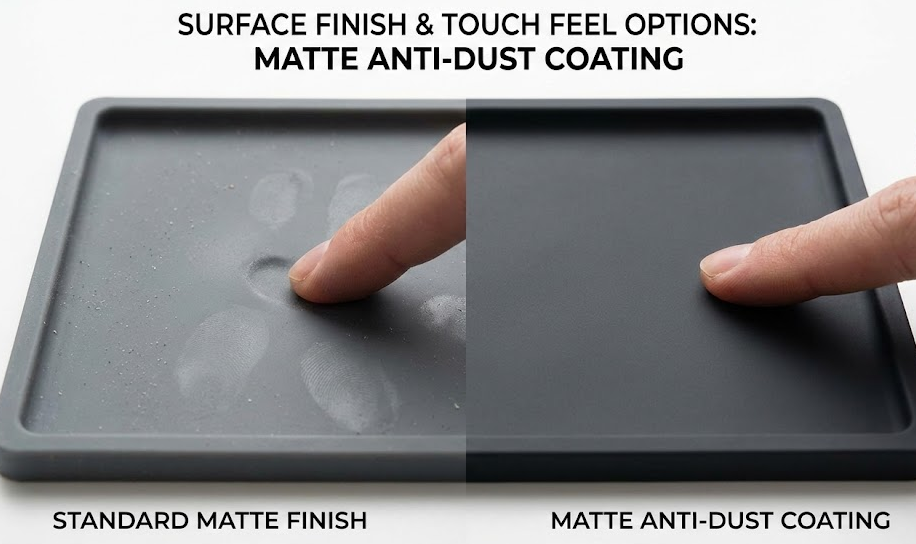
Specialized surface treatment reduces electrostatic attraction, keeping parts clean and maintaining premium appearance throughout product lifecycle.
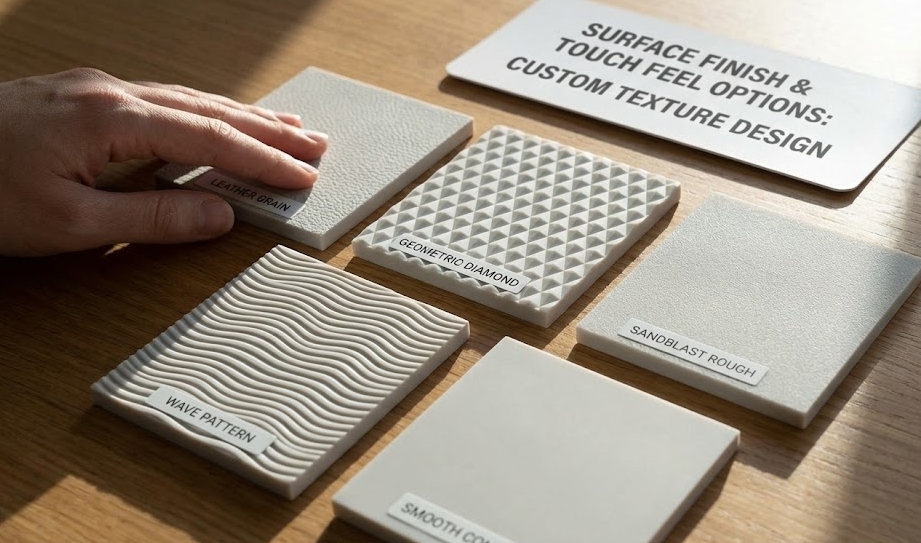
Precision-etched mold cavities transfer intricate surface patterns that enhance grip, hide minor imperfections, and create distinctive brand identity.
Mirror-finish surface treatment delivers luxury appearance with superior color depth and optical clarity for premium product positioning.
Your specified Pantone code translated to silicone formulation
Physical color samples submitted for your verification
Approved standard maintained across all batches
All production batches verified against approved color master for consistency.
Explore finish options tailored to your product requirements and brand positioning.
Request Finish Sample BookPredictable project progression with defined deliverables at every stage, ensuring you always know what happens next.
Engineering analysis identifies manufacturability issues, tolerance concerns, and sealing risks before tooling investment.
Precision mold fabrication with in-house CNC machining, EDM processing, and cavity surface finishing to production standards.
Initial trial shots for dimensional verification, followed by first-approval samples in production-intent material and color.
Your validation of samples against specifications establishes the locked production standard for all future batches.
Pre-production verification run confirms process stability, identifies optimization opportunities, and validates cycle time projections.
Full-scale manufacturing with continuous process monitoring, batch traceability, and quality documentation for every shipment.
Experience predictable project execution with clear communication at every milestone.
Start Your ProjectEquipment and process control infrastructure designed for consistent repeatability from pilot runs to high-volume production.
12 sets of precision LSR machines (85T-120T tonnage) with automated material feeding and closed-loop temperature control for consistent shot-to-shot performance.
Complete mold design and fabrication capabilities with CNC machining centers, EDM equipment, and precision surface finishing for rapid tooling iterations.
Dimensional verification with CMM, optical comparators, hardness testers, and environmental chambers for validation testing and continuous process monitoring.
Dedicated post-curing ovens, deflashing stations, and Class 100,000 clean room packaging facilities ensure product integrity through final shipment.
Purpose-built production campus in Dongguan with dedicated zones for tooling, molding, post-processing, quality control, and warehousing. Climate-controlled environments maintain process stability year-round.
Tour our facility virtually or schedule an on-site audit to verify our manufacturing capabilities.
Request Facility OverviewMulti-stage inspection with complete traceability from incoming materials through final shipment, backed by documented records.
Incoming Quality Control
In-Process Quality Control
Final Quality Control
Outgoing Quality Control
Every shipment linked to material lot numbers, production date, machine ID, and operator records for complete supply chain visibility.
Documented process parameters, inspection results, and control charts maintained for audit and continuous improvement analysis.
ISO 9001/14001/IATF 16949 certified systems ensure audit-ready documentation and continuous quality management.
Request inspection reports and process documentation to evaluate our quality control rigor.
Download Quality ManualA validation plan aligned with sealing performance and real-world use, ensuring long-term durability and consistent quality.
Verify that sealing performance and material properties remain stable after prolonged exposure to elevated temperatures.
70°C for 168 hours (7 days) in air-circulating oven
No visible cracking, hardness change ≤5 Shore A, sealing function maintained
Confirm that silicone maintains dimensional stability and sealing integrity when exposed to vape e-liquids.
Full immersion in representative e-liquid at 23°C for 72 hours
Volume swell ≤10%, no surface degradation, maintained sealing compression
Measure permanent deformation after sustained compression to predict long-term sealing reliability.
25% compression at 70°C for 22 hours per ASTM D395
Compression set ≤25% indicates good recovery and sealing longevity
Simulate real-world temperature fluctuations to verify dimensional stability and sealing consistency.
-20°C to +60°C cycles, 30 min dwell each, 10 cycles minimum
No cracking, warpage, or loss of sealing contact pressure
Download our complete validation checklist tailored to your vape component type.
Get Validation ChecklistPractical engineering fixes to protect your yield and reputation, with root cause analysis and prevention strategies.
Excessive material overflow at parting line due to inadequate clamping force, worn mold surfaces, or improper venting design.
Optimize parting line placement away from sealing zones, maintain mold condition, adjust injection pressure and clamp tonnage, add proper venting channels.
Visual inspection under magnification, dimensional measurement of sealing surface flatness, functional leak testing.
Uneven cooling, excessive internal stress from overpacking, insufficient cure time, or non-uniform wall thickness in part design.
Balance wall thickness in design, optimize cooling channel layout, control injection speed and packing pressure, extend cure time if needed.
CMM dimensional inspection, flatness measurement, visual assessment after 24-hour stress relaxation period.
Insufficient material packing in thick sections, premature gate freeze-off, or trapped air pockets during injection.
Redesign thick sections with coring or ribs, increase packing pressure/time, optimize gate location, improve venting to release trapped air.
Visual surface inspection, cross-sectional cut inspection for internal voids, ultrasonic or X-ray inspection for critical parts.
Batch-to-batch pigment variation, incorrect pigment dispersion, contamination from previous colors, or material degradation from excessive heat/shear.
Lock approved color master sample, use consistent pigment suppliers, purge equipment thoroughly between colors, control process temperature within specification.
Visual comparison against locked standard under controlled lighting (D65), spectrophotometer measurement for critical color matching.
Sharp edges on mating plastic parts, excessive interference fit, lack of assembly lead-ins or chamfers, or improper assembly sequence.
Add lead-in chamfers (0.3-0.5mm), round sharp corners (R0.2mm minimum), optimize interference fit calculations, provide assembly jigs/fixtures if needed.
Assembly trial with production tooling, visual inspection for cuts/tears after assembly, functional testing post-assembly.
Incompatible substrate material, contaminated substrate surface (oil/release agent), insufficient bonding area, or improper surface preparation.
Validate silicone-substrate compatibility early, use adhesion primers if needed, ensure substrate cleanliness, optimize surface texture/undercuts for mechanical bonding.
Peel adhesion testing per ASTM D429, visual inspection for delamination, accelerated aging to verify long-term bond strength.
Have a defect issue? Upload photos for engineering feedback and actionable solutions.
Upload Defect Photos for AnalysisReal workflows and outcomes—shared without confidential details—demonstrating our engineering-driven approach to solving critical vape component challenges.
Eliminate e-liquid leakage from tank-to-mouthpiece interface while maintaining easy user assembly.
Original O-ring design showed 8% leak rate in production due to parting line placement and inconsistent compression across tolerance stack-up.
DFM review relocated parting line 90°, optimized compression from 18% to 12-15%, added assembly lead-in chamfer, implemented tighter dimensional SPC.
✓ Leak rate reduced to <0.3% | ✓ Assembly force reduced 40% | ✓ Consistent batch quality
Achieve consistent tactile feedback (actuation force) across 100,000+ cycle lifetime with stable Shore hardness.
Compression molded buttons showed ±15% force variation batch-to-batch, and hardness drift after thermal exposure affected user experience.
Switched to LSR injection for tighter process control, validated post-cure cycle to stabilize hardness, implemented force testing in IQC/FQC.
✓ Force variation reduced to ±5% | ✓ 120K+ cycle durability validated | ✓ Zero hardness complaints
Deliver premium-feel protective sleeve with minimal dust attraction and long-lasting color consistency.
Standard solid silicone showed high static attraction (dust/lint), tackiness after handling, and color yellowing under UV exposure.
Applied matte anti-dust surface treatment, selected UV-stable pigment system, validated cleaning protocol to maintain surface properties.
✓ Dust adhesion reduced 70% | ✓ No tackiness after 1000hrs aging | ✓ Color stable under UV
Request a feasibility review for a similar project with our engineering team.
Request Project Feasibility ReviewUpload drawings, photos, or samples—our engineers respond within 24 hours with quote estimate, DFM notes, and process recommendations.
Budgetary pricing with tooling + unit cost breakdown within 24 hours
Manufacturability feedback covering sealing design, parting line, and tolerance concerns
Suggested silicone grade and molding process based on your requirements
Realistic timeline from tooling kickoff through T1 samples to mass production