Working with an elite silicone manufacturer provides unparalleled technical expertise and high-precision production capabilities required for demanding industrial applications. Here is the deal. Many businesses struggle with inconsistent component quality or slow development cycles when sourcing from generic suppliers. Selecting a premier Silicone Manufacturer eliminates these hurdles by offering specialized liquid silicone rubber (LSR) processing alongside comprehensive design support. This partnership ensures that your products meet strict regulatory standards while maintaining a competitive edge in the global market.
Imagine your product launch is only weeks away but the silicone seals keep failing the pressure test. You watch your budget drain away as mold revisions pile up and your production timeline slips into the red. It is a nightmare scenario that ruins reputations and costs fortunes. But here’s the kicker. You can avoid this frustration entirely by partnering with a verified expert. Our engineering team at Hualin provides the precision tooling and material science necessary to get your design right the first time.
1. Why Choose a High-Quality Silicone Manufacturer for Your Business?
A high-quality Silicone Manufacturer provides the essential infrastructure and certified quality management systems needed to scale your production without sacrificing precision. You might be wondering why specialized expertise matters so much in a crowded market. The answer lies in the subtle science of polymer behavior and the rigors of high-volume vulcanization.
How does material expertise impact performance?
Choosing the right raw material is the first step toward a durable and functional end product. This is where it gets interesting. Expert manufacturers analyze your specific application to recommend the perfect shore hardness and chemical resistance profile.
- Medical-grade LSR for biocompatibility.
- High-temperature solid silicone for automotive seals.
- Food-grade materials for consumer kitchenware.
Can custom formulations solve your unique problems?
Standard materials often fail when pushed to environmental extremes or specialized industrial use cases. We develop custom silicone blends that offer specific mechanical properties like enhanced tear strength or electrical conductivity. Believe it or not most product failures stem from using “off-the-shelf” solutions for custom problems.
| Parameter | Benefit of High-Quality Sourcing |
| Production Yield | Significantly higher with precision molds |
| Material Waste | Minimized through flashless molding |
| Lead Times | Reduced via in-house tooling workshops |
Consistent material selection remains the cornerstone of long-term product reliability.
Key Takeaway: High-quality manufacturing partners reduce risk by aligning material science with your specific functional requirements.
2. How Does an Integrated Silicone Manufacturer Streamline Production?
An integrated Silicone Manufacturer manages the entire lifecycle of a part from initial mold design to final surface treatment in one facility. Wait, there’s more. By keeping these processes under one roof, communication gaps disappear and the speed of the production cycle increases dramatically.
Why is in-house mold making a game changer?
Having an internal CNC and EDM workshop allows for immediate adjustments to tooling during the prototyping phase. The best part is that engineers can walk from the design office to the machine shop to solve issues in minutes rather than weeks.
- Reduced shipping time for heavy steel molds.
- Higher precision with German Roders CNC machines.
- Lower cost for mold modifications and repairs.
What are the benefits of one-stop post-processing?
Integrated factories handle secondary operations like UV coating, silk-screen printing, and adhesive lamination immediately after molding. Here’s the deal. This prevents contamination during transport and ensures that the surface finish adheres perfectly to the freshly molded substrate.
| Integration Phase | Efficiency Improvement |
| Design to Prototype | 30% faster turnaround |
| Quality Feedback | Real-time adjustments |
| Logistics | Eliminated inter-factory transport |
Centralizing production steps eliminates the complexity of managing multiple vendors for a single component.
Key Takeaway: Integrated services simplify your supply chain while ensuring consistent quality across all production stages.
3. What Certifications Should a Silicone Manufacturer Hold?
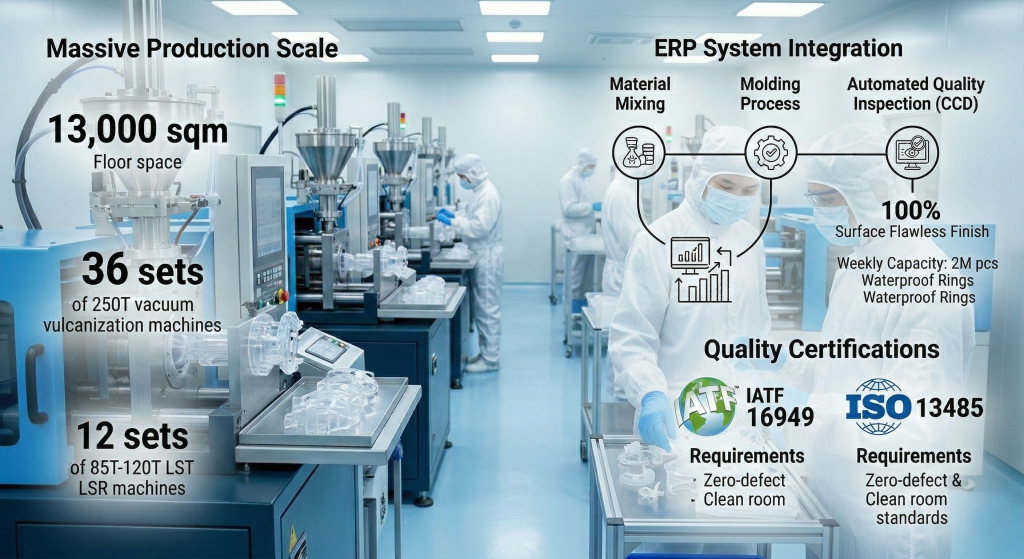
A reputable Silicone Manufacturer must hold globally recognized certifications such as IATF 16949 and ISO 13485 to prove their commitment to excellence. You might be thinking that these are just pieces of paper on a wall. In reality, they represent a rigorous framework for traceability, risk management, and continuous improvement.
Why is IATF 16949 vital for automotive parts?
The automotive industry demands zero-defect policies and strict adherence to the Production Part Approval Process (PPAP). But wait, there’s more. This certification ensures that every seal or gasket produced for an electric vehicle meets the same high standard over millions of cycles.
- Standardized quality control documentation.
- Full batch traceability for every raw material.
- Rigorous environmental and mechanical testing protocols.
Does ISO 13485 matter for non-medical products?
While designed for medical devices, the cleanliness and precision required for ISO 13485 often benefit consumer electronics and wearables. This is where it gets interesting. It demonstrates that the factory can maintain a Class 100k clean room and manage sensitive biological safety requirements.
| Certification | Industry Focus | Core Requirement |
| IATF 16949 | Automotive | Zero-defect manufacturing |
| ISO 13485 | Medical | Biocompatibility and safety |
| ISO 9001 | General | Quality management system |
Compliance with international standards acts as a safety net for your brand’s reputation and global market entry.
Key Takeaway: Proper certification ensures that your supplier speaks the same language of quality as your internal compliance team.
4. How Does Liquid Silicone Rubber Benefit a Silicone Manufacturer?
Modern Silicone Manufacturer facilities rely heavily on Liquid Silicone Rubber (LSR) for complex parts that require high precision and fast cycle times. Let’s face it. Traditional solid silicone compression molding cannot compete with the automation and repeatability offered by modern LSR injection systems.
Is LSR molding better for waterproof components?
LSR is the gold standard for creating the intricate, tiny waterproof rings found in smartphones and Type-C connectors. Believe it or not the low viscosity of liquid silicone allows it to flow into complex geometries that solid rubber simply cannot reach.
- Precision sealing for IP68 rated devices.
- Consistent wall thickness in thin-walled parts.
- Flashless production reduces manual labor costs.
Can automation improve your production consistency?
LSR machines utilize advanced dosing systems to ensure that the material mix is always perfect. This is where it gets interesting. By removing human error from the mixing process, you get parts with identical mechanical properties every single time.
| Feature | LSR Injection Molding | Solid Compression |
| Cycle Time | 30 – 90 Seconds | 3 – 8 Minutes |
| Precision | High (0.01mm) | Moderate (0.1mm) |
| Automation | Fully Automated | Manual/Semi-Auto |
Switching to LSR technology often provides a lower total cost of ownership for high-volume, high-precision projects.
Key Takeaway: Embracing LSR technology allows for the production of sophisticated designs that were previously impossible or too expensive.
5. Why Is a Clean Room Essential for a Silicone Manufacturer?
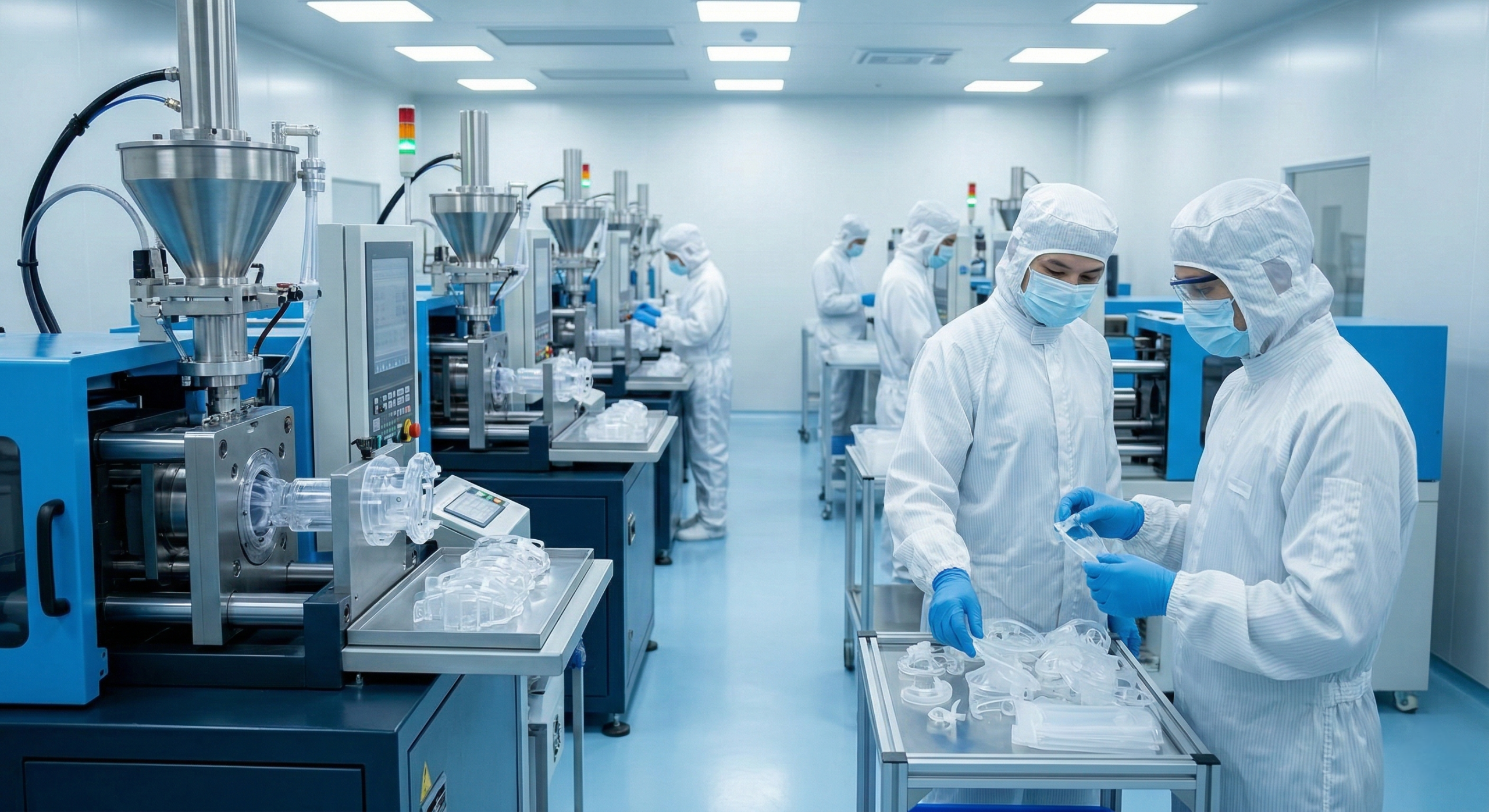
A professional Silicone Manufacturer operates a certified clean room to prevent environmental contaminants from ruining high-value components. You might be wondering if a bit of dust really matters for a rubber part. For optical components, medical sensors, or wearable electronics, even a single microscopic fiber can cause a total product failure.
How does a clean room protect your products?
Controlled environments regulate air filtration, temperature, and humidity to ensure the material cures in a sterile state. But here’s the kicker. Without this control, silicone parts often develop “black spots” or embedded particles that lead to massive rejection rates during final inspection.
- Prevention of airborne dust contamination.
- Strict gowning protocols for all operators.
- Controlled curing conditions for consistent aesthetics.
Is environmental control necessary for consumer electronics?
High-end wearables like earbud tips and smartwatch bands require a flawless surface finish to ensure user comfort and brand prestige. Here’s the deal. A clean room environment ensures that the soft-touch surface of your product feels premium and remains free of irritating allergens.
| Environment Type | Particle Limit | Primary Use Case |
| Class 100,000 | < 100,000 particles/ft³ | General Electronics/Wearables |
| Class 10,000 | < 10,000 particles/ft³ | Medical Grade Components |
| Standard Workshop | Uncontrolled | Industrial Gaskets/Large Parts |
Operating within a clean room reflects a manufacturer’s commitment to the highest level of cosmetic and functional hygiene.
Key Takeaway: Clean room manufacturing is non-negotiable for any product where cosmetic perfection and biological safety are priorities.
6. How Does a Silicone Manufacturer Handle Rapid Prototyping?
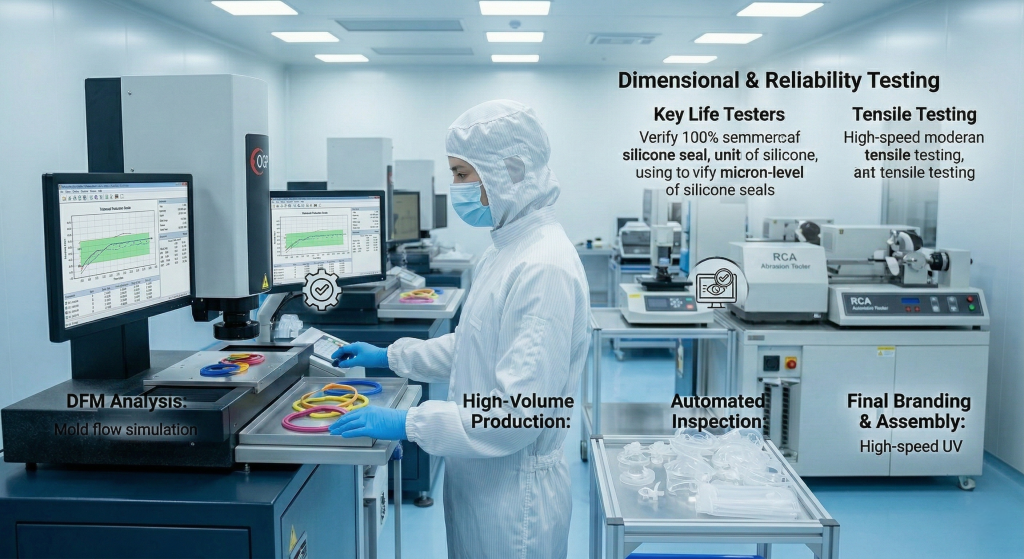
A top-tier Silicone Manufacturer uses rapid prototyping to help engineers validate designs and test functionality before committing to expensive mass production tooling. Ready for the good part? Modern prototyping techniques allow you to hold a physical silicone part in your hands in a matter of days.
Why is DFM support critical during prototyping?
Design for Manufacturing (DFM) feedback ensures that your initial concepts are actually buildable in a production environment. This is where it gets interesting. Our engineers analyze draft angles, wall thickness, and gating locations to prevent sink marks and air bubbles before the first mold is cut.
- Early detection of potential molding defects.
- Optimization of material usage to save costs.
- Identification of areas for structural reinforcement.
Can rapid tooling speed up your market entry?
Using aluminum or soft-steel molds for small batches allows you to test the market without a massive upfront investment. Believe it or not many successful startups launch with “bridge tooling” to generate revenue while their high-volume molds are being finalized.
| Prototyping Stage | Purpose | Typical Timeline |
| 3D Printing | Fit and Form testing | 24 – 48 Hours |
| Prototype Tooling | Functional material testing | 7 – 14 Days |
| Pilot Run | Market validation / PPAP | 2 – 3 Weeks |
Early-stage collaboration with manufacturing experts prevents costly redesigns and accelerates your total time-to-market.
Key Takeaway: Prototyping services bridge the gap between a digital design and a successful, manufacturable reality.
7. What Testing Equipment Does a Silicone Manufacturer Use?
The reliability of a Silicone Manufacturer is often defined by the sophistication of its internal testing laboratory and quality assurance equipment. Wait, there’s more. A factory without a robust lab is essentially flying blind, unable to verify if the parts they ship will survive real-world conditions.
Why are mechanical tests necessary for keypads?
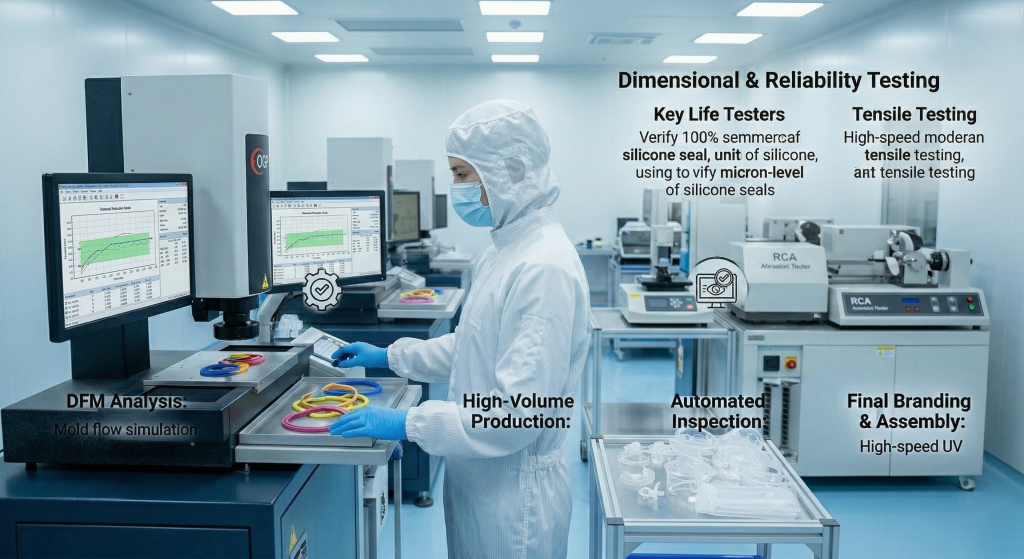
Silicone buttons must withstand hundreds of thousands of presses without losing their tactile feel or tearing. Here’s the deal. We use key life testers and load meters to ensure that the actuation force remains consistent throughout the entire lifespan of the product.
- Tensile strength testing for durability.
- Hardness testing (Shore A/OO) for feel.
- Abrasion testing for printed logos and graphics.
How do we verify dimensional accuracy for seals?
For waterproof components, even a variance of 0.05mm can lead to a leak and a ruined device. This is where it gets interesting. We utilize OGP automatic image measuring instruments and 2.5D testers to verify every critical dimension with sub-micron precision.
| Test Category | Equipment Example | Critical Metric |
| Dimensional | OGP Image Measurer | Tolerance Compliance |
| Mechanical | Key Life Tester | Cycles to Failure |
| Environmental | Temp/Humid Chamber | Material Degradation |
A fully equipped lab ensures that every batch of parts meets your technical specifications before it leaves the factory floor.
Key Takeaway: In-house testing provides the data-driven assurance required for high-stakes industrial and medical applications.
8. How Does a Silicone Manufacturer Support Brand Customization?
A partner-oriented Silicone Manufacturer offers a variety of surface treatments and assembly services that help your brand stand out on the shelf. What’s the real story? Functional excellence is required, but the look and feel of a product are what ultimately drive consumer purchasing decisions.
What are the benefits of UV modification?
Applying a UV coating to silicone prevents the “sticky” feel that often attracts dust and lint. But here’s the kicker. This treatment creates a smooth, silk-like texture that makes products like watch bands and phone cases feel much more expensive and premium.
- Improved resistance to skin oils and sweat.
- Enhanced aesthetic appeal with matte finishes.
- Protection against yellowing and environmental aging.
Can your manufacturer handle final assembly?
Many brands prefer to receive a finished product that is already assembled and packed in a retail-ready gift box. Ready for the good part? By offering assembly and packaging, we reduce your logistical headache and lower the risk of damage during transit between different vendors.
| Customization Option | Brand Impact | User Benefit |
| Custom Pantone Colors | Brand Recognition | Aesthetic Choice |
| Laser Etching | Permanent Branding | Durability |
| Retail Packaging | Market Readiness | Convenience |
Customization services allow you to transform a raw silicone component into a polished, market-ready consumer product.
Key Takeaway: Advanced post-processing turns standard industrial parts into high-end consumer experiences.
9. How Does a Silicone Manufacturer Manage Large Volume Orders?
Scaling with a Silicone Manufacturer requires a facility that possesses enough machines and automated systems to maintain speed during peak demand. Let’s face it. Small shops often struggle when an order jumps from 1,000 units to 100,000 units, leading to delayed shipments and quality slips.
What is the capacity of a modern silicone factory?
A large-scale facility like ours operates dozens of vacuum vulcanization and LSR machines to ensure a massive daily output. Believe it or not we can produce over 1 million precision seal components per day while maintaining strict quality control.
- 36 sets of 250T vacuum vulcanization machines.
- Mixing capacity of 2,000 kg of raw material per day.
- Automated CCD inspection to catch defects at high speeds.
How does an ERP system help your project?
Managing the flow of materials and production schedules for hundreds of clients requires advanced software. This is where it gets interesting. An Enterprise Resource Planning (ERP) system tracks your order from the moment the raw silicone is mixed until the final package is scanned for shipping.
| Resource Type | Quantity/Capacity | Output Potential |
| LSR Machines | 12 Sets | 2M pcs/week (Precision) |
| Vulcanization | 36 Sets | 140K pcs/day (Buttons) |
| Inspection | CCD Machines | 100% Visual Accuracy |
A high-capacity manufacturer provides the security of knowing that your supply chain will remain stable even during rapid growth.
Key Takeaway: Massive production capacity ensures your business can scale infinitely without needing to find new suppliers.
# 10. How Can You Choose the Best Silicone Manufacturer for Your Needs?
Selecting the right Silicone Manufacturer involves a careful evaluation of their technical equipment, certification history, and previous client portfolio. Here is the deal. You need more than just a vendor; you need a production partner that understands your industry and can grow alongside your brand.
Should you look at the equipment list first?
A factory is only as good as the tools it uses to shape the material. This is where it gets interesting. Look for names like Sodick and Roders, which indicate that the manufacturer has invested in the high-end precision required for top-tier electronics and medical parts.
- Japanese Sodick EDM for mirror finishes on molds.
- German Roders CNC for high-speed precision.
- Automated LSR dosing systems for material consistency.
Why is the client list a strong indicator of quality?
If a manufacturer works with global giants like Huawei, Lenovo, or JBL, they have already passed some of the toughest audits in the world. But wait, there’s more. Their ability to maintain long-term partnerships with these brands proves they can handle strict deadlines and evolving technical requirements.
| Selection Criteria | What to Look For | Why it Matters |
| Engineering Support | DFM Reports & Prototyping | Prevents design failures |
| Quality Control | In-house Lab & CCD | Guarantees performance |
| Communication | Dedicated Project Managers | Ensures project alignment |
Finding a partner that offers both high-end technology and strong communication is the final step to a successful product launch.
Key Takeaway: The best manufacturers combine world-class machinery with a service-oriented approach to solve your most difficult production challenges.
Finding a reliable production partner is the most important decision you will make for your product’s success. We have discussed how integrated capabilities, advanced certifications, and high-precision LSR technology provide a foundation for excellence. By choosing a partner that offers everything from mold design to final assembly, you eliminate the risks of quality degradation and logistical delays. If you are ready to elevate your product quality and streamline your supply chain, contact us today to speak with our engineering team. Our mission is to transform your complex designs into perfect silicone realities through our dedication to service and technical precision.
FAQ Section
Q1: Can I request a custom color match for my silicone products?
Yes, we can match any Pantone or RAL color code you provide. Our team uses precision dosing systems to ensure that every production batch remains consistent with your brand’s specific aesthetic requirements.
Q2: What’s the best way to determine if I need LSR or solid silicone molding?
LSR is generally superior for high-precision, small, or complex parts that require biocompatibility or high automation. Solid compression molding is often more cost-effective for larger, simpler parts or projects with lower initial budgets.
Q3: How do I know if a manufacturer’s clean room is actually certified?
You should always ask for a copy of their most recent ISO 14644 certificate or the equivalent Class 100k documentation. A transparent supplier will provide these records along with their quality management certifications like ISO 9001 or ISO 13485.
Q4: Can I start with a low order quantity for my startup brand?
Yes, while we specialize in mass production, we offer bridge tooling and rapid prototyping services to help new brands enter the market. As your volume grows, we can seamlessly transition your project into our high-capacity production lines.
Q5: How do I know if my design is suitable for silicone molding?
Our engineers provide a detailed Design for Manufacturing (DFM) report before any tooling begins. We analyze your 3D files for draft angles, potential air traps, and structural integrity to ensure your part can be manufactured efficiently and reliably.