What is the LFGB silicone standard?
The LFGB standard refers to the German Food and Commodities Act, representing the most rigorous food-grade certification in Europe. When evaluating What is FDA approved silicone and how is it tested?, it becomes clear that LFGB goes beyond basic requirements to ensure no harmful substances migrate into food. It is often required for premium kitchenware sold in Germany and France.
What does LFGB stand for?
LFGB stands for Lebensmittel-, Bedarfsgegenstände-und Futtermittelgesetzbuch, or the Foods, Consumer Goods, and Feedstuffs Code. This regulation is the German implementation of European laws governed by the Federal Institute for Risk Assessment.
- Primary focus on food safety.
- Regulates materials in contact with food.
- Ensures no chemical leaching.
- Provides the “knife and fork” seal.
Believe it or not, this standard is significantly harder to pass than most others.
Key Takeaway: LFGB is a high-level German safety certification for food-contact materials, often considered the gold standard in Europe.
| Aspect | LFGB Specification |
|---|---|
| Jurisdiction | Germany / European Union |
| Primary Goal | Prevent chemical migration into food |
| Symbol | Knife and Fork |
The LFGB framework provides consumers and businesses with the highest level of assurance regarding material purity.

How do LFGB and FDA standards differ?
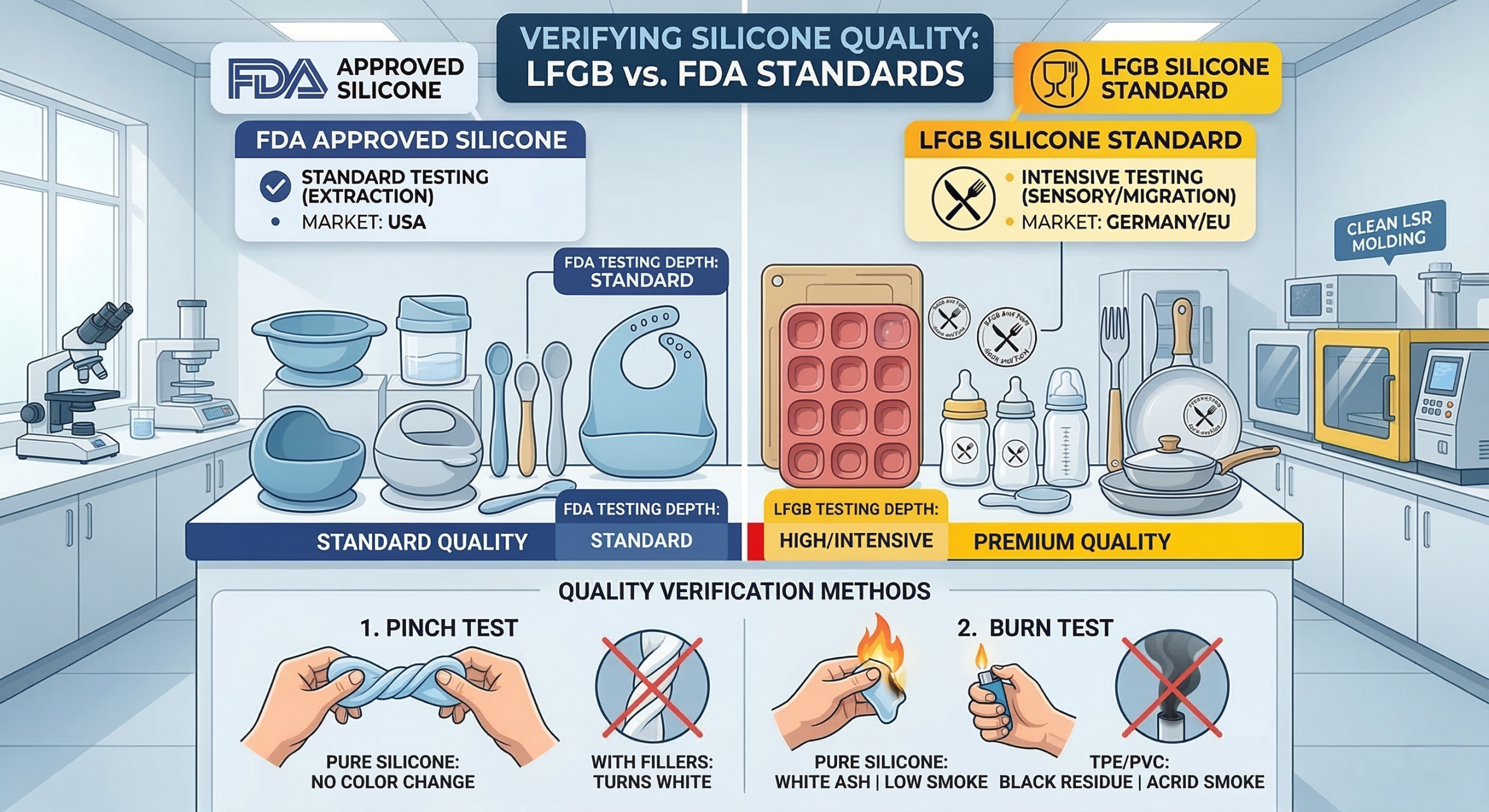
LFGB and FDA differ primarily in their testing intensity and the specific chemical limits allowed in the silicone material. While both ensure a product is safe, you must understand what is FDA approved silicone and how is it tested to see why LFGB is often preferred for high-end applications. LFGB requires more comprehensive sensory and migration tests than the standard American FDA process.
Is one stricter than the other?
Yes, the LFGB standard is widely recognized as being stricter than the FDA standard. While FDA testing focuses on extraction limits, LFGB adds rigorous tests for organoleptic properties, meaning the material cannot change the smell or taste of food.
- Stricter migration limits.
- Includes sensory (taste/smell) testing.
- Lower tolerance for volatile organic compounds.
- Mandatory for certain European markets.
Think about it: a product could pass FDA but still fail the more demanding LFGB protocols.
Key Takeaway: LFGB is the premium tier of food-grade silicone, offering stricter oversight than the standard FDA requirements.
| Feature | FDA Standard | LFGB Standard |
|---|---|---|
| Testing Depth | Standard | High / Intensive |
| Sensory Test | No | Yes |
| Primary Market | USA / International | Germany / France / EU |
Choosing between these depends largely on your target market and the quality level your brand aims to represent.
Is LFGB silicone worth the extra cost?
LFGB silicone is more expensive because it utilizes higher-purity raw materials and more complex manufacturing processes. When comparing this to What is FDA approved silicone and how is it tested?, manufacturers often find that the “platinum curing” process required for LFGB adds significant value. This investment results in a product that is more durable and completely free of odors.
Why is it more expensive?
The increased cost stems from the use of high-quality catalysts and the necesidad for longer “post-curing” times to remove volatile substances. This ensures the silicone meets the strict ppm (parts per million) limits required by German law.
- Use of platinum catalysts.
- Extended oven-curing times.
- Higher raw material costs.
- Reduced manufacturing speed.
It gets better: though the upfront cost is higher, the perceived quality of the finished product is vastly superior.
Key Takeaway: The higher price of LFGB silicone reflects its superior purity, durability, and compliance with the world’s toughest safety standards.
| Cost Factor | Impact on Price | Benefit |
|---|---|---|
| Platinum Curing | Higher | No odors or yellowing |
| Extended Baking | Higher | Removal of volatiles |
| Lab Testing | Higher | Strict safety compliance |
Investing in LFGB silicone is a strategic move for brands targeting the premium or European market segments.
Why is the pinch test so effective?
The pinch test is a simple, non-destructive way to check if a silicone product contains inexpensive plastic fillers. Even if you know what is FDA approved silicone and how is it tested, the pinch test provides a quick “field check” for purity. If you twist or pinch the silicone and it turns white, it indicates the presence of fillers like calcium carbonate.
How do you perform the test?
To perform the test, simply grab a piece of the silicone material and twist it or pinch it firmly between your fingers. Pure silicone will maintain its color, whereas “adulterated” silicone will show white streaks or a white base color through the stretch.
- Grip a flexible part of the product.
- Twist it 180 degrees.
- Look for any white coloration at the bend.
- Check thicker sections for more accurate results.
But wait, there’s more: this test is especially useful for thin items like silicone baby bibs.
Key Takeaway: The pinch test is a reliable indicator of silicone purity, as 100% pure silicone does not change color when stretched.
| Result | Indication |
|---|---|
| No Color Change | 100% Pure Silicone |
| White Streak/Color | Contains Fillers |
| Brittle Texture | Low Quality |
While not a lab-grade analysis, the pinch test is the most common way for consumers to verify material quality.
What does a burn test reveal about quality?
A burn test is a definitive method to distinguish real silicone from thermoplastic elastomers (TPE) or PVC. By understanding What is FDA approved silicone and how is it tested?, you can use this destructive test to confirm the chemical nature of the sample. Pure silicone burns into a white ash, whereas plastics usually melt and produce black, acrid smoke.
How do you identify silicone ash?
When you ignite a small sample of the material, observe the smoke color and the remaining residue. High-quality silicone produces very little smoke and leaves behind a fine, white, crumbly ash consisting mostly of silica.
- Snip a tiny, inconspicuous piece.
- Hold it with tweezers and ignite.
- Observe the smoke (should be light/white).
- Examine the ash (should be white).
Keep in mind that this test will damage the product, so use a small scrap.
Key Takeaway: A burn test provides chemical confirmation of silicone, as only pure silicone leaves behind a distinct white ash.
| Observation | Silicone | PVC / Plastic |
|---|---|---|
| Smoke Color | White/Light | Black/Dark |
| Odor | Mild/Inoffensive | Sharp/Chemical |
| Residue | White Ash | Black, melted blob |
The burn test is the ultimate “truth teller” when you suspect a material might not be silicone at all.
Does LFGB silicone use special curing?
LFGB-grade silicone almost exclusively utilizes platinum-based curing systems to ensure the highest purity levels. In contrast, when researching what is FDA approved silicone and how is it tested, you may find that some lower-grade FDA silicones use peroxide curing. Platinum curing does not produce the “blooming” or odor-causing byproducts associated with peroxide.
What is platinum-cured silicone?
Platinum-cured silicone uses a platinum catalyst to cross-link the polymer chains, resulting in a cleaner and more stable material. This process is essential for medical-grade and high-end food-grade products because it leaves no chemical residues.
- No byproducts (acid-free).
- Greater clarity and transparency.
- Excellent tensile strength.
- Superior heat stability.
In other words, it is the cleanest way to manufacture silicone.
Key Takeaway: Platinum curing is the preferred method for LFGB silicone because it eliminates the odors and impurities common in cheaper curing methods.
| Curing Type | Catalyst | Byproducts |
|---|---|---|
| Platinum | Platinum | None |
| Peroxide | Peroxide | Organic acids (odorous) |
Using platinum-cured silicone is a hallmark of premium products, such as custom baby teethers.
Are there specific tests for silicone resin?
Yes, LFGB protocols include specific tests for “volatile organic matter” in silicone resins that the FDA does not always require. When asking What is FDA approved silicone and how is it tested?, you will see that FDA focuses on total extractives, while LFGB specifically targets substances that could vaporize or migrate into food at high temperatures. These tests ensure the silicone is safe for oven use.
What is the volatile matter test?
This test involves heating the silicone to a high temperature for a set duration and measuring any weight loss. Excessive weight loss indicates that unreacted chemicals or low-molecular-weight silicones are gassing out, which is prohibited under LFGB.
- Sample is weighed before heating.
- Heated at 200°C for 4 hours.
- Weight loss must be below 0.5%.
- Ensures stability at cooking temperatures.
This is exactly why LFGB silicone is preferred for baking molds.
Key Takeaway: The volatile matter test is a critical differentiator for LFGB, ensuring the material remains stable under heat.
| Test Parameter | LFGB Limit | FDA Limit |
|---|---|---|
| Volatile Matter | < 0.5% | No specific limit |
| Peroxide Residue | Not allowed | Varies |
| Extractables | Very strict | Standard |
These rigorous checks ensure that even under intense kitchen use, no harmful vapors are released.
Why do some brands use fillers in silicone?
Brands often use fillers to reduce the cost of raw materials and increase the weight of the product. Even if a brand understands what is FDA approved silicone and how is it tested, they may cut corners to offer a more competitive price point. These fillers can compromise the flexibility, heat resistance, and safety of the silicone.
What are common silicone fillers?
The most common fillers are minerals like calcium carbonate (chalk) or silicates. While these are “non-toxic” in some contexts, they are not part of a pure silicone structure and can leach or degrade over time.
- Increases product weight.
- Lowers raw material cost.
- Decreases elasticity.
- May cause “whitening” when stretched.
The bottom line is that you get what you pay for in the silicone market.
Key Takeaway: Fillers are used primarily as a cost-saving measure but result in a less durable and potentially less safe product.
| Component | Pure Silicone | Silicone with Fillers |
|---|---|---|
| Flexibility | High | Reduced |
| Heat Resistance | Excellent | Variable |
| Manufacturing Cost | High | Low |
To maintain a reputation for quality, it is essential to source from manufacturers that guarantee 100% pure silicone.
How can you identify genuine LFGB products?
You can identify genuine LFGB products by looking for the “knife and fork” symbol and requesting a valid test report from the manufacturer. It is important to know What is FDA approved silicone and how is it tested? to distinguish it from the more rigorous LFGB documentation. A reputable supplier will always have up-to-date certification from accredited labs like SGS or TÜV.
Should you ask for a lab report?
Absolutely. A legitimate manufacturer will provide a деклараation of compliance or a laboratory test report specific to the product batch. This report will detail the specific tests conducted and the results achieved against the LFGB criteria.
- Verify the laboratory’s accreditation.
- Check the product name on the report.
- Look for the “Pass” status on migration tests.
- Ensure the report is recent (within 1-2 years).
Don’t just take their word for it; verify the paperwork.
Key Takeaway: Verification of LFGB status requires a combination of physical testing (pinch/burn) and reviewing official laboratory certifications.
| Verification Step | Purpose |
|---|---|
| Knife & Fork Logo | Market claim of safety |
| SGS/TÜV Report | Scientific proof of compliance |
| Physical Testing | Immediate on-site verification |
By insisting on these verifications, you protect your business from the risks associated with counterfeit materials.
How to choose the right silicone supplier?
Choosing the right supplier involves auditing their manufacturing capabilities, quality control processes, and commitment to international standards. You should understand what is FDA approved silicone and how is it tested before engaging a partner to ensure they can meet the specific needs of your market. A good partner will be transparent about their raw material sourcing and curing methods.
What should you look for in an OEM?
Look for a manufacturer with extensive experience in liquid silicone rubber (LSR) and compression molding. They should have a dedicated quality assurance team and a track record of producing goods for markets with high safety standards like the EU and USA.
- In-house testing capabilities.
- Certifications (ISO, LFGB, FDA).
- Clean production environment.
- Experience with custom silicone baby bowls.
Essentially, the best supplier is one that views quality as a non-negotiable standard rather than an optional add-on.
Key Takeaway: The ideal supplier combines technical expertise with a robust quality management system to deliver certified silicone products.
| Supplier Attribute | Why It Matters |
|---|---|
| Experience | Deep understanding of material behavior |
| Certification | Proof of adherence to global standards |
| Customization | Ability to meet specific design needs |
A partnership with a reliable manufacturer ensures your products remain safe, compliant, and competitive in the global marketplace.
Conclusion
Navigating the world of silicone certifications can be complex, but understanding the difference between FDA and LFGB is vital for any business committed to quality. While both standards ensure safety, LFGB represents a higher echelon of purity and performance, particularly for the European market. By utilizing simple tests like the pinch or burn method and demanding rigorous lab documentation, you can guarantee that your products meet the highest standards. We are dedicated to providing only the best materials for our clients. For premium, certified silicone solutions that protect your brand and your customers, contact us today.
FAQ
Can I use a microwave with LFGB silicone?
Yes, LFGB silicone is highly heat-resistant and safe for use in microwaves, often up to 230°C.
What’s the best way to clean silicone baby products?
The best way is to use mild soap and warm water, or place them in the top rack of a dishwasher.
Can I tell the difference between FDA and LFGB just by looking?
Visually they look similar, but LFGB (platinum-cured) is often more transparent and has no chemical odor compared to some FDA grades.
How do I know if my silicone is BPA-free?
True silicone is naturally BPA-free as it does not contain the chemicals used in polycarbonate plastics.
Can I use the pinch test on very thick silicone blocks?
The pinch test is less effective on very thick items; for those, a burn test or laboratory certification is more reliable.