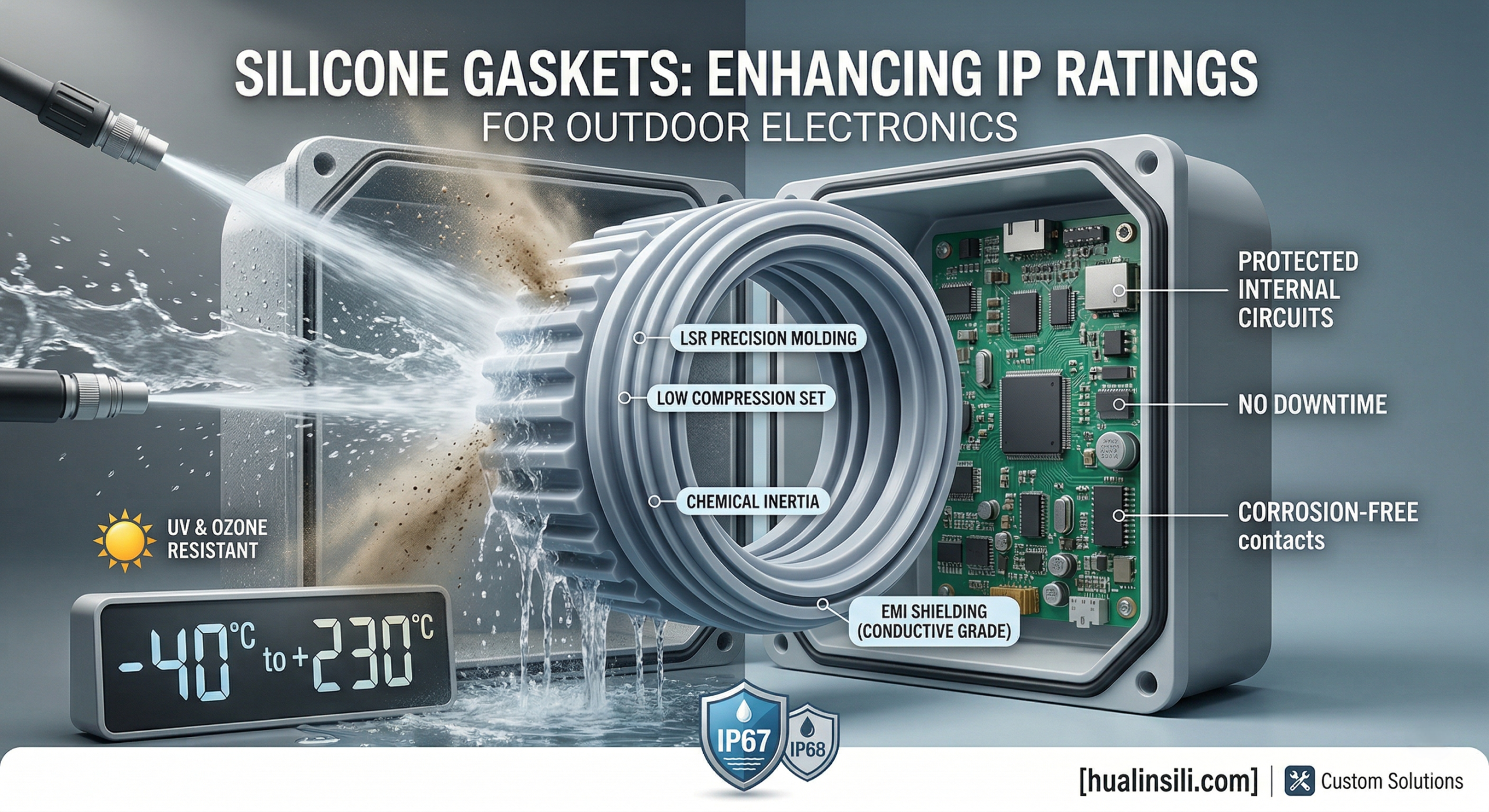
Outdoor enclosures for sensitive electronics face a constant threat from moisture, dust, and environmental stressors that can lead to catastrophic failure. If your seal fails, the internal circuitry corrodes, causing expensive system downtime and damaging your professional reputation with clients. Silicone gaskets improve IP ratings by creating a resilient, airtight barrier that remains flexible across extreme temperatures to prevent ingress. Utilizing high-quality Silicone Electrical Products ensures that your hardware meets the most demanding ingress protection standards. You can find out more about our capabilities at hualinsili.com.
What are IP ratings and why do they matter?
IP ratings represent the international standard for defining how effectively an enclosure blocks solids and liquids from entering. When you design outdoor hardware, these ratings determine where your Silicone Electrical Products can be safely deployed without risking internal damage.
How do digits indicate protection?
You need to understand that the two digits in an IP rating represent specific testing protocols for solids and liquids respectively. The first digit (0-6) measures dust and particle exclusion, while the second (0-9K) measures water resistance under various pressures.
Look:
- First Digit: 6 indicates a completely dust-tight seal.
- Second Digit: 7 or 8 indicates protection against temporary or continuous immersion.
- Testing: Standardized tests involve vacuum pressure and high-velocity water jets.
Is the seal the weakest link in your design?
Believe it or not, the mechanical joints of an enclosure are the most common points of failure for any ingress protection strategy. Without a high-performance gasket, even the strongest metal housing will leak at the seams under thermal stress.
But that’s not all:
- Gaskets must compensate for housing warpage.
- Material degradation over time creates micro-paths for water.
- Proper compression is required to maintain the hermetic barrier.
Key Takeaway: An IP rating is only as reliable as the gasket material used to seal the enclosure’s interface, making material selection a critical engineering decision.
| IP Rating | Dust Protection | Water Protection | Application |
|---|---|---|---|
| IP65 | Dust-Tight | Water Jets | General Outdoor |
| IP66 | Dust-Tight | Powerful Jets | Heavy Rain Areas |
| IP67 | Dust-Tight | Immersion (1m) | Flood-Prone Zones |
| IP68 | Dust-Tight | Continuous Immersion | Underwater/Submersible |
Properly identifying the required protection level allows you to optimize material costs while ensuring the safety of internal electronics.
Why is silicone superior to other elastomers?
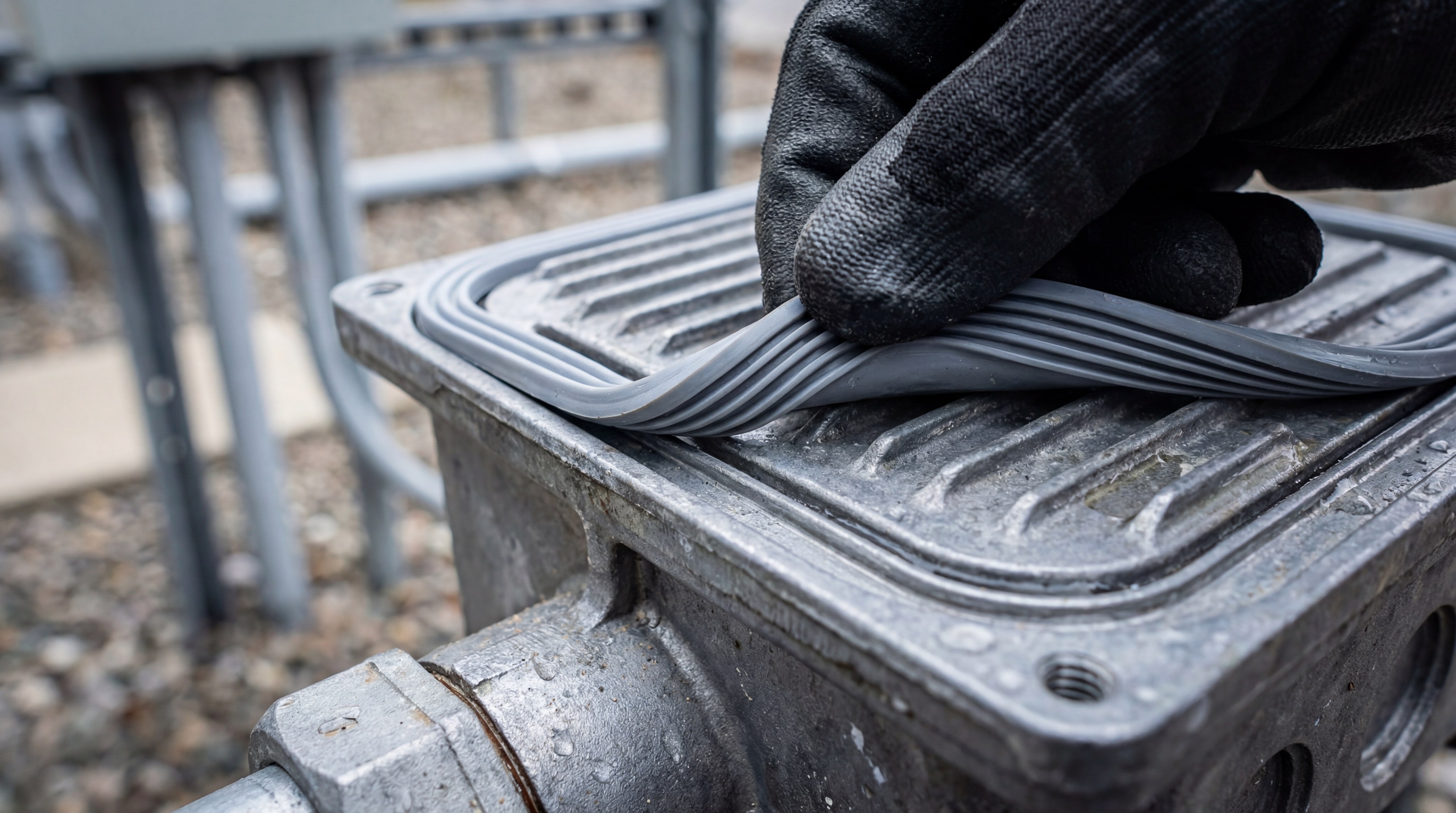
Silicone outperforms standard rubbers because it maintains its physical properties and sealing force across a much wider range of environmental conditions. By integrating Silicone Electrical Products into your assembly, you benefit from a material that does not become brittle or lose its shape under pressure.
Does material memory affect the seal?
You should consider that “compression set” is the ability of a gasket to return to its original thickness after being squeezed. Silicone has an incredibly low compression set, which means it keeps pushing back against the enclosure walls for years.
Here is the kicker:
- It prevents the formation of “leak paths” during mechanical shifts.
- The seal remains active even if the enclosure is opened and closed for maintenance.
- Resilience is maintained across thousands of compression cycles.
How does surface conformity prevent leaks?
Wait, there’s more; silicone is naturally soft and flexible, allowing it to flow into the microscopic imperfections of cast or machined surfaces. This intimate contact ensures that there are no gaps for capillary action to pull moisture into the device.
Check this out:
- Silicone adapts to uneven mating surfaces better than EPDM.
- It requires less closing force to achieve a watertight bond.
- The material fills voids caused by manufacturing tolerances in mold making.
Key Takeaway: The chemical structure of silicone provides a unique balance of softness and resilience that ensures a long-lasting, high-performance IP seal.
| Feature | Silicone Gaskets | Standard Rubber (EPDM) | Benefit |
|---|---|---|---|
| Compression Set | Very Low | Moderate to High | Long-term reliability |
| Surface Flow | Excellent | Average | Superior micro-sealing |
| Elastic Recovery | 95%+ | 70-80% | Maintains seal pressure |
The high recovery rate of silicone ensures that your enclosure remains protected even after significant vibration or impact.
How does silicone handle extreme temperatures?
Silicone remains functional and flexible at temperatures ranging from -40°C to over 230°C, ensuring the IP rating is never compromised by weather shifts. Your outdoor Silicone Electrical Products must survive both arctic freezes and scorching summer heat without cracking or melting.
What happens during thermal expansion?
You need to know that as outdoor enclosures heat up in the sun, the materials expand at different rates, putting massive stress on the seal. Silicone’s high elasticity allows it to stretch and compress without losing its bond to the housing surface.
Look:
- It manages the expansion/contraction cycle of aluminum and plastic.
- The material does not “tear” under thermal mechanical stress.
- Seal integrity is maintained during rapid temperature swings.
Can it survive arctic or desert heat?
Believe it or not, many common sealing materials turn into hard plastic in the cold or become sticky in the heat. Silicone remains a stable elastomer across the entire global climate spectrum, protecting your electronics in any geography.
Here is the deal:
- No embrittlement occurs at sub-zero temperatures.
- The material does not soften or “creep” at high operating temperatures.
- It provides consistent protection for LSR communication parts.
Key Takeaway: Thermal stability is the primary reason silicone is used for mission-critical outdoor sealing, as it eliminates weather-related seal failures.
| Temp Range | Silicone State | EPDM/Nitrile State | IP Rating Impact |
|---|---|---|---|
| -40°C | Flexible | Brittle/Cracking | Seal Maintained |
| 25°C | Optimal | Optimal | Seal Maintained |
| 100°C+ | Stable | Softening/Deforming | Seal Maintained |
The ability to remain functional in extreme environments reduces the risk of thermal-induced leaks in high-power electrical units.
Can silicone resist UV and ozone damage?
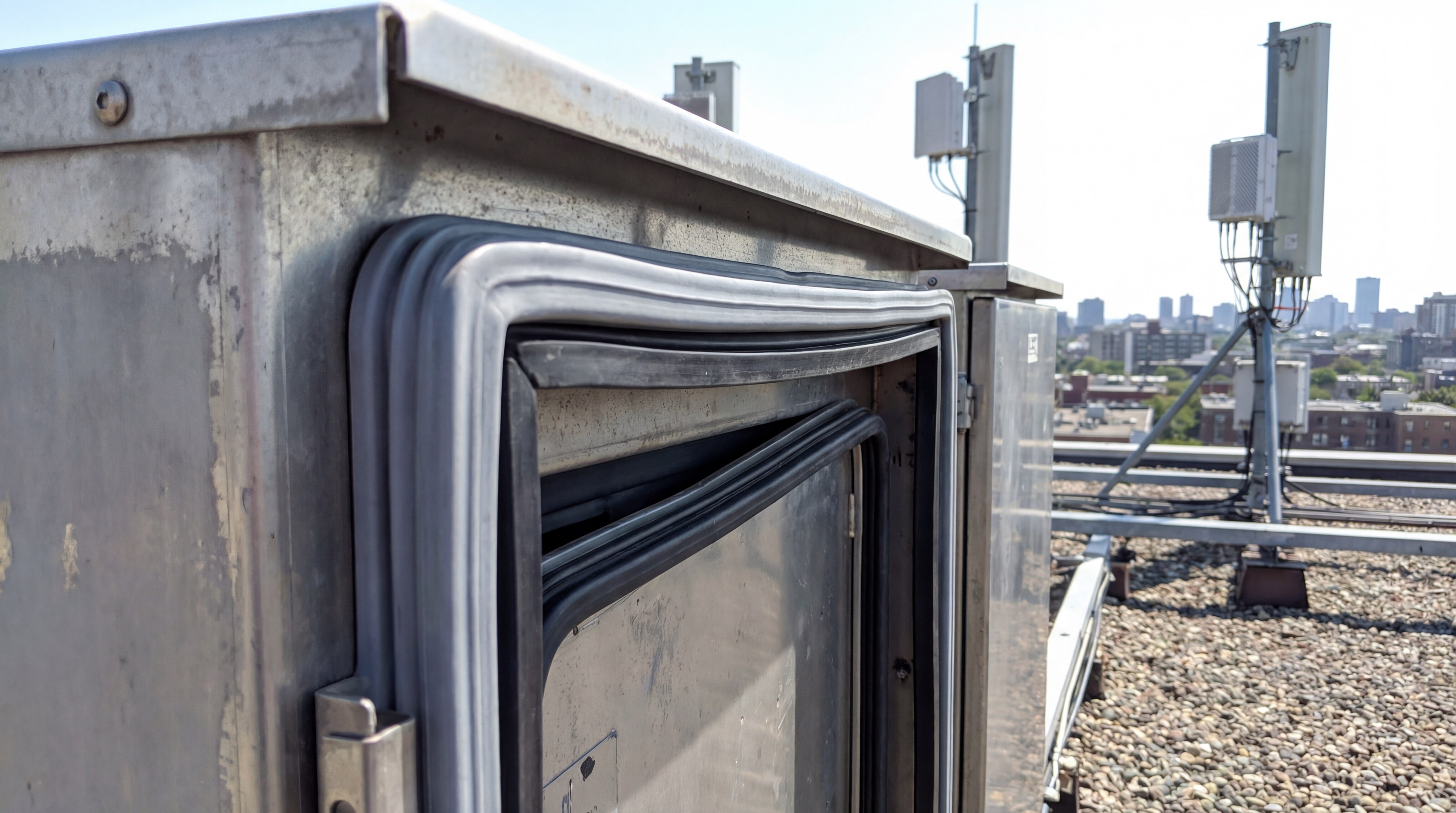
Unlike many organic rubbers, silicone is inherently resistant to ultraviolet radiation and ozone, preventing the surface cracking that leads to leaks. Choosing Silicone Electrical Products means your enclosure seals will not “chalk” or flake away even after decades of direct sunlight exposure.
Why do standard seals crack in the sun?
You might have noticed that old rubber seals often develop a web of tiny cracks when left outdoors for too long. This is due to UV rays breaking the carbon bonds in the material, a process that silicone’s inorganic backbone is largely immune to.
The result?
- No “dry rot” or structural thinning of the gasket.
- The material retains its original color and texture.
- Consistent sealing thickness is maintained over time.
How does silicone prevent seal embrittlement?
Wait, there’s more: ozone in the atmosphere attacks stressed rubber, but silicone remains chemically inert in most outdoor environments. This ensures that the gasket stays soft and pliable, which is essential for maintaining an IP67 or IP68 rating.
Think about it:
- It eliminates the need for expensive UV-protective coatings.
- The gasket remains functional for the entire product lifecycle.
- It resists the “ozone cracking” common in industrial zones.
Key Takeaway: UV and ozone resistance ensure that the physical barrier of your gasket does not degrade, keeping your IP rating intact for years.
| Environment | Silicone Durability | Standard Rubber | Failure Mode |
|---|---|---|---|
| Direct Sun | 20+ Years | 2-5 Years | Surface Cracking |
| Coastal Air | Excellent | Moderate | Salt Corrosion |
| Industrial Zone | Excellent | Poor | Ozone Attack |
Selecting a UV-stable material prevents the most common cause of long-term sealing failure in pole-mounted or rooftop equipment.
What is the benefit of low compression set?
Low compression set ensures that the gasket maintains a constant outward force against the sealing surface, even after years of being squeezed. Reliable Silicone Electrical Products depend on this property to ensure that the enclosure remains watertight after every maintenance cycle.
Will the gasket recover after opening?
You should realize that if a gasket stays “flat” after the enclosure is opened, it will not seal properly when the door is closed again. Silicone’s molecular structure acts like a spring, ensuring it recovers its shape to provide a fresh seal every time.
But that’s not all:
- It allows for frequent access to internal components.
- The seal is less sensitive to exact bolt torque values.
- It reduces the risk of human error during reassembly.
Does it prevent permanent deformation?
Here is the kicker: materials with high compression set eventually “take a set” and lose their ability to bridge gaps caused by vibration or pressure. Silicone stays active, filling the space even as parts move or settle over time.
Look:
- Constant sealing pressure is maintained for decades.
- It prevents the formation of permanent “flat spots” in the seal.
- It is ideal for high-vibration custom silicone solutions.
Key Takeaway: The elastic memory of silicone is what guarantees the long-term airtightness of an enclosure, regardless of how many times it is accessed.
| Material Property | Silicone | Foam Tapes | Benefit |
|---|---|---|---|
| Recovery Rate | High | Low | Multiple maintenance uses |
| Pressure Retention | Excellent | Poor | Prevents slow leaks |
| Gap Filling | Consistent | Variable | Reliable IP Protection |
Maintaining sealing pressure is the most important factor in preventing the ingress of fine dust particles and high-pressure moisture.
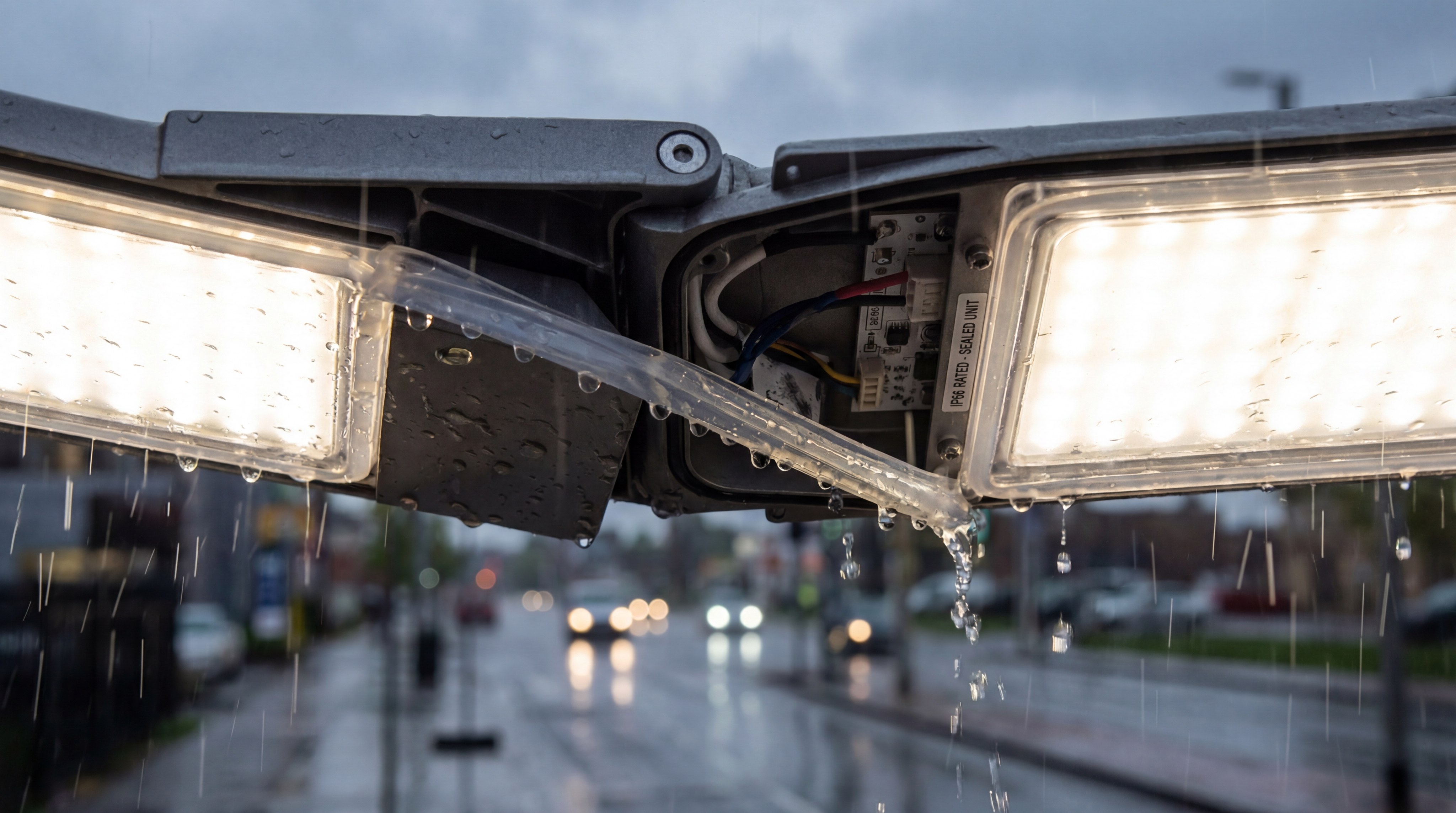
How do gaskets protect against salt and chemicals?
Silicone gaskets are chemically inert, meaning they do not react with salt spray or common industrial cleaning agents that can destroy other seals. Utilizing Silicone Electrical Products is essential for marine electronics or food processing equipment where corrosive substances are a daily reality.
Is it suitable for coastal environments?
Keep in mind that salt air is incredibly aggressive toward metal and rubber, but silicone acts as a non-reactive shield that keeps the salt out. This prevents the “wicking” of saline moisture into the enclosure, which could otherwise short out sensitive boards.
Believe it or not:
- Silicone passes rigorous 1000-hour salt spray tests.
- It does not allow salt crystals to embed in the material.
- The seal protects internal copper and silver contacts from corrosion.
Can it withstand industrial washdowns?
You should know that IP69K ratings require enclosures to withstand high-pressure, high-temperature cleaning with harsh detergents. Silicone remains stable during these “washdown” cycles, where standard gaskets would swell or degrade.
Wait, there’s more:
- It resists common oils, greases, and mild acids.
- The material is non-toxic and odor-free for sensitive areas.
- It maintains its seal during high-pressure jet cleaning.
Key Takeaway: Chemical resistance ensures that your IP rating holds up in specialized environments like chemical plants, offshore rigs, and kitchens.
| Substance | Silicone Resistance | Nitrile Resistance | Seal Life |
|---|---|---|---|
| Salt Water | Excellent | Good | 15+ Years |
| Detergents | Excellent | Moderate | 10+ Years |
| Engine Oils | Moderate | Excellent | Variable |
Choosing the right grade of silicone allows your product to survive in harsh chemical environments without compromising its waterproof status.
Does silicone provide EMI shielding for enclosures?
Conductive silicone gaskets can be engineered to block electromagnetic interference while simultaneously providing an IP-rated environmental seal. These specialized Silicone Electrical Products use metal fillers to create an electrical path across the enclosure seams.
What are conductive silicone gaskets?
You need to understand that by blending silver, nickel, or carbon particles into the silicone, engineers can create a material that conducts electricity. This allows the gasket to act as an extension of the enclosure’s metal Faraday cage to block RFI.
Look:
- It provides a dual-function environmental and EMI seal.
- The material maintains its flexibility despite the metal loading.
- It is essential for high-frequency communication hardware.
Can one part solve two problems?
But that’s not all; using a single conductive silicone gasket reduces the complexity of your design and the number of leak points in the housing. This “two-in-one” approach is the standard for military and aerospace outdoor enclosures.
The result?
- Reduced assembly time and lower total part count.
- Consistent shielding across a wide frequency range.
- Superior waterproofing for LSR molding components.
Key Takeaway: Conductive silicone allows for a streamlined design that meets both ingress protection and electromagnetic compatibility standards.
| Gasket Type | IP Protection | EMI Shielding | Best Use |
|---|---|---|---|
| Standard Silicone | Yes | No | General Lighting |
| Nickel-Graphite | Yes | High | Telecom / Industrial |
| Silver-Copper | Yes | Excellent | Military / Aerospace |
Integrating shielding into the gasket itself is the most efficient way to protect sensitive outdoor electronics from signal noise and moisture.
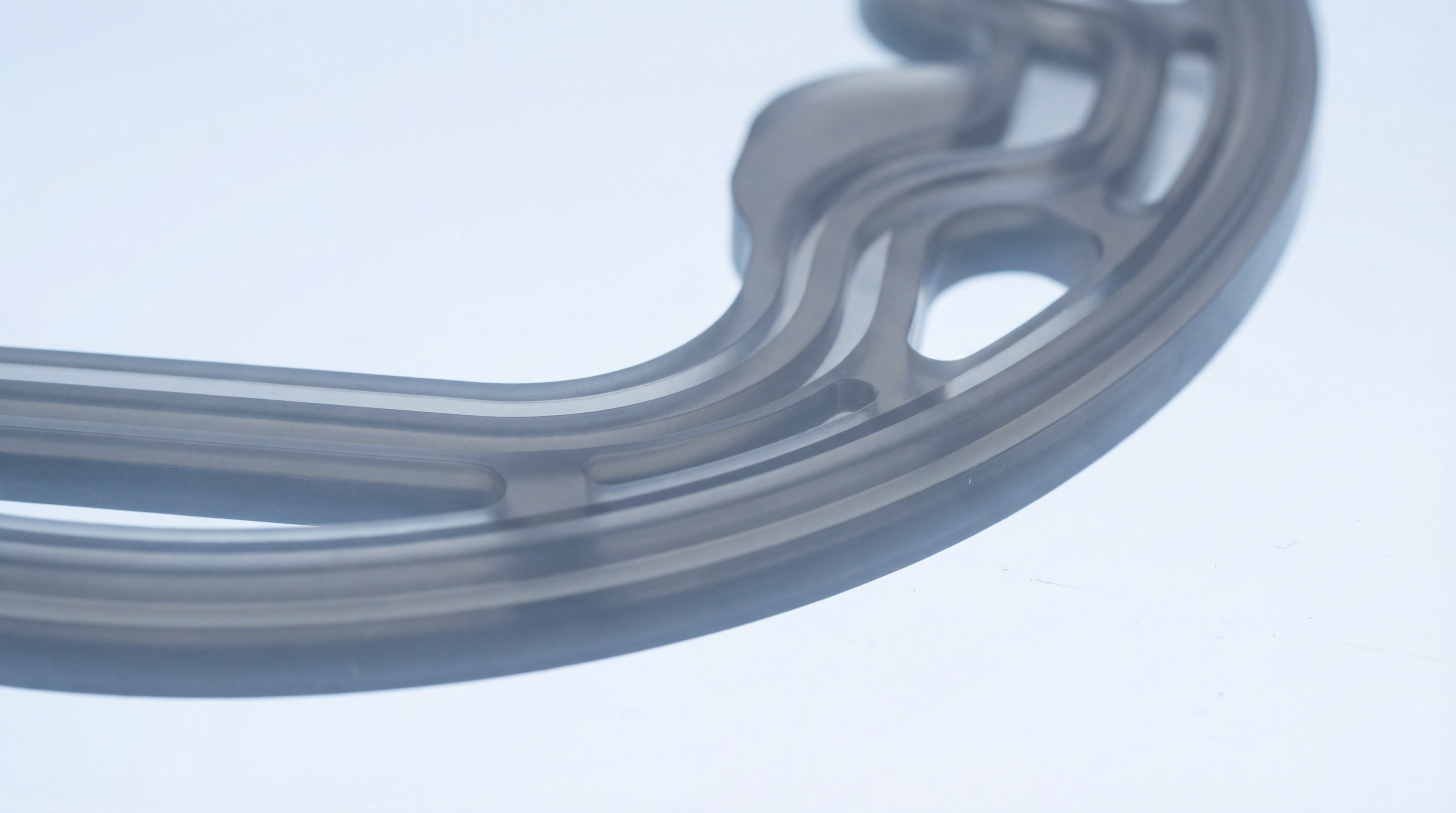
How does LSR molding enhance gasket precision?
Liquid Silicone Rubber (LSR) molding allows for the production of high-precision, complex gasket shapes that fit perfectly into intricate enclosure grooves. For top-tier Silicone Electrical Products, this manufacturing process ensures that every seal is consistent and free of defects.
Is liquid silicone better for complex shapes?
You should realize that LSR has a very low viscosity, which means it can flow into tiny, intricate mold details that traditional compression molding might miss. This allows for “ribbed” or “D-shape” profiles that create multiple sealing points for higher IP ratings.
Here is the deal:
- It supports flash-less and waste-free production.
- Thin-wall sections are easily achieved for compact designs.
- It enables overmolding directly onto enclosure parts.
How do tight tolerances improve IP?
Wait, there’s more: because LSR molding is a highly automated and precise process, the dimensional tolerances of the gaskets are incredibly tight. A more precise gasket means a more predictable seal and a higher likelihood of passing IP67 tests.
Think about it:
- Consistency across millions of production units.
- Eliminates the need for manual trimming or finishing.
- Reduces the risk of “leak points” caused by molding flash.
Key Takeaway: LSR molding is the preferred manufacturing method for high-performance gaskets where precision and reliability are non-negotiable.
| Process | Tolerance | Surface Finish | Complexity |
|---|---|---|---|
| LSR Molding | +/- 0.05mm | Mirror-Smooth | High |
| Compression | +/- 0.20mm | Standard | Moderate |
| Die-Cutting | +/- 0.50mm | Rough Edge | Low |
The precision of the LSR process directly translates into a more robust and reliable IP seal for high-value outdoor equipment.
What are common design pitfalls for outdoor seals?
Improper gasket compression or poor groove design can lead to seal failure even if the material choice is correct. When sourcing Silicone Electrical Products, you must ensure that your mechanical design supports the physical properties of the silicone.
How much compression is required?
You need to know that over-compressing a gasket can damage its internal structure, while under-compressing leaves gaps for moisture to enter. The “sweet spot” for silicone gaskets is typically between 25% and 40% of their original thickness.
Look:
- Too much pressure causes housing warpage and seal creep.
- Too little pressure fails the IP66 high-pressure jet test.
- Calibrated torque on fasteners is essential for even sealing.
Are seamless gaskets more reliable?
Believe it or not, gaskets made from spliced or glued strips are significantly more likely to leak at the joints under thermal stress. One-piece, molded gaskets provide a continuous perimeter that eliminates the weak points associated with manual splicing.
But that’s not all:
- Molded corners are stronger and more flexible.
- No adhesive is required to hold the gasket together.
- It simplifies the assembly process on the production line.
Key Takeaway: A successful IP rating depends as much on the mechanical design of the enclosure as it does on the quality of the silicone gasket.
| Design Pitfall | Consequence | Prevention |
|---|---|---|
| Over-Compression | Permanent Deformation | Use Compression Stops |
| Jointed Gaskets | Leak at Splicing Point | Use Molded O-Rings |
| Dirty Surfaces | Capillary Leakage | Clean with Alcohol |
Avoiding these common mistakes during the design phase will save significant time and money during the IP certification process.
Is silicone the most cost-effective long-term?
While silicone may have a higher upfront material cost than standard rubber, it significantly reduces the total cost of ownership by preventing product failures. High-quality Silicone Electrical Products pay for themselves through reduced warranty claims and longer maintenance intervals.
Does it reduce maintenance costs?
You should consider that every time a technician has to visit a remote outdoor site to repair a water-damaged unit, the costs skyrocket. Silicone gaskets ensure the unit stays dry the first time, eliminating the need for unscheduled service calls.
Wait, there’s more:
- No need for routine gasket replacements.
- Protects high-value internal components from corrosion.
- Reduces the liability risk of electrical shorts.
How does it impact product lifecycle?
Here is the kicker: in a world where product longevity is a competitive advantage, silicone seals ensure your equipment lasts for 15-20 years rather than 5. This builds trust with your B2B clients and increases the resale value of your hardware.
Check this out:
- Higher customer satisfaction and brand loyalty.
- Better performance in extreme, unmonitored environments.
- Compliance with green regulations and durability standards.
Key Takeaway: The “true cost” of a gasket includes the cost of failure; when you factor in reliability, silicone is the most economical choice.
| Cost Factor | Silicone Gasket | Cheap Foam Seal | Outcome |
|---|---|---|---|
| Material Cost | Moderate | Low | Higher Upfront |
| Warranty Rate | < 0.1% | 5-10% | Massive Savings |
| Lifespan | 20 Years | 3 Years | 6x ROI |
Investing in high-performance materials is the most effective way to protect your profit margins and ensure long-term product success.
Can I… FAQs about Silicone Gaskets and IP Ratings
- Can I achieve an IP68 rating with standard silicone?
Yes, silicone is ideal for IP68 because it maintains a hermetic seal under continuous water pressure, provided the enclosure design allows for proper compression and a seamless gasket profile. - What’s the best Shore A hardness for outdoor enclosure seals?
Typically, a Shore A hardness of 30 to 50 is best for outdoor seals. This range provides enough softness to conform to surfaces while maintaining the structural integrity needed to resist water jets. - Can I use silicone gaskets in areas with high oil exposure?
Standard silicone has moderate oil resistance, but for environments with constant fuel or oil contact, you should use fluorosilicone. It offers the same IP benefits as standard silicone with enhanced chemical resistance. - What’s the best way to prevent a gasket from falling out during assembly?
The best method is to design a “dovetail” or interference-fit groove that holds the gasket in place mechanically. Alternatively, you can use a pressure-sensitive adhesive (PSA) on one side of the gasket. - Can I overmold a silicone gasket directly onto my plastic housing?
Absolutely. This process, known as overmolding or 2K molding, creates a permanent chemical bond between the gasket and the housing, which eliminates assembly errors and ensures a perfect IP seal every time.
Secure Your Design Today
Achieving a high IP rating is not just about passing a lab test; it is about ensuring your product survives the unpredictable reality of the outdoors. Silicone gaskets provide the resilience, thermal stability, and UV resistance necessary to protect your electronics for decades. By choosing a partner with deep expertise in LSR and compression molding, you can eliminate the risks of moisture ingress and material failure. Don’t leave your product’s reputation to chance—contact us today to discuss your custom sealing requirements and get a quote for your next project.