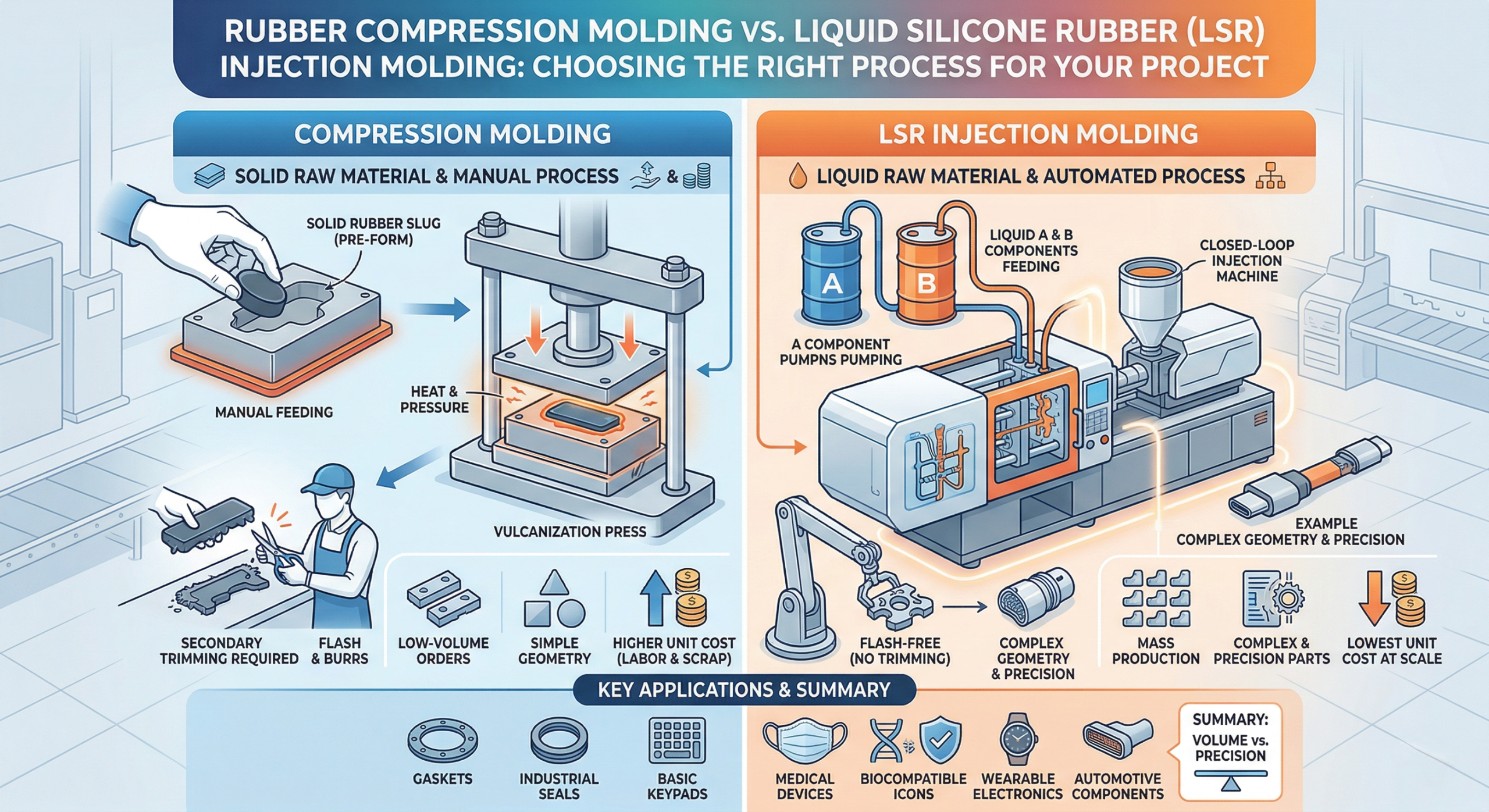
The right choice between rubber compression molding and LSR injection molding depends entirely on your project’s volume, precision needs, and budget. It is easy to struggle with defective parts when choosing the wrong manufacturing method. Your mass production gets delayed, and you face mounting costs due to material waste and inconsistent quality. Here is an easy way to eliminate those headaches by selecting the perfect molding technique. By understanding the core benefits of LSR Injection Molding, you can easily optimize your production line for maximum efficiency.
What Sets Compression and LSR Injection Molding Apart?
Compression molding relies on heat and pressure to cure solid rubber, while LSR Injection Molding injects liquid silicone into closed cavities. If you need tight tolerances, LSR Injection Molding provides unmatched consistency for complex geometries. Compression techniques are generally better suited for simpler, lower-volume parts with less stringent dimensional requirements. Choosing between them dictates your overall production timeline and unit economics.
Both processes have distinct advantages depending on your specific industry applications. Medical and automotive sectors often dictate strict compliance standards that influence this choice heavily. You must evaluate your long-term goals before committing to tooling.
Understanding the Basic Mechanics
Here’s the deal: the physical state of the raw material changes everything about the production line. Liquid silicone flows naturally into microscopic mold details, ensuring a flawless finish. Solid silicone requires manual placement, which introduces human error. This fundamental difference affects your bottom line directly.
To clarify the mechanics, consider these critical operational differences:
- Raw material feeding is automated in injection setups.
- Curing times are drastically shorter for liquid materials.
- Labor costs drop when manual material placement is eliminated.
Which Material Fits Your Needs?
When evaluating these methods, you have to look closely at your performance requirements. High-end wearables demand the soft touch and biocompatibility found in liquid silicone. Industrial seals might only need the durable nature of traditional solid rubber.
Key Takeaway: You must align your material selection with your product’s end-use environment to ensure long-term durability. Liquid options offer superior consistency, but solid rubber remains viable for basic applications.
| Feature | Compression Molding | LSR Injection Molding |
| Material State | Solid | Liquid |
| Precision Level | Moderate | Extremely High |
| Labor Intensity | High | Low |
This comparison highlights why automated liquid processes dominate high-precision manufacturing.
Why Is LSR Injection Molding a Manufacturing Game-Changer?
LSR Injection Molding is a game-changer because it allows for fully automated, flash-free production at incredible speeds. When you utilize LSR Injection Molding, you virtually eliminate secondary trimming operations that slow down traditional manufacturing. This efficiency translates directly into lower per-part costs for massive production runs. Your supply chain becomes more predictable when human error is removed from the equation.
Modern consumers expect flawless aesthetics and reliable performance from their devices. Traditional methods struggle to meet these high expectations without significant manual intervention. The shift toward liquid processes addresses these modern demands seamlessly.
Why Precision Matters Most?
You might be wondering: why do top electronics brands insist on liquid silicone? The answer lies in the microscopic tolerances required for waterproofing components like Type-C connectors. Even a fraction of a millimeter of flash can ruin an IP68 waterproof rating.
Here are the main reasons precision is non-negotiable:
- Prevents costly product recalls due to component failure.
- Ensures seamless assembly in tight consumer electronic housings.
- Maintains strict aesthetic standards for premium brand perception.
Delivering Complex Geometries
Creating intricate designs with undercuts or micro-features is nearly impossible with solid rubber. Liquid silicone flows effortlessly into the most complex mold cavities without leaving voids. This capability empowers your engineering team to design without traditional manufacturing constraints.
Key Takeaway: You can confidently design highly complex, miniature parts knowing that liquid injection will reproduce every detail perfectly. This design freedom accelerates your time-to-market for innovative products.
| Capability | Solid Rubber | Liquid Silicone |
| Flash Rate | High | Near Zero |
| Design Complexity | Limited | Unlimited |
| Trimming Required | Yes | Rarely |
The dramatic reduction in secondary trimming operations solidifies the financial advantage of liquid systems.
How Does LSR Injection Molding Benefit Medical Devices?
LSR Injection Molding benefits medical devices by providing unparalleled biocompatibility and sterilization resilience. Incorporating LSR Injection Molding into your medical supply chain ensures compliance with strict ISO 13485 standards. The closed-loop system prevents contamination, which is critical for respiratory masks and surgical tools. Your medical products will safely withstand repeated autoclave cycles without degrading.
Regulatory bodies demand absolute traceability and hygienic manufacturing environments. The automated nature of liquid injection minimizes human contact, creating a cleaner production process. This sterile approach is essential for modern healthcare applications.
Exploring Biocompatibility Features
What’s the real story? Not all silicones are safe for prolonged skin or internal contact. Medical-grade liquid silicone is inherently pure, resisting bacterial growth and remaining hypoallergenic. This makes it the ultimate choice for wearable health monitors and infant care products.
Consider these vital medical material benefits:
- Passes stringent FDA and CE biocompatibility testing.
- Resists harsh chemical disinfectants and UV sterilization.
- Maintains flexibility and comfort against human skin.
Meeting Strict FDA Standards
Passing FDA audits requires consistent, documented production processes. The precision control of liquid injection machines ensures that every batch meets identical chemical and physical specifications. You avoid the batch-to-batch variations commonly seen in manual mixing.
Key Takeaway: You protect your brand and your end-users by choosing a manufacturing process that guarantees medical-grade purity and consistency. Investing in liquid silicone reduces regulatory friction and accelerates product approvals.
| Requirement | Manual Mixing | Closed-Loop LSR |
| Contamination Risk | High | Extremely Low |
| FDA Compliance | Difficult | Streamlined |
| Batch Consistency | Variable | Identical |
A closed-loop system acts as a built-in safeguard against costly contamination events in medical manufacturing.
Can Compression Molding Compete With LSR Injection Molding?
Compression molding competes well for low-volume orders and extremely oversized parts where tooling costs must remain low. While LSR Injection Molding dominates precision work, compression vulcanization is still highly effective for standard gaskets and basic keypads. If your project lacks complex undercuts and requires rapid prototyping, compression molds are cheaper and faster to produce. You must weigh the upfront tooling savings against higher per-part labor costs.
Many legacy products still rely on solid rubber because the original molds are already paid for. Transitioning to a new method isn’t always financially viable for products nearing the end of their lifecycle. Both methods coexist successfully in modern factories.
When to Choose Solid Silicone?
Ready for the good part? You can save thousands of dollars on tooling if your design is simple. Heavy-duty industrial seals often do not require the microscopic perfection of liquid injection. In these scenarios, solid rubber delivers the necessary durability at a fraction of the initial cost.
Here is when solid rubber makes the most sense:
- Production volumes are under 10,000 units.
- Part dimensions are extremely large or thick.
- Cosmetic perfection is not a strict requirement.
Handling Large Production Runs
Once your production scales into the millions, the math flips entirely. The slow cycle times and high scrap rates of compression methods quickly erase any initial tooling savings. Liquid injection machines run continuously with minimal supervision, driving costs down at scale.
Key Takeaway: You should strategically leverage compression techniques for prototyping and low volumes, but transition to automated injection when scaling up. Understanding your projected volume is the key to maximizing profitability.
| Production Scale | Recommended Method | Upfront Cost |
| Under 10k Units | Compression | Low |
| 100k+ Units | LSR Injection | High |
| Oversized Parts | Compression | Low |
Analyzing your projected annual volume prevents you from overspending on unnecessary precision tooling.
How Does Automation Cut LSR Injection Molding Costs?
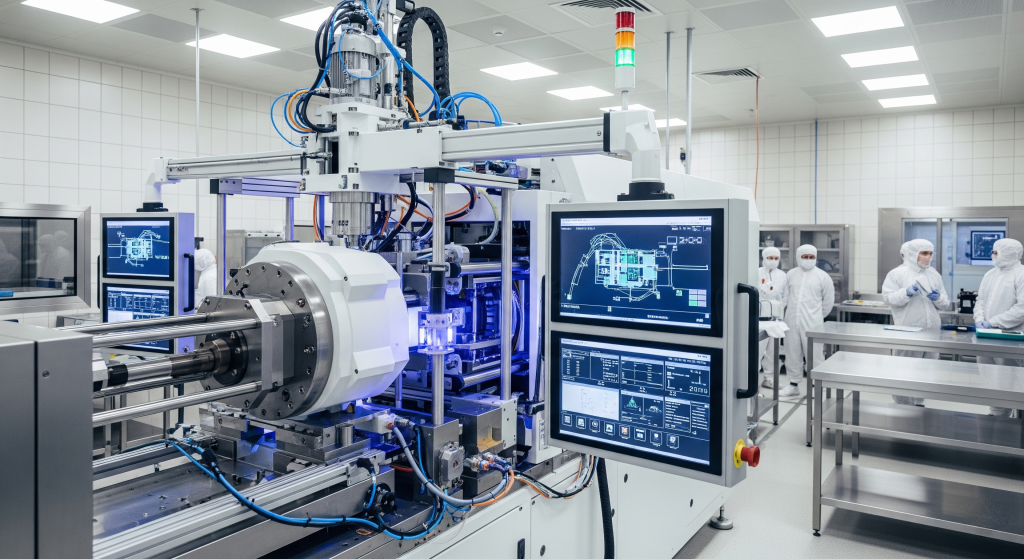
Automation cuts costs by eliminating the manual labor needed for material weighing, placement, and demolding. Integrating LSR Injection Molding with robotic extraction ensures continuous 24/7 production without human fatigue. You stop paying for the labor hours previously wasted on trimming flash and inspecting manual defects. This streamlined workflow dramatically lowers the total cost of ownership for high-volume orders.
Labor shortages and rising wages make manual manufacturing increasingly risky and expensive. By investing in automated equipment, factories stabilize their pricing models. You benefit from predictable pricing regardless of global labor market fluctuations.
Reducing Manual Labor Needs
This is where it gets interesting… one technician can operate multiple automated injection machines simultaneously. The liquid material is pumped directly from drums into the mold, completely bypassing the manual mixing room. This efficiency drastically reduces your dependency on a large workforce.
Automation provides several distinct labor advantages:
- Eliminates the physical strain of loading heavy solid rubber.
- Removes the need for dedicated trimming personnel.
- Reduces human error and associated scrap material costs.
Ensuring Consistent Quality
Automated sensors monitor temperature, pressure, and injection speed in real-time. If a parameter drifts, the machine adjusts instantly, ensuring every part is identical. You avoid the hidden costs of sorting through mixed batches of good and defective parts.
Key Takeaway: You unlock massive long-term savings by choosing a highly automated production partner. Your unit price drops significantly because you are paying for machine efficiency rather than manual labor hours.
| Cost Factor | Manual Process | Automated LSR |
| Labor Dependency | High | Minimal |
| Scrap Rate | 5% – 10% | < 1% |
| 24/7 Capability | No | Yes |
Transitioning to automated systems fundamentally protects your profit margins against rising global labor costs.
Which Has Faster Cycle Times: Compression or LSR Injection Molding?
LSR injection processes boast significantly faster cycle times due to rapid platinum curing mechanics. Unlike solid rubber, LSR Injection Molding utilizes liquid materials that cure in seconds upon hitting the heated mold. You can manufacture thousands of parts per hour, vastly outpacing traditional hydraulic presses. This rapid output is essential when facing tight time-to-market deadlines for consumer electronics.
Solid rubber requires time to absorb heat and flow manually into the cavity shape. The vulcanization process for thick solid parts can take several minutes per cycle. These delays bottleneck your entire supply chain during peak demand seasons.
Analyzing Production Speed
Here’s the kicker… a single injection cycle can finish before a compression operator has even finished loading their mold. The rapid cross-linking chemistry of liquid silicone reacts almost instantly to high temperatures. This speed is a massive competitive advantage for your inventory management.
Faster cycle times impact your business in several ways:
- Reduces the total number of molds needed for mass production.
- Enables rapid replenishment of depleted warehouse stock.
- Lowers the energy consumption per unit manufactured.
Why Faster Curing Matters?
When a product goes viral, you need a supply chain that can react immediately. Slow manufacturing processes force you to rely on expensive air freight to catch up. Rapid injection cycles give you the agility to fulfill unexpected spikes in customer demand.
Key Takeaway: You should specify liquid injection when your business model relies on speed and agility. Shorter cycles mean you can hit the market faster and capture revenue before your competitors.
| Metric | Compression | LSR Injection |
| Average Cycle Time | 2 – 5 Minutes | 20 – 60 Seconds |
| Output Speed | Slow | Extremely Fast |
| Agility | Low | High |
Maximizing cycle speed directly correlates with improved cash flow and reduced inventory holding costs.
Does LSR Injection Molding Offer Better Heat Resistance?
Liquid silicone exhibits exceptional thermal stability, performing flawlessly in extreme temperature fluctuations. Leveraging LSR Injection Molding guarantees that your automotive or industrial components will not degrade under the hood. You can expose these parts to freezing arctic conditions or scorching engine heat without losing flexibility. Compression-molded solid rubber also offers good resistance, but liquid variations often provide superior long-term elasticity.
Engineers frequently face challenges when designing seals for harsh mechanical environments. The material must maintain its compressive force without taking a permanent set over time. Liquid silicone excels at retaining its original shape after severe thermal stress.
Testing Extreme Temperatures
Look at it this way: a failed seal in an automotive battery pack can lead to catastrophic consequences. Liquid silicone maintains its mechanical integrity from -60°C up to 250°C continuously. This immense temperature window makes it the default choice for aerospace and electric vehicle applications.
Thermal stability offers critical engineering benefits:
- Prevents cracking and embrittlement in freezing climates.
- Stops melting or deformation near high-heat engines.
- Maintains watertight sealing properties during thermal expansion.
Chemical Exposure Reliability
Beyond heat, these components often face exposure to oils, coolants, and harsh cleaning agents. The dense cross-linking of injected silicone provides a robust barrier against chemical degradation. Your products will survive rigorous industrial cleaning protocols without breaking down.
Key Takeaway: You can confidently specify liquid silicone for your most demanding environmental applications. Its unmatched ability to survive thermal shock and chemical exposure guarantees a longer lifespan for your end product.
| Environment | Solid Silicone | Liquid Silicone |
| High Heat (250°C) | Good | Excellent |
| Freezing (-60°C) | Good | Excellent |
| Chemical Barrier | Moderate | Superior |
Superior environmental resistance significantly lowers the long-term warranty and replacement costs for your products.
Why Is Flash-Free LSR Injection Molding Vital for Electronics?
Flash-free manufacturing ensures that sensitive electronic assemblies fit perfectly without manual reworking. LSR Injection Molding utilizes highly precise CNC-machined tools that prevent material from leaking out of the cavities. You avoid the microscopic burrs and flash that routinely plague traditional compression methods. For smartwatches and earbuds, this pristine finish is non-negotiable for both aesthetics and waterproofing.
Consumer electronics rely on incredibly tight internal tolerances to save space. Even a 0.1mm burr on a silicone seal can prevent a device casing from closing properly. The flash-free nature of injection processes guarantees a perfect fit right out of the mold.
Eliminating Defect Rates
What’s the catch? Achieving a flash-free result requires a substantial upfront investment in premium tooling. However, eliminating post-processing trims means your defect rate plummets to near zero. You never have to worry about a worker accidentally cutting into the actual part while trimming flash.
Flash-free production provides immediate assembly benefits:
- Speeds up downstream assembly lines dramatically.
- Guarantees IP68 water resistance without fail.
- Enhances the premium feel of the final product.
Waterproofing Smart Wearables
Wearable technology is exposed to sweat, rain, and submersion daily. The seals protecting the internal batteries must be utterly flawless to prevent short circuits. Injected liquid silicone creates a seamless, impenetrable barrier that solid rubber simply cannot match.
Key Takeaway: You must insist on flash-free injection molding if your product requires strict waterproofing or premium aesthetics. Eliminating manual trimming is the only way to achieve true consistency in electronic sealing.
| Feature | Compression | LSR Injection |
| Flash Presence | Common | Almost None |
| Trimming Risk | High | N/A |
| Waterproofing | Inconsistent | Highly Reliable |
Investing in flash-free technology directly protects the structural integrity and brand reputation of your electronic devices.
How Do Tooling Costs Compare in LSR Injection Molding?
Tooling for liquid systems is significantly more expensive due to the cold-runner systems and extreme precision required. However, LSR Injection Molding tools are built from hardened steel and last for millions of cycles. You must view this as a long-term capital investment rather than a short-term prototyping expense. Compression molds are cheaper initially, but they wear out faster and require frequent replacement.
Your procurement team must analyze the total cost of ownership over the product’s entire lifespan. Focusing solely on the initial tooling invoice often leads to poor long-term financial decisions. High-volume runs quickly amortize the higher cost of premium injection tools.
Upfront Mold Investments
But here’s the kicker… a premium injection mold can cost three to five times more than a basic compression mold. The complexity of vacuum systems, cooling channels, and tight tolerances drives this price up. This high barrier to entry can be daunting for startups with limited initial capital.
Consider these factors influencing tool pricing:
- Cold runner systems reduce material waste but cost more to build.
- Hardened steel extends mold life but requires expensive CNC machining.
- Automated demolding features add mechanical complexity to the tool.
Long-Term ROI Explained
Once production exceeds a hundred thousand units, the premium tool pays for itself. The elimination of material waste, zero manual trimming, and rapid cycle times create massive daily savings. Your cost per part drops so low that the initial tool price becomes mathematically irrelevant.
Key Takeaway: You should secure funding for high-quality injection tooling if your project is destined for mass market success. The long-term savings in labor and scrap will completely eclipse the steep initial setup costs.
| Tooling Aspect | Compression Mold | Injection Mold |
| Initial Cost | Lower | Significantly Higher |
| Mold Lifespan | ~100k Cycles | 1 Million+ Cycles |
| Part Unit Cost | Higher | Very Low |
A thorough break-even analysis will prove that premium tooling is a highly profitable asset for high-volume manufacturing.
How to Choose Between Compression and LSR Injection Molding?
Choosing between these methods requires a careful analysis of your volume, geometry, and material needs. LSR Injection Molding is the undisputed champion for high-volume, high-precision, and automated medical or electronic parts. Conversely, compression techniques remain the smartest choice for low-volume industrial gaskets or massive rubber components. You must involve your manufacturing partner early in the design phase to make the right choice.
Engineers sometimes over-engineer a simple part, driving up costs unnecessarily. It is crucial to match the manufacturing technology to the actual functional requirements of the component. A transparent discussion with your supplier will reveal the most cost-effective path forward.
Assessing Your Project Needs
Truth be told, there is no one-size-fits-all answer in rubber manufacturing. You have to audit your project’s lifecycle, from initial funding to expected peak annual sales. If you project a slow start, you might begin with compression and transition later.
Evaluate these key parameters before deciding:
- Calculate your realistic annual production volume.
- Determine the necessary tolerance limits for your assembly.
- Assess the regulatory and biocompatibility requirements.
Finalizing Your Decision
Once you weigh the initial budget against the long-term unit cost, the decision becomes mathematically clear. Fast-moving consumer goods demand the speed and automation of liquid systems. Niche industrial replacements thrive on the low-cost tooling of traditional presses.
Key Takeaway: You can guarantee project success by aligning your manufacturing method with your business strategy. Trusting a full-service partner who offers both technologies ensures you receive unbiased, profitable advice.
| Project Profile | Recommended Process | Primary Benefit |
| High Volume / Complex | LSR Injection | Lowest Unit Cost |
| Low Volume / Simple | Compression | Lowest Tool Cost |
| Medical / Wearables | LSR Injection | Purity & Precision |
Selecting the correct molding process aligns your engineering reality with your financial objectives seamlessly.
Rubber Compression Molding vs. Liquid Injection Molding: Which One is Right for Your Project?
Both molding techniques offer unique advantages, but liquid silicone clearly dominates the high-volume, precision manufacturing landscape. By evaluating your production scale and geometric complexity, you can dramatically lower your unit costs and improve product quality. Whether you need medical-grade purity or flash-free electronic seals, automation is the key to scaling successfully. We understand how daunting material selection can be, which is why our integrated factory provides tailored engineering support. If you are ready to optimize your next production run, contact us today to see how our expertise can elevate your brand. We strive to be your ultimate production partner, turning complex engineering challenges into flawless realities.
FAQ
Q1: Can I use compression molding for highly complex part designs?
No, it is generally not recommended for complex parts. Solid rubber does not flow easily into intricate mold cavities or undercuts, which often results in incomplete fills and high defect rates.
Q2: What’s the best way to reduce my per-part manufacturing costs?
Transitioning to an automated liquid injection system is the best approach. While the initial mold is expensive, the elimination of manual labor and faster cycle times drastically reduces the cost per unit at high volumes.
Q3: How do I know if I need medical-grade liquid silicone?
You need it if your product involves prolonged skin contact, bodily fluid exposure, or requires frequent sterilization. Liquid silicone is inherently pure, hypoallergenic, and passes strict FDA and ISO 13485 biocompatibility tests seamlessly.
Q4: Can I switch from compression to injection molding later?
Yes, but you will need to invest in entirely new tooling. Injection machines require specialized cold-runner molds that are completely different from traditional heated compression presses, so plan your budget accordingly.
Q5: What’s the best method to avoid flash and burrs on my products?
Liquid injection molding is the optimal choice for flash-free results. The liquid material is injected into highly precise closed cavities under immense pressure, preventing material leakage and eliminating the need for manual trimming.