Understanding industrial silicone and traditional rubbers involves comparing their chemical foundations, thermal limits, and environmental resistances to determine which material ensures your project’s long-term reliability. You are likely designing a high-performance component, but you are unsure if a standard elastomer will survive the harsh operating environment of your specific application. Choosing the wrong material leads to premature sealing failure, costly maintenance downtime, and compromised brand reputation for your company. Fortunately, analyzing Silicone vs Rubber: What’s the Difference for Industrial Buyers provides the technical clarity needed to optimize your production and reduce supply chain risks.
What is the primary difference in chemical structure?
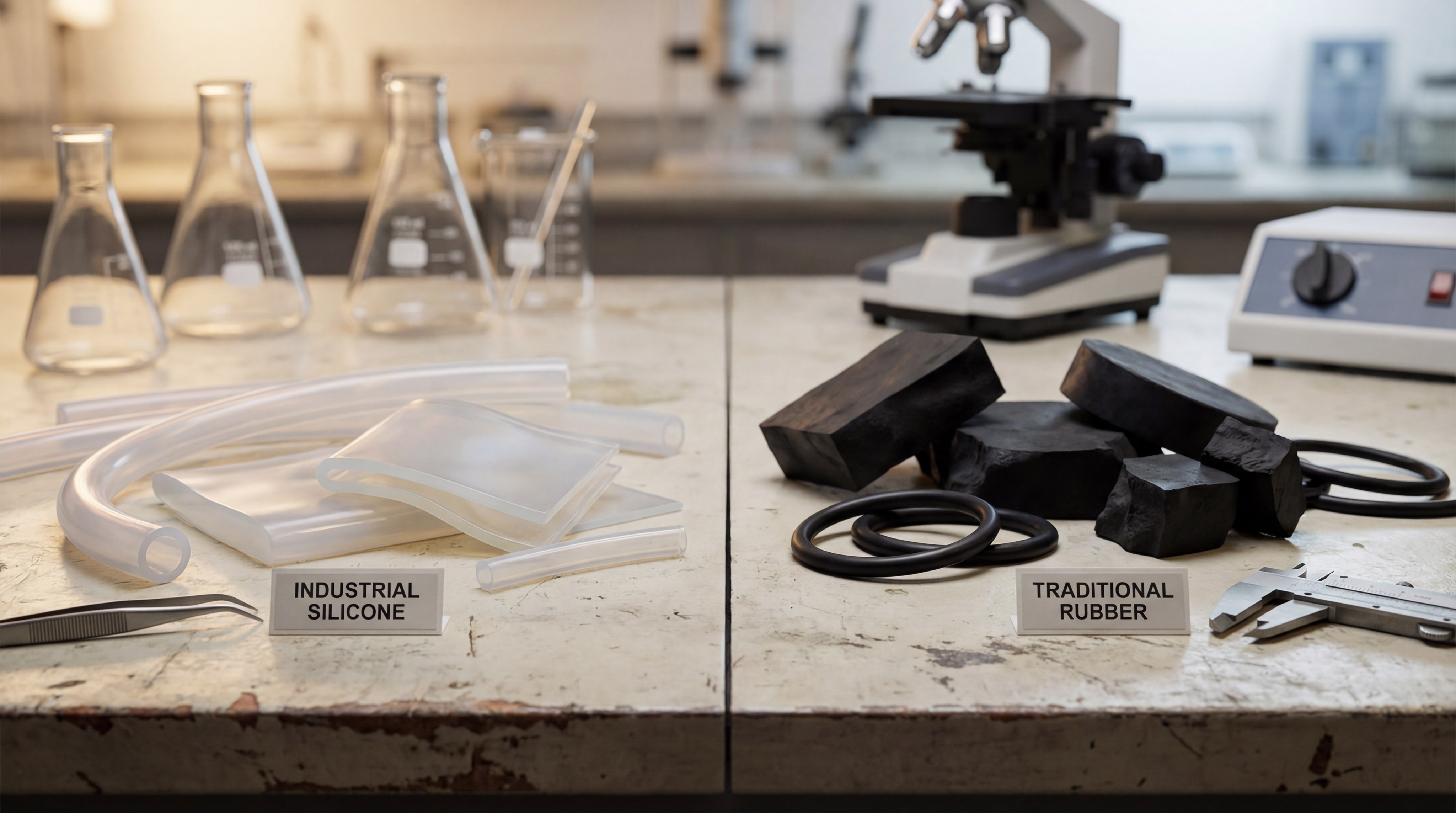
Industrial silicone features a silicon-oxygen backbone, whereas traditional rubbers are carbon-based organic polymers derived from petroleum or latex. Silicone vs Rubber: What’s the Difference for Industrial Buyers begins at the molecular level, where the Si-O bond provides much higher thermal stability than the C-C bonds found in NBR or EPDM.
Why does the molecular backbone affect your performance?
The inorganic nature of the silicone chain makes it more resistant to heat and oxygen. However, traditional rubbers rely on carbon chains that are more susceptible to oxidation and UV degradation.
But wait, there is more:
- Silicone: Inorganic Si-O backbone, highly stable.
- Natural Rubber: Organic C-C backbone, highly elastic but degradable.
- EPDM: Saturated carbon backbone, good for weather but poor for oil.
Key Takeaway: The chemical foundation dictates how your part reacts to heat, light, and aging.
| Material | Backbone Type | Primary Advantage |
|---|---|---|
| Silicone | Inorganic (Si-O) | Extreme Temperature Stability |
| Traditional Rubber | Organic (C-C) | High Mechanical Strength |
This structural disparity is the fundamental reason why silicone survives where organic rubbers melt or crack.
How do they perform under extreme temperatures?
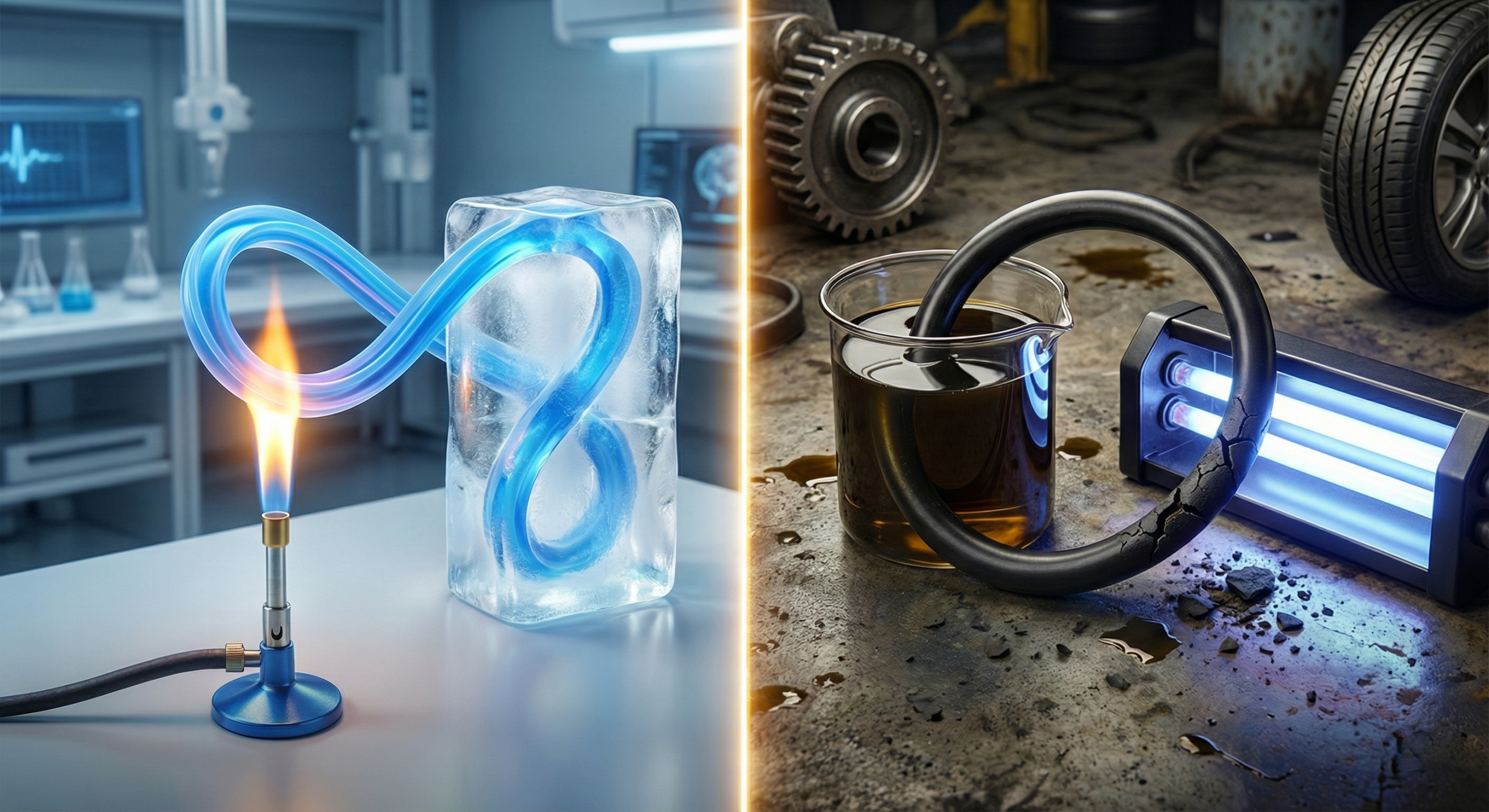
Silicone maintains its physical properties from -60°C to +230°C, significantly outperforming traditional rubbers in both heat and cold. Silicone vs Rubber: What’s the Difference for Industrial Buyers is most evident when your parts must remain flexible in a freezer or stable in an industrial oven.
Will your seals fail in high-heat environments?
Most traditional rubbers like Nitrile or Natural Rubber begin to harden and become brittle once temperatures exceed 100°C. Silicone remains supple and functional even when exposed to continuous heat that would cause EPDM to degrade.
Think about this:
- Silicone Range: -60°C to +230°C.
- EPDM Range: -40°C to +150°C.
- Nitrile Range: -30°C to +120°C.
Key Takeaway: If your application exceeds 150°C, silicone is the only viable long-term solution.
| Temperature Condition | Silicone Performance | Traditional Rubber Performance |
|---|---|---|
| Deep Freeze (-50°C) | Remains flexible | Often becomes brittle/cracks |
| Extreme Heat (200°C) | Fully functional | Melts, hardens, or fails |
Evaluating the thermal peaks of your operating environment prevents catastrophic gasket failure during production.
Which material offers better oil and fuel resistance?
Nitrile (NBR) is superior for petroleum contact, while standard silicone will swell and degrade when exposed to fuels or hydrocarbons. Silicone vs Rubber: What’s the Difference for Industrial Buyers becomes a critical question when your components are submerged in engine oil or gasoline.
Should you use silicone for fuel system components?
No, you should avoid standard silicone for fuel lines as the material absorbs hydrocarbons, leading to significant swelling and loss of tensile strength. Nitrile rubber is specifically engineered with high acrylonitrile content to resist petroleum-based fluids.
Consider the following:
- Nitrile: The “king” of oil resistance for gaskets and O-rings.
- EPDM: Completely incompatible with oils; will dissolve quickly.
- Silicone: Poor resistance to fuels but handles brake fluids well.
Key Takeaway: Always choose Nitrile or Fluorosilicone for applications involving direct contact with petroleum oils.
| Fluid Type | Silicone Suitability | Traditional Rubber (NBR) Suitability |
|---|---|---|
| Engine Oil | Poor (Swells) | Excellent |
| Gasoline/Diesel | Not Recommended | Excellent |
| Brake Fluid | Good | Poor |
Matching material compatibility to your specific industrial fluids is essential for leak-free operations.
Is silicone more durable for outdoor applications?
Yes, silicone is virtually immune to UV radiation and ozone, whereas organic rubbers like NBR or natural rubber crack under environmental exposure. Silicone vs Rubber: What’s the Difference for Industrial Buyers often centers on how many years a seal can remain outdoors before requiring replacement.
How does ozone attacking your rubber parts?
Ozone causes “crazing” or small cracks in traditional rubbers that are under tension, eventually leading to full part failure. Silicone does not have the double carbon bonds that ozone attacks, making it the most durable choice for solar, aerospace, and telecommunications.
Here is the truth:
- Silicone: Decades of UV resistance without embrittlement.
- EPDM: Excellent weather resistance, often used for roofing.
- Natural Rubber: Rapidly degrades in sunlight without heavy additives.
Key Takeaway: For long-term outdoor exposure exceeding 10 years, silicone and EPDM are your primary candidates.
| Environmental Factor | Silicone Resistance | Traditional Rubber Resistance |
|---|---|---|
| UV / Sunlight | Excellent | Variable (Poor to Good) |
| Ozone | Superior | Variable (Poor to Good) |
Choosing an ozone-resistant material reduces the maintenance cycles for your outdoor infrastructure.
What are the mechanical strength trade-offs?
Traditional rubbers like EPDM and natural rubber offer higher tensile and tear strength compared to the more fragile matrix of silicone. Silicone vs Rubber: What’s the Difference for Industrial Buyers is often a choice between environmental stability and physical toughness.
Can silicone handle high-friction mechanical wear?
Generally, silicone is not the best choice for dynamic parts subject to heavy abrasion or sharp cutting forces. While it is flexible, it lacks the “toughness” of natural rubber or reinforced EPDM used in tires and conveyor belts.
But wait, there is more:
- Tensile Strength: Natural rubber can reach 20+ MPa; silicone usually tops out at 10 MPa.
- Abrasion Resistance: Traditional rubbers are much more resistant to scuffing.
- Tear Strength: Silicone is prone to “nick growth” where a small cut leads to a full tear.
Key Takeaway: Use traditional rubbers for drive belts and tires; use silicone for static seals and cushions.
| Mechanical Property | Silicone | Traditional Rubber (NR/EPDM) |
|---|---|---|
| Tensile Strength | Moderate | High |
| Abrasion Resistance | Low | High |
Analyze the physical stress on your part to ensure the material doesn’t tear during high-speed operation.
Which material is safest for medical or food contact?
Silicone is the industry standard for bio-sensitive applications due to its inert nature, lack of leachable plasticizers, and hypoallergenic properties. Silicone vs Rubber: What’s the Difference for Industrial Buyers is paramount when your products must meet FDA, LFGB, or USP Class VI standards.
Why is silicone preferred over latex in hospitals?
Latex allergies are a significant risk with natural rubber, whereas silicone is biologically inert and does not cause allergic reactions. Furthermore, silicone can withstand repeated steam sterilization (autoclaving) without breaking down or releasing toxins.
Look at this:
- Silicone: Naturally BPA-free, phthalate-free, and odorless.
- EPDM: Can be food-grade, but requires specific, more expensive formulations.
- Natural Rubber: Contains proteins that can trigger severe allergies.
Key Takeaway: Silicone is the safest and most compliant choice for infant products and medical devices.
| Compliance Need | Silicone | Traditional Rubber |
|---|---|---|
| Biocompatibility | Superior (USP VI) | Limited |
| Sterilization | Excellent (Steam/Gamma) | Poor to Moderate |
Selecting an inert material like silicone ensures you bypass complex regulatory hurdles in healthcare and food sectors.
How do compression set and elasticity compare?
Silicone offers exceptional recovery and low compression set at high temperatures, though natural rubber provides the highest raw elasticity at room temp. Silicone vs Rubber: What’s the Difference for Industrial Buyers involves looking at how the part rebounds after being squeezed in a flange for months.
Will your gasket permanently flatten over time?
If you use a traditional rubber gasket in a high-heat environment, it will likely “take a set,” meaning it loses its ability to spring back and maintain a seal. Silicone maintains its “bounce” across a much wider range, ensuring a long-lasting waterproof barrier.
Think about this:
- Compression Set: Silicone remains resilient at 150°C; EPDM flattens.
- Elongation: Both can reach 600%+, but natural rubber has the best “snap.”
- Low-Temp Flex: Silicone stays rubbery at -60°C where others turn to “glass.”
Key Takeaway: For seals that must be opened and closed repeatedly, silicone’s low compression set is vital.
| Performance Metric | Silicone | Traditional Rubber |
|---|---|---|
| Recovery (High Temp) | Excellent | Poor |
| Room Temp Elasticity | Good | Superior |
Focusing on the recovery rate of your elastomer prevents slow-leaking seals in your finished assemblies.
What are the total cost of ownership differences?
While silicone has a higher upfront material cost, its longer service life in harsh conditions often results in lower lifecycle costs. Silicone vs Rubber: What’s the Difference for Industrial Buyers is a calculation of initial price versus the cost of failure and replacement.
Is the premium price of silicone worth it?
If your component is difficult to access or mission-critical, the 3x higher cost of silicone is negligible compared to a $50,000 factory shutdown. For low-stress consumer goods, traditional rubbers like SBR or EPDM offer the most economical path for high-volume production.
Here is the truth:
- Material Cost: EPDM/Nitrile are commodity-priced; silicone is a specialty polymer.
- Labor Cost: Frequent replacements of cheap rubber parts increase long-term labor expenses.
- Reliability: Silicone reduces the risk of warranty claims and product recalls.
Key Takeaway: Choose silicone for high-performance ROI; choose rubber for budget-driven commodity parts.
| Cost Factor | Silicone | Traditional Rubber |
|---|---|---|
| Initial Purchase | High | Low |
| Lifecycle Duration | Long | Short to Moderate |
Determining the “cost of failure” for your application will clarify if the silicone investment is financially sound.
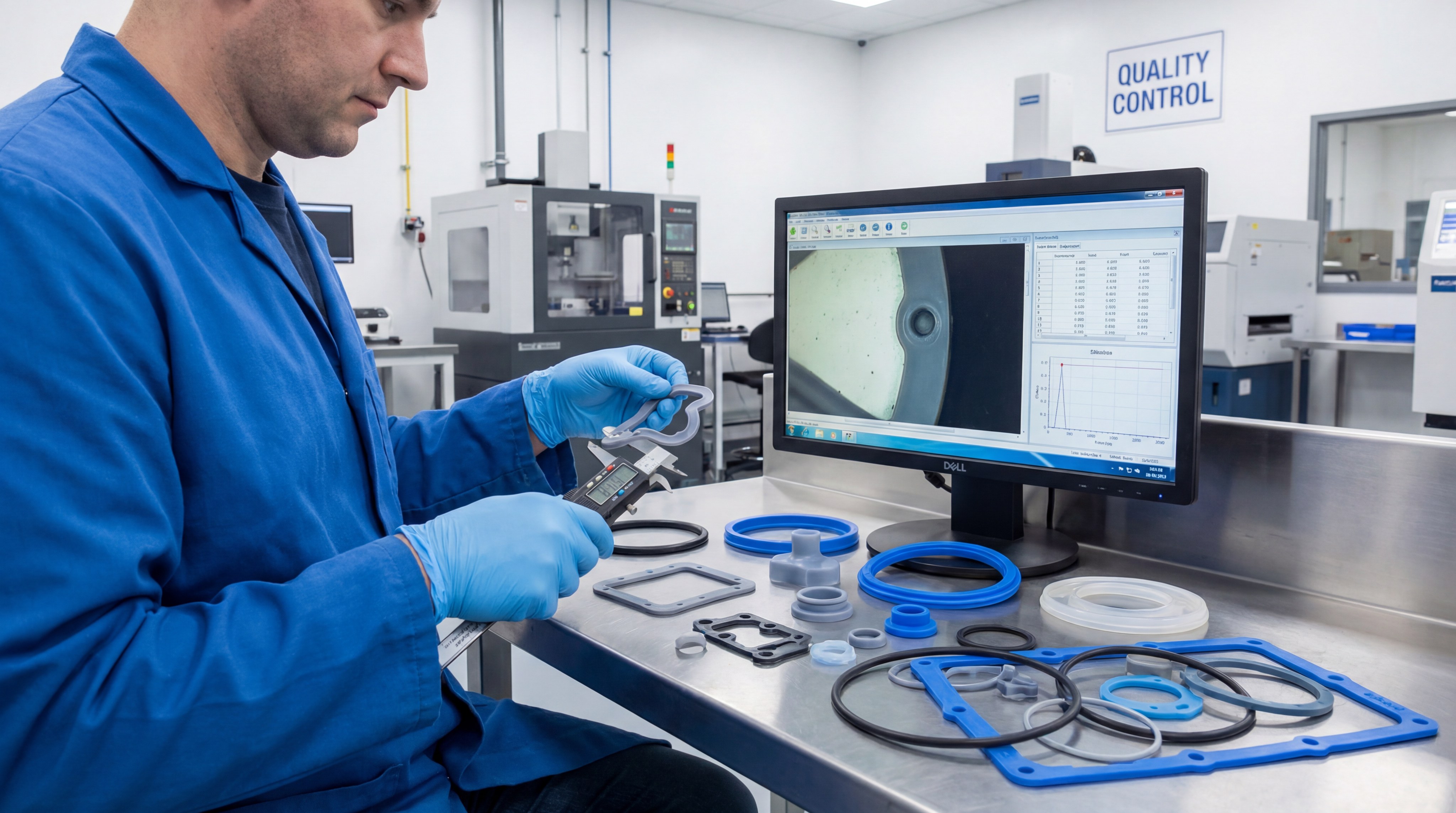
Which molding process is best for high precision?
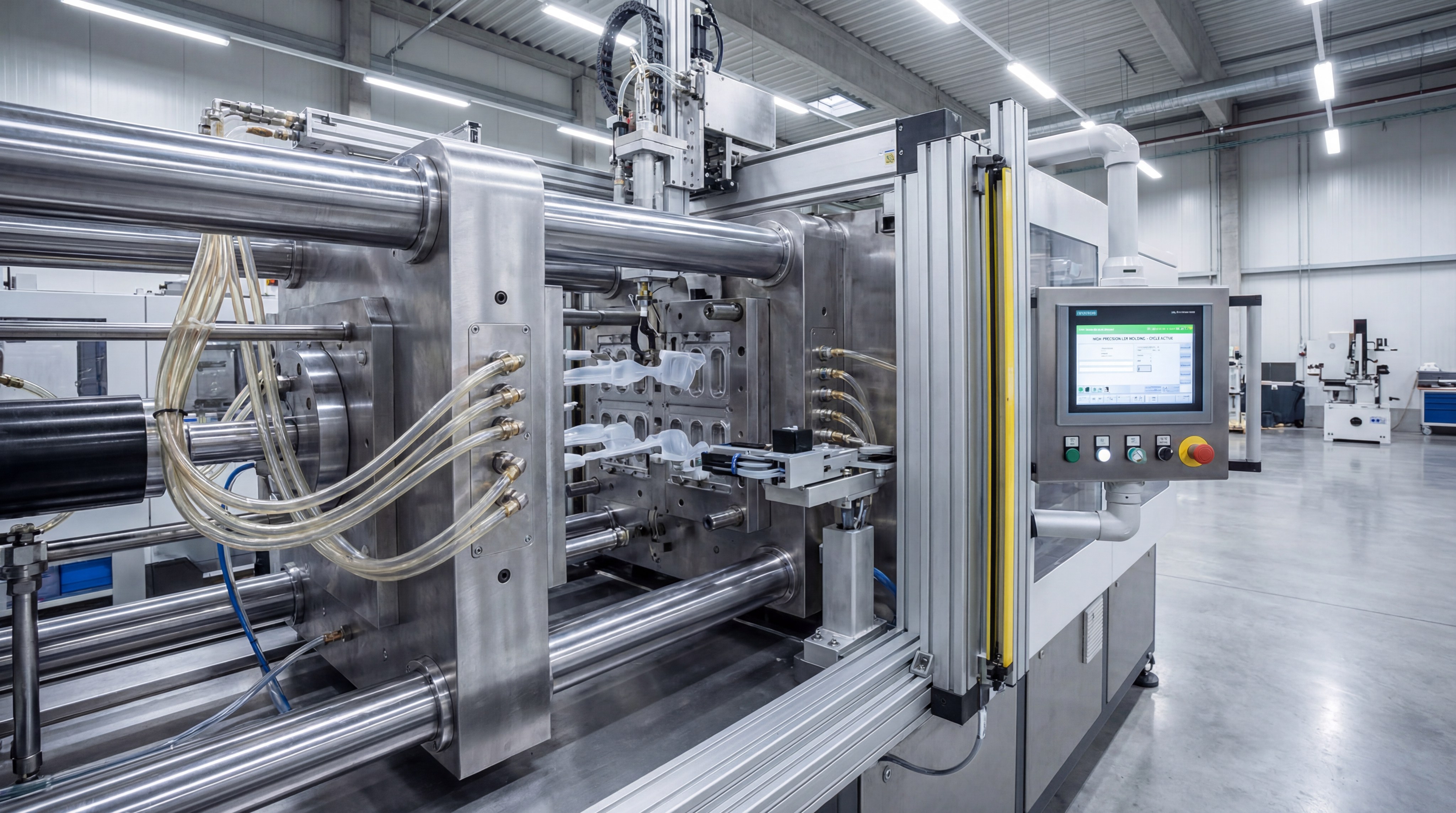
Liquid Silicone Rubber (LSR) injection molding provides tighter tolerances and cleaner parts than traditional compression molding used for organic rubbers. Silicone vs Rubber: What’s the Difference for Industrial Buyers affects which tooling and machinery you must invest in for your project.
How does LSR molding improve your part quality?
LSR is a closed-loop system that reduces contamination and allows for complex geometries with very thin walls. Traditional rubber compression molding is effective for large, simple shapes but often results in more “flash” and lower dimensional consistency.
Consider the following:
- LSR Molding: High speed, high precision, minimal waste.
- Compression Molding: Lower tooling cost, best for large gaskets.
- Overmolding: Silicone bonds exceptionally well to metals and plastics for multi-material parts.
Key Takeaway: For high-volume, high-precision electronics or medical parts, LSR is the gold standard.
| Process Feature | LSR Injection | Traditional Compression |
|---|---|---|
| Dimensional Precision | Very High | Moderate |
| Cycle Time | Short | Long |
Choosing the right molding route ensures your parts fit perfectly into complex mechanical assemblies.
When should you choose EPDM over silicone?
EPDM is the better choice for high-volume, cost-sensitive outdoor applications where steam, water, or polar chemicals are the primary stressors. Silicone vs Rubber: What’s the Difference for Industrial Buyers often leads back to EPDM when you need “ruggedness” without the high price tag.
Is EPDM better than silicone for water systems?
In many potable water and steam applications, EPDM is preferred because it has lower water absorption rates and higher resistance to calcium buildup. It provides a durable, cost-effective seal for garden hoses, washing machines, and HVAC systems.
Look at this:
- EPDM: Best for acids, alkalis, and hot water.
- Cost: Significant savings on large-scale infrastructure projects.
- Durability: Handles mechanical vibration better than silicone in automotive chassis.
Key Takeaway: If you don’t need heat resistance over 150°C and aren’t in a medical setting, EPDM is often the smarter choice.
| Application Type | Recommended Material | Why? |
|---|---|---|
| Automotive Coolant Hose | EPDM | Chemical & Vibration Resistance |
| Window Seals | EPDM | Cost & UV Resistance |
Balancing environmental needs with budgetary constraints ensures your project remains both competitive and reliable.
Conclusion: Strategic Material Selection for Industrial Success
Selecting between industrial silicone and traditional rubbers is a strategic decision that directly impacts your product’s performance, safety, and profitability. At HuaLin Silicone, our vision is to empower global manufacturers with high-precision, ISO-certified silicone solutions that solve the most demanding engineering challenges. Whether you require medical-grade purity, extreme thermal stability, or complex overmolding, our team is ready to transform your technical drawings into high-performance reality. To optimize your component design and secure a reliable supply chain, contact us today for a comprehensive DFM review and quotation.
FAQ
Can I use silicone for oil-submerged seals?
No, you should use Nitrile (NBR) or Viton instead. Standard silicone swells and weakens when exposed to petroleum-based oils and fuels.
What’s the best material for medical-grade tubing?
Silicone is the superior choice. It is biocompatible, hypoallergenic, and can be easily sterilized via autoclave or gamma radiation.
Can I color match my industrial rubber parts?
Yes, silicone is much easier to pigment into bright or translucent colors. Traditional rubbers are often limited to black due to their carbon black filler content.
What’s the best rubber for outdoor solar panels?
Silicone or EPDM are the best options. Both offer exceptional resistance to UV rays and ozone, though silicone provides a longer service life in extreme heat.
Can I overmold silicone onto plastic components?
Yes, using LSR overmolding techniques allows you to create high-precision, multi-material parts with a permanent chemical bond between the silicone and the substrate.