
1. What is Silicone Overmolding and How Does It Enhance Plastic Enclosure Performance?
Silicone Overmolding acts as a specialized manufacturing process injecting liquid silicone rubber directly onto rigid plastic substrates. This technique dramatically enhances grip feel alongside shock resistance by wrapping soft layers outside hard enclosures.
How does this process operate?
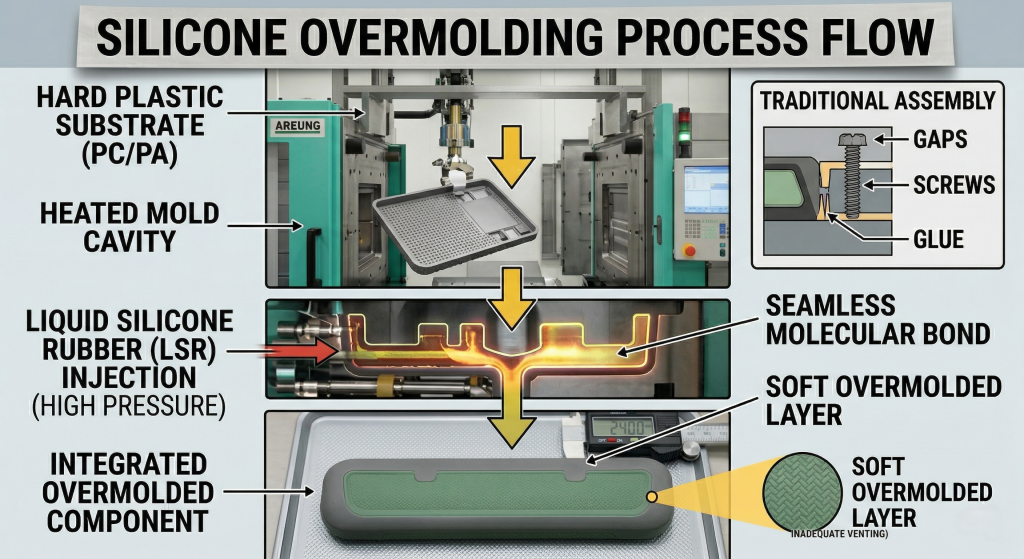
Engineers must first precisely place pre-formed plastic parts into dedicated silicone molds. Machines then inject liquid material into heated cavities under high pressure, ensuring tight integration with rigid surfaces.
Why choose this over traditional assembly?
Traditional assembly usually relies on glues or screws, increasing labor costs while leaving gaps vulnerable regarding water leaks. Here is the kicker… This integrated molding process achieves seamless material fusion at molecular levels.
- It completely eliminates manual assembly gaps, boosting overall waterproof ratings significantly.
- Engineers reduce component numbers on project bills of materials.
- Manufacturers significantly lower risks regarding long-term debonding or loose parts.
Can your project benefit from these techniques?
If you develop equipment enduring impacts or wet environments, this technology remains an absolute necessity. It significantly extends product lifespans while improving final user experiences.
Key Takeaway: This process not only upgrades physical durability but also optimizes overall manufacturing workflows by reducing complex assembly steps.
| Feature Comparison | Traditional Assembly | Silicone Overmolding |
| Sealing Performance | Poor, prone gap formation | Excellent, seamless integration |
| Part Count | Multiple separate components | Single integrated component |
| Production Efficiency | Lower, requires manual labor | High, automated molding |
Data analysis indicates that integrated molding processes upgrade sealing reliability while slashing subsequent manual assembly costs.
2. Why Choose Silicone Overmolding for High-Durability Applications?
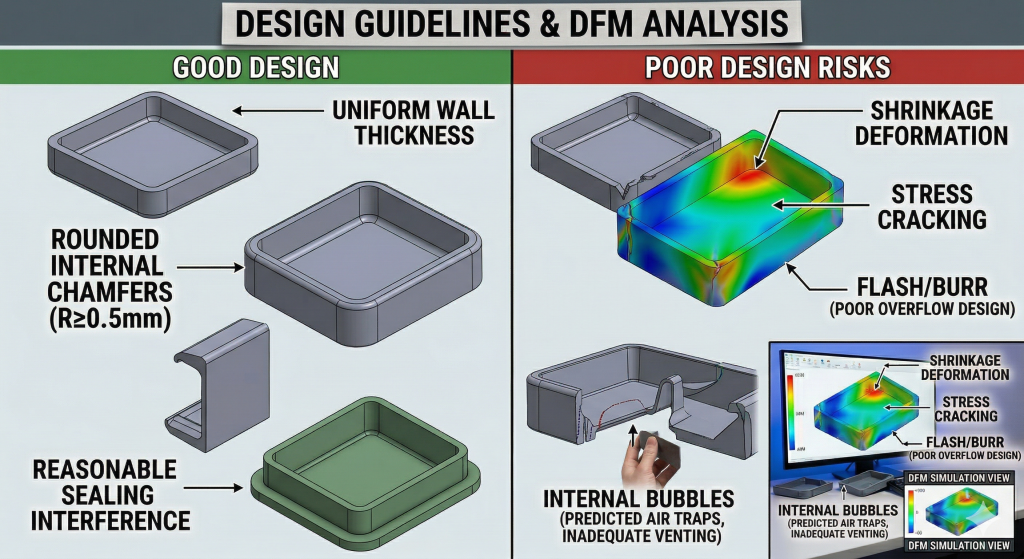
You choose Silicone Overmolding for high-durability applications because it provides outstanding drop resistance, shock absorption, and extreme weatherability. Whether facing drastic temperature shifts or intense physical impacts, this method ensures delicate internal electronic components remain perfectly safe.
How do we achieve ultimate shock absorption?
Silicone material possesses an extremely high elastic modulus, acting like springs absorbing kinetic energy from external collisions. When equipment accidentally drops, external soft layers deform first, protecting internal rigid plastics against catastrophic destruction.
Can it resist harsh outdoor environments?
Silicone excels regarding physical protection while its chemical stability remains equally impressive. What is the real story? It never becomes brittle or degrades under blazing sun exposure or freezing conditions like ordinary rubber.
- Materials feature excellent resistance against ultraviolet radiation and ozone aging.
- Components maintain flexibility across extreme temperature ranges spanning -60°C up toward 200°C.
- Surfaces provide natural defense against various chemical solvents, greases, and harsh industrial cleaners.
What do laboratory test results reveal?
Drop tests repeatedly prove that shells utilizing this technique survive impacts multiple times better than pure plastic counterparts. This characteristic remains crucial for industrial-grade equipment or rugged outdoor adventure gear facing severe daily challenges.
Key Takeaway: High-durability applications heavily depend upon outstanding physical and chemical properties provided by silicone, offering ultimate all-weather protection.
| Testing Parameter | Pure Plastic Enclosure | Silicone Overmolded Enclosure |
| Drop Resistance Height | < 1 meter | > 2 meters |
| Operating Temperature Range | -20°C up toward 80°C | -60°C up toward 200°C |
| UV Aging Resistance | Prone fading and brittleness | Extremely high, no color fading |
Environmental testing comparisons clearly show composite material enclosures survive extreme conditions far better than single-structure plastics.
3. Which Plastic Substrates Offer the Best Compatibility with Silicone Overmolding?
High-temperature engineering plastics like PC, PA, and PBT offer excellent compatibility with Silicone Overmolding. Because liquid silicone requires elevated temperatures during vulcanization, only heat-resistant substrates maintain stable shapes inside hot molds.
Why do engineers prefer PC (Polycarbonate)?
Polycarbonate possesses immense mechanical strength while its surface tension characteristics interact exceptionally well with chemical primers. This makes PC a top substrate choice for premium consumer electronics cases alongside medical device panels.
Which materials should you strictly avoid?
Not every plastic withstands such rigorous processing environments. Ready for the good part? Choosing wrong substrates causes bonding failures or melts entire parts inside expensive mold cavities.
- Avoid utilizing low-melting-point standard plastics like PP or PE.
- Soft plastics containing heavy plasticizers severely hinder normal silicone curing processes.
- Overly smooth surfaces lacking any roughening treatments struggle forming effective mechanical interlocks.
How do manufacturers verify material compatibility?
Engineering teams usually conduct small-batch trial runs alongside rigorous peeling force tests before entering mass production. This systematic verification step helps identify and eliminate potential debonding risks early.
Key Takeaway: Correctly selecting heat-resistant engineering plastics with matching surface activity forms a foundational prerequisite for successful injection overmolding processes.
| Substrate Type | Heat Deflection Temperature | Silicone Bonding Compatibility |
| PC (Polycarbonate) | High (around 135°C) | Excellent (with chemical primer) |
| PA (Nylon) | Extremely high (around 200°C) | Good (requires specific primer) |
| PE/PP | Very low (deforms easily) | Poor (cannot bond effectively) |
Material compatibility matrices clearly indicate PC alongside PA act as reliable golden partners, whereas standard PE requires strict exclusion.
4. How Do You Ensure Strong Adhesion Between Silicone Overmolding and Plastics?
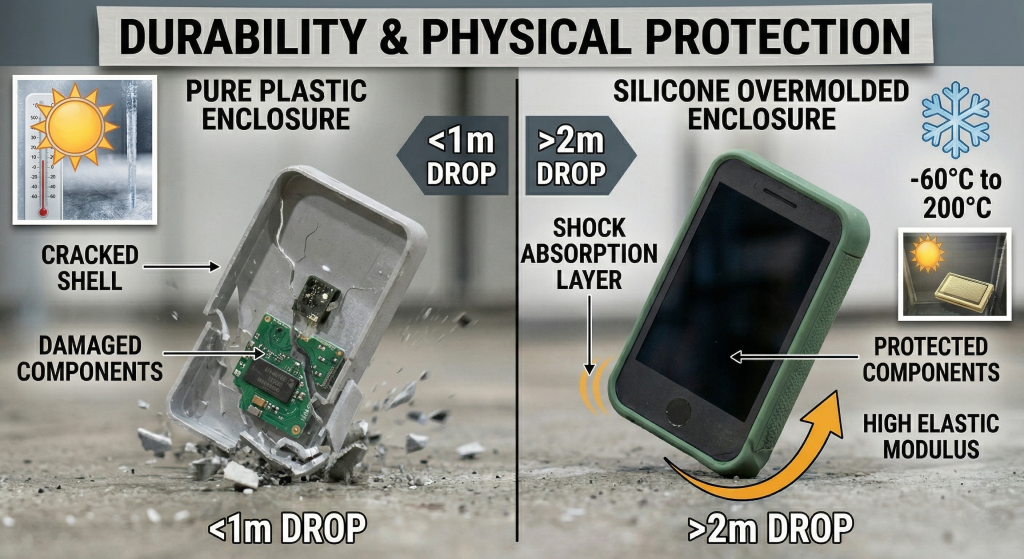
Ensuring strong adhesion between Silicone Overmolding and plastics requires selecting appropriate primers, optimizing mold temperatures, and utilizing self-adhesive liquid silicone. Adhesion strength acts as a core metric measuring composite enclosure durability, since any localized peeling causes overall protection failures.
Should you choose mechanical interlocking or chemical bonding?
Mechanical interlocking fixes materials by designing grooves onto plastic substrates, whereas chemical bonding relies entirely upon direct molecular cross-linking. Combining both methods often achieves flawless results for projects demanding high-standard waterproof seals.
How does surface preparation impact adhesive strength?
Microscopic cleanliness alongside roughness on plastic surfaces directly determines primer attachment effectiveness. This is where it gets interesting… Even tiny fingerprint oils or mold release agent residues become invisible killers destroying molecular bonds.
- Applying plasma or corona treatments significantly increases surface energy across plastic substrates.
- Substrates require strict ultrasonic cleaning alongside high-temperature drying before secondary injection phases.
- Adding subtle textured patterns onto critical joint areas massively boosts mechanical friction forces.
How do quality teams test final peel strength?
Quality control personnel utilize professional tensile testers performing destructive 90-degree or 180-degree peel tests on molded samples. Batches only receive clearance for shipping when peeling forces completely exceed specified industry standards.
Key Takeaway: Extremely powerful adhesion never occurs accidentally; it requires perfect synergistic coordination between chemical primer treatments and physical structural designs.
| Bonding Method | Implementation Difficulty | Adhesion Strength | Best Application Scenario |
| Pure Mechanical Interlock | Lower | Medium | Complex structures, no strict waterproofing |
| Primer + Chemical Bonding | Higher | Extremely high | Medical gear, deep-water outdoor devices |
| Self-adhesive Silicone | Medium | High | High-efficiency, large-volume automated mass production |
This bonding strategy comparison reveals chemical bonding alongside self-adhesive technologies remain irreplaceable when pursuing top-tier waterproof performance.
5. What Are the Crucial Design Guidelines for Successful Silicone Overmolding?
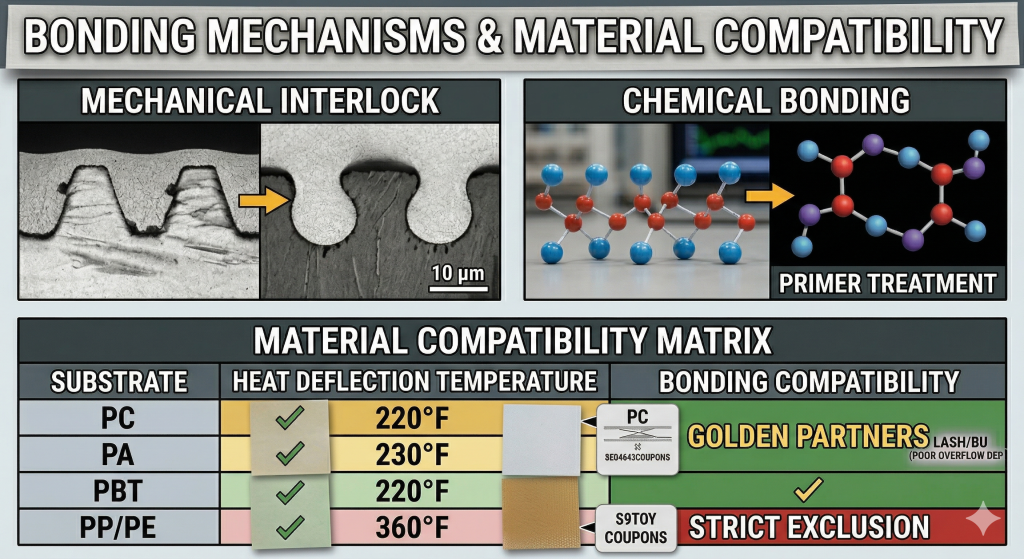
Crucial design guidelines for successful Silicone Overmolding include maintaining uniform wall thickness, avoiding sharp internal chamfers, and designing reasonable overflow grooves. Excellent Design for Manufacturability (DFM) avoids eighty percent of potential production defects during expensive tooling development stages.
Why does wall thickness matter so much?
Designing uneven wall thickness across silicone coverings causes drastically different shrinkage rates during cooling vulcanization phases. This inconsistent internal shrinkage stress triggers product appearance deformation while severely weakening adhesive strength around critical sealing areas.
How can you design perfect sealing lips?
Sealing lips serve as a primary physical defense line for enclosure waterproof systems, requiring extremely high geometric precision. But wait, there is more… Calculating reasonable interference fits achieves perfect self-adaptive sealing without needing massive mechanical clamping forces.
- Seal ring cross-sections need smooth rounded corners, avoiding sharp edges causing stress concentration tears.
- Engineers must reserve sufficient elastic compression space, preventing hard squeezing from rupturing soft silicone layers.
- Plastic substrate support surfaces must remain sufficiently flat alongside rigid characteristics, providing uniform compression reactions.
Has your design passed strict DFM reviews?
Before officially cutting mold steel, professional tooling engineers run comprehensive simulation tests on your 3D designs using advanced mold flow analysis software. This crucial step accurately predicts potential air traps alongside weld line locations for early elimination.
Key Takeaway: Strictly following these structural design specifications drastically improves mass production yield rates while significantly shortening final new product launch cycles.
| Key Design Parameter | Industry Recommended Standard | Non-compliant Design Risk Warning |
| Minimum Silicone Wall Thickness | 1.0 – 1.5 mm | Too thin breaks easily, too thick causes shrinkage |
| Internal Transition Chamfer | R ≥ 0.5 mm | Internal sharp corners easily cause stress cracking |
| Sealing Interference Compression | 15% – 30% | Insufficient compression directly causes water leakage failures |
Following these crucial dimension and tolerance specifications acts as a core secret for engineers avoiding mold modification traps.
6. Can Silicone Overmolding Improve Waterproof and Sealing Performance?
Yes, Silicone Overmolding significantly and permanently upgrades product IP waterproof ratings by forming seamless elastic barriers. When handling deep-water high-pressure immersion or high-frequency water jets, this process demonstrates structural sealing reliability unmatched by traditional split O-ring seals.
Can it genuinely achieve an IP68 rating?
You can absolutely achieve this. External water molecules cannot find microscopic gaps for penetration once liquid silicone bonds chemically with rigid plastic substrates. This allows premium smartwatches alongside underwater detection equipment to easily pass rigorous continuous deep-water IP68 certification testing.
What causes catastrophic sealing failures?
Despite extremely advanced injection processes, disastrous water leakage risks persist if early structural planning remains improper. Think about this… Leakage issues rarely originate from silicone materials themselves, but rather stem from mold machining inaccuracies or unstable molding parameters.
- Minor stress displacements across substrates during injection cause severe localized silicone coverage thickness deficiencies.
- Setting vulcanization temperatures too low prevents liquid silicone from completing full cross-linking solidification.
- Early injection deformation across plastic substrates creates uneven support surfaces, directly destroying flat sealing loops.
What waterproof standards apply for medical devices?
Medical instruments typically require surviving frequent high-temperature steam sterilization treatments without losing any sealing integrity. Professional outdoor equipment prioritizes resisting sudden hot and cold thermal shocks, relying heavily upon all-weather zero-dead-angle protection provided by integrated processes.
Key Takeaway: Integrated direct-molding silicone cover designs fundamentally eliminate water leakage hazards caused by manual assembly errors, serving as ultimate solutions for top-tier sealing.
| International IP Rating | Traditional O-Ring Performance | Silicone Overmolding Performance |
| IP65 (Multi-directional water jets) | Good, requires regular maintenance | Excellent, lifetime maintenance-free |
| IP67 (Short-term shallow immersion) | Average, heavily impacted by assembly errors | Excellent, zero assembly tolerance risks |
| IP68 (Continuous deep-water pressure) | Poor, extremely prone aging failures | Outstanding, long-term stable underwater reliability |
This stepped protection rating comparison eloquently proves integrated overmolding processes possess overwhelming physical advantages facing extreme water pressure challenges.
7. What Are Common Silicone Overmolding Defects and How Do You Avoid Them?
Common Silicone Overmolding defects include flash overflows, internal air bubbles, and localized poor adhesion, which operators avoid completely by optimizing machine injection parameters. Deeply understanding these common production issues alongside mastering corresponding preventive measures remains crucial for maintaining highly efficient mass production.
What exactly causes annoying flash overflows?
Heated liquid silicone features excellent physical fluidity, quickly penetrating any micron-level closing gaps between steel molds to form extremely difficult-to-clean flashes. This usually happens because mold machining precision falls short or injection machines apply excessive injection pressures.
How can operators completely eliminate internal bubbles?
Bubbles ruin transparent product appearances while acting as weak stress concentration points, causing silicone layers to rupture under active usage. Here is the deal… Conducting strict exhaust control during material vacuuming alongside mold injection phases represents the only way resolving this stubborn disease.
- Mold structural designs must feature reasonably placed and extremely smooth micro exhaust grooves or forced vacuum drawing systems.
- Operators must ensure liquid silicone absorbs zero tiny air particles inside static mixers alongside material feeding pipelines.
- Appropriately slowing down machine injection speeds gives hot air inside mold cavities sufficient time for safe escape.
How should we manage and control defect rates?
Production managers quickly identify manufacturing anomalies by introducing fully automated visual inspection equipment (CCD) across assembly lines. Monitoring various pressure curves on injection machines in real-time allows timely parameter adjustments, keeping overall defect rates deadlocked at extremely low single-digit levels.
Key Takeaway: Solving these tricky production defects requires experienced machine tuning masters working closely alongside ultra-high-precision molds and scientifically rigorous quality control systems.
| Common Defect Type | Core Cause Analysis | Fundamental Prevention and Solution Measures |
| Flash (Burr Phenomenon) | Micro gaps exist within molds, insufficient clamping force | Improve CNC mold machining precision, increase machine clamping forces |
| Internal Micro Bubbles | Extremely poor mold cavity exhaust, overly fast injection speeds | Add forced vacuum extraction functions, optimize multi-stage injection curves |
| Localized Debonding | Substrate surfaces suffer contamination, uneven chemical primer spraying | Strictly execute ultrasonic substrate cleaning, utilize plasma pretreatments |
This highly practical defect troubleshooting table provides intuitive process guidance for factory floors, ensuring engineers promptly block continuous defective part generation.
8. How Does Mold Design Impact the Silicone Overmolding Manufacturing Process?
Mold design directly determines Silicone Overmolding molding precision, factory production efficiency, and final product appearance quality. An excellent silicone overmolding tool acts as a perfect crystallization uniting metal art with mechanical engineering, serving as a core lifeline deciding if products successfully transition from R&D blueprints onto consumer shelves.
Why do engineers demand such strict tolerance controls?
Liquid silicone generates massive internal fluid pressures inside mold cavities during high-speed injection. If mold cavities leave excessively large positioning tolerances for rigid plastic substrates, substrates get crushed instantly or experience severe displacement, demanding extreme aerospace-level CNC machining precision.
How do cooling systems boost manufacturing capacity?
Factories typically utilize cutting-edge hot mold technologies paired with cold runner systems during liquid silicone overmolding processes. Want to know a secret? Outstanding runner thermal management systems prevent premature silicone curing inside cold runners while significantly shortening material vulcanization times across every injection production cycle.
- Meticulously designed internal water channels constantly keep cold runner plates at low temperatures, saving extremely expensive liquid silicone materials.
- Scientifically distributed heating pipe networks inside mold cavities ensure synchronous complete vulcanization across all product thickness areas.
- Highly efficient heat exchange engineering designs allow heavy metal molds to safely complete opening and closing cycles at maximum speeds.
Are specialized mold coatings genuinely necessary?
Applying special Teflon or Diamond-Like Carbon (DLC) physical coatings onto mold cavity metal surfaces greatly improves silicone demolding effects for medical or consumer products requiring extreme optical surface standards. This significantly reduces daily chemical release agent usage, firmly guaranteeing medical-grade cleanliness for final products.
Key Takeaway: Precision molds serve as the control soul for entire complex process workflows, directly defining quality ceilings for mass-produced goods.
| Crucial Mold Feature | Impact on Final Product Quality | Impact on Overall Project Cost |
| Ultra-precision Positioning Design | Effectively prevents rigid substrate crushing, massively boosts yields | High initial tooling investment, but saves massive scrap long-term |
| Wasteless Cold Runner Technology | Achieves flash-free injection, significantly improves dimensional appearance precision | Extremely complex mold structure costs more, saves massive silicone consumables |
| High-quality Heat-treated Imported Steel | Drastically extends mold service life, guarantees long-lasting smooth surfaces | Increases direct mold manufacturing costs, sharply reduces later maintenance downtime |
Investing in high-quality cold runner ultra-precision molds significantly increases initial project hardware expenses while delivering extremely lucrative long-term returns regarding material savings.
9. Which Specific Industries Benefit Most from Silicone Overmolding Technology?
Core industries like medical devices, consumer electronics, automotive parts, and baby products benefit most from high-reliability protection provided by Silicone Overmolding. High-end products within these special sectors frequently face the harshest operating environments globally, alongside extremely strict international compliance requirements regarding human contact safety.
Why cannot medical equipment function without it?
Precision surgical instrument handles alongside patient monitor silicone buttons require frequent high-temperature and high-pressure steam sterilization. Perfect molecular-level bonding between medical-grade liquid silicone and special heat-resistant plastics guarantees absolute anti-slip grip for doctors while completely preventing deadly bacteria breeding inside tiny hidden crevices.
How do consumer electronics stand out utilizing this?
Cold and stiff pure plastic enclosures completely fail satisfying picky consumer tastes during this smart era heavily emphasizing ultimate user experiences. Picture this… Market premium capabilities skyrocket exponentially when engineers seamlessly wrap rigid industrial tablet edges with extremely silky, super drop-resistant protective silicone layers.
- Extremely soft elastic touches greatly enhance daily holding comfort for portable handheld devices.
- The process provides outstanding military-grade drop cushioning protection for expensive smartwatches and extreme sports cameras.
- Smart products gain higher recognizability across crowded markets through extremely vibrant and fade-resistant dual-color injection designs.
What strict standards apply within the automotive industry?
Modern automotive electronic control components located under hoods endure extremely violent mechanical vibrations alongside severe extreme high-temperature environments year-round. Global manufacturers widely apply liquid silicone overmolding technology across various critical sensor waterproof seals and complex wiring harness jackets, ensuring absolute physical safety for vehicle driving.
Key Takeaway: This disruptive process technology relentlessly redefines product standards alongside ultimate user experiences across various high-end smart manufacturing sectors through cross-boundary polymer material fusion.
| Benefiting Application Industry | Core Industry Technical Requirement | Disruptive Value Brought by Silicone Overmolding |
| Medical Devices & Healthcare | Extremely high biocompatibility, endures repeated high-temp sterilization | Provides completely bacteria-proof and easily cleanable surfaces lacking hygienic dead angles |
| 3C Consumer Electronics | Ergonomic comfortable touch, top-tier drop and waterproof performance | Drastically upgrades portable device extreme durability alongside premium brand texture |
| Modern Automotive Industry | Extremely tolerant against rapid temperature changes, resists strong high-frequency vibrations | Ensures absolute reliability for core electronic sensors operating under harsh physical environments |
Although specific application scenarios differ across industries, they unanimously find perfect engineering answers from outstanding protection performances delivered by silicone overmolding processes.
10. How Do You Choose the Right Manufacturing Partner for Your Silicone Overmolding Project?
Choosing the right manufacturing partner for your Silicone Overmolding project requires comprehensively evaluating their internal tooling capabilities, international quality certification completeness, and long-term mass production stability. Finding a premium manufacturer who deeply participates in optimizing early product development remains a crucial final puzzle piece for overall commercial success.
Why is an in-house tooling workshop mandatory?
Physical factories possessing complete internal precision CNC tooling workshops respond extremely rapidly toward any design changes you request. This completely eliminates terribly lengthy outsourced cross-company communication times, while firmly ensuring core mold drawing confidentiality alongside absolute subsequent maintenance timeliness from the source.
Which quality certificates should you prioritize?
International quality certificates act as hard power business cards objectively measuring modern management levels for physical factories. Let that sink in… Physical enterprises holding IATF 16949 automotive-grade or ISO 13485 medical-grade certifications demonstrate rigorous strictness regarding on-site process control that ordinary counterfeit workshops simply cannot match.
- IATF 16949 certificates prove they genuinely possess zero-defect systematic production control capabilities required by automotive industries.
- ISO 13485 represents their full ability satisfying rigorous international standards for extremely high-risk dust-free medical device manufacturing.
- Complete internal IQC (Incoming Quality Control) and OQC (Outgoing Quality Control) independent laboratories provide solid physical backing promising quality baselines.
Can they provide genuine one-stop services?
Top-tier manufacturing partners handle entire complex workflows ranging from early DFM structural analysis, ultra-precision tooling machining, and dual-color injection molding, all the way toward final finished product assembly packaging. This helps you completely eliminate devastating delivery delay risks caused by frequently disconnected supply chains.
Key Takeaway: Outstanding robust manufacturing partners utilize profound industry technical accumulations alongside rock-solid quality management systems, escorting your core products toward perfect on-time, high-quality deliveries.
| Core Evaluation Dimension | Current Status of Ordinary Small/Medium Foundries | Advantages of Premium Top-tier Manufacturing Partners |
| Core Tooling Development | Relies upon outsourcing, extremely high communication friction costs, lengthy cycles | Invests heavily building internal machining centers, iterates quickly, responds extremely fast |
| International Quality Certification | Only possesses most basic ISO 9001 systems | Comprehensively holds high-level industry certifications like IATF 16949, ISO 13485 |
| Early Engineering Support | Only passively performs rough machining based on drawings | Actively provides professional DFM optimization reports, deeply participates in early joint R&D |
This sharply contrasting factory evaluation chart bluntly points out that only premium source factories possessing genuine full-chain one-stop service capabilities truly reduce risks for complex product development across treacherous markets.
In summary, adopting this advanced integrated molding process completely solves various engineering pain points regarding electronic product drop resistance, high-pressure waterproofing, and extreme environmental durability. When you strive building the strongest and most extremely experienced plastic enclosures across markets, top-tier manufacturing process support serves as your most powerful backing for winning market shares. We deeply understand the massive challenges you face within complex global supply chains, while demonstrating our ability transforming your innovative product designs flawlessly into reality through outstanding and rigorous integrated factory production systems. If you are ready to comprehensively elevate absolute market competitiveness for next-generation products, please feel free to contact us today, allowing us to jointly launch an extraordinary chapter for your next explosive success project.
FAQ
Q1: Can I use any plastic for Silicone Overmolding?
No, you absolutely cannot use ordinary cheap plastics. You must specify utilizing high-temperature engineering plastics (like PC polycarbonate or PA nylon), because ordinary low-melting-point plastics experience fatal melting or severe structural deformation during rigorous injection processes where liquid silicone undergoes high-temperature vulcanization.
Q2: What’s the best way to ensure the silicone doesn’t peel off?
The best way ensuring it never peels involves deeply combining mechanical interlocking structures with dedicated chemical primers. Thoroughly cleaning plastic substrate surfaces using plasma equipment and evenly applying dedicated chemical adhesive primers establishes extremely strong and irreversible chemical bonds on molecular levels across two completely different materials.
Q3: How do I know if my design is suitable for overmolding?
The only standard for judgment relies on conducting professional DFM (Design for Manufacturability) technical evaluations. Experienced tooling engineers utilize software carefully checking whether your product wall thickness remains uniform, whether you successfully avoided internal sharp chamfer stress, and verifying if sufficient overflow safety grooves and air exhaust spaces exist inside molds.
Q4: What’s the best tolerance I can expect from this process?
If you choose collaborating with top-tier factories, you can expect controlling core dimensional tolerances precisely within ±0.05 millimeters. However, this heavily depends on whether the factory possesses extremely high-precision imported CNC mold machining capabilities, alongside their precise real-time data monitoring for various parameters on cold runner injection machines.
Q5: Can I achieve an IP68 rating with Silicone Overmolding?
You absolutely can achieve this. Because highly elastic liquid silicone tightly fuses seamlessly with rigid plastic substrates at molecular levels under high temperatures, it fundamentally eliminates tiny water seepage gaps inevitably existing inside traditional assembled parts from a physical perspective, making it the most ideal and reliable process choice for achieving top-tier IP68 waterproof and dustproof ratings.