The primary difference between silicone and rubber for industrial buyers lies in their chemical composition, which dictates their thermal range, chemical resistance, and mechanical durability. You may often find yourself in a scenario where a high-performance seal fails prematurely due to extreme temperatures or environmental exposure. This failure agitates production schedules and increases maintenance costs, potentially damaging your bottom line. Integrating the right elastomer through Silicone vs Rubber: What’s the Difference for Industrial Buyers provides a long-term solution by matching material properties to specific operational demands.
What Are the Main Differences Between Silicone and Rubber?
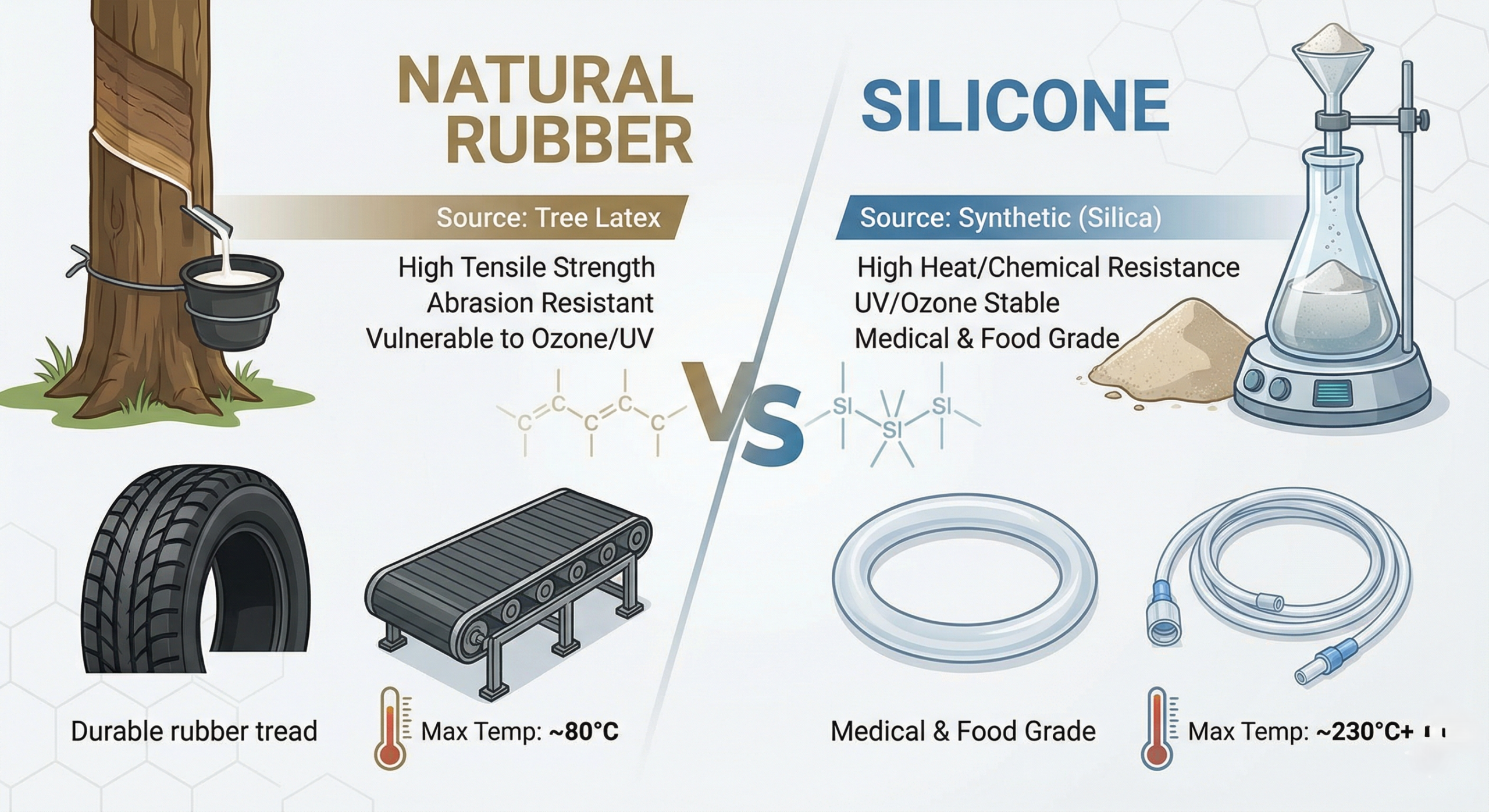
The core of Silicone vs Rubber: What’s the Difference for Industrial Buyers is found in their atomic backbones and origins. Silicone is a synthetic inorganic polymer made of silicon and oxygen, while natural rubber is an organic material harvested from latex. Because of these distinct structures, they react very differently to heat, pressure, and chemicals.
Comparing Synthetic vs. Natural Origins
Silicone is chemically engineered in controlled lab environments to possess specific industrial traits. Look:
- Natural rubber comes from Hevea brasiliensis trees.
- Silicone is derived from silica (sand).
- Synthetic rubber involves petroleum-based monomers.
Basic Molecular Structures and Polymers
The silicon-oxygen (siloxane) bond in silicone is significantly stronger and more stable than the carbon-carbon bonds in rubber. This molecular stability allows silicone to resist degradation from UV and ozone far better than its organic counterparts. Consequently, you get a material that doesn’t “dry rot” in the sun.
| Feature | Natural Rubber | Silicone |
|---|---|---|
| Backbone | Carbon-Carbon | Silicon-Oxygen |
| Origin | Tree Latex | Synthetic / Silica |
| Durability | High Mechanical | High Environmental |
This table highlights the fundamental structural differences that dictate how each material behaves under stress.
Which Material Offers Better Heat and Chemical Resistance?
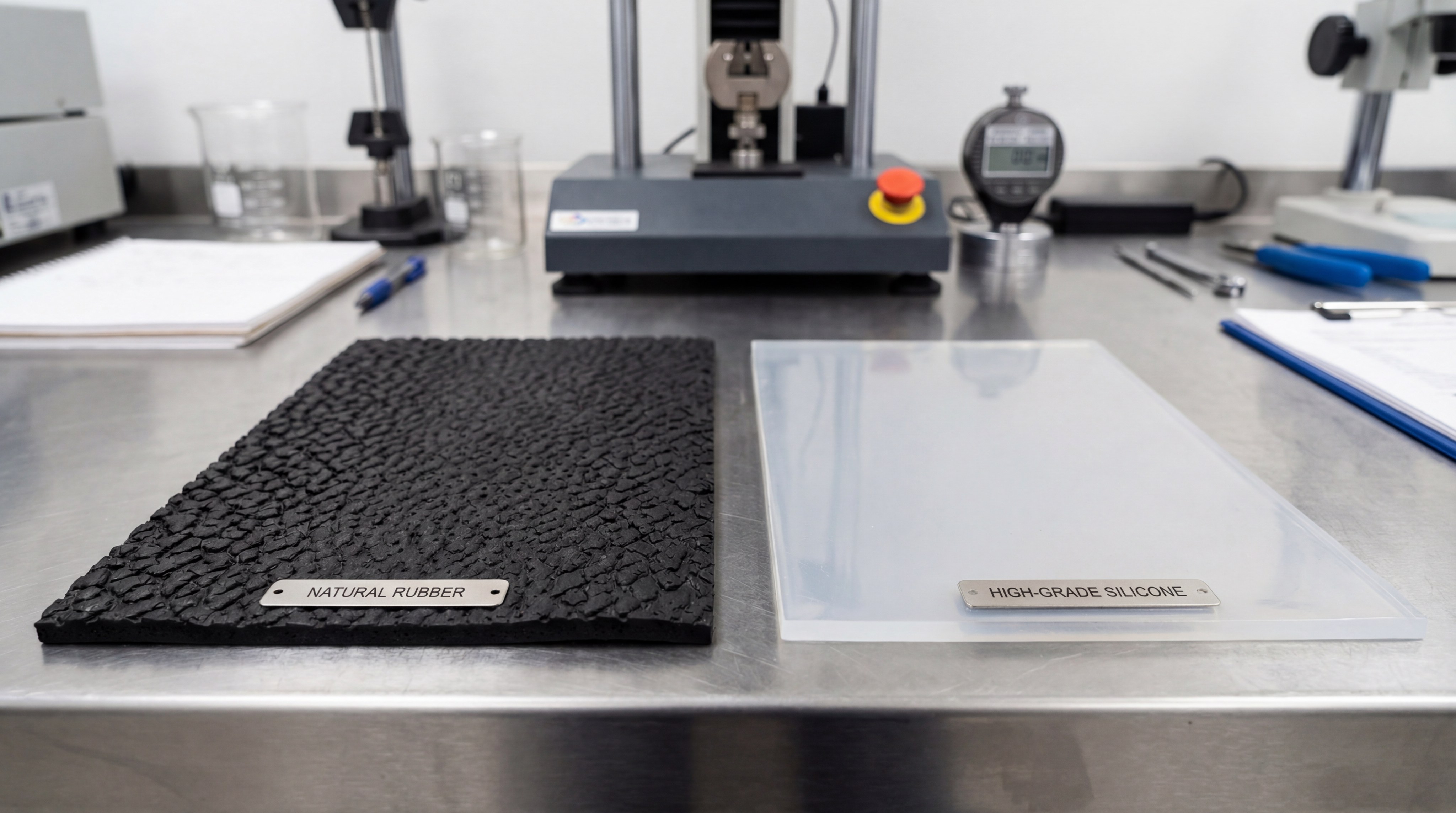
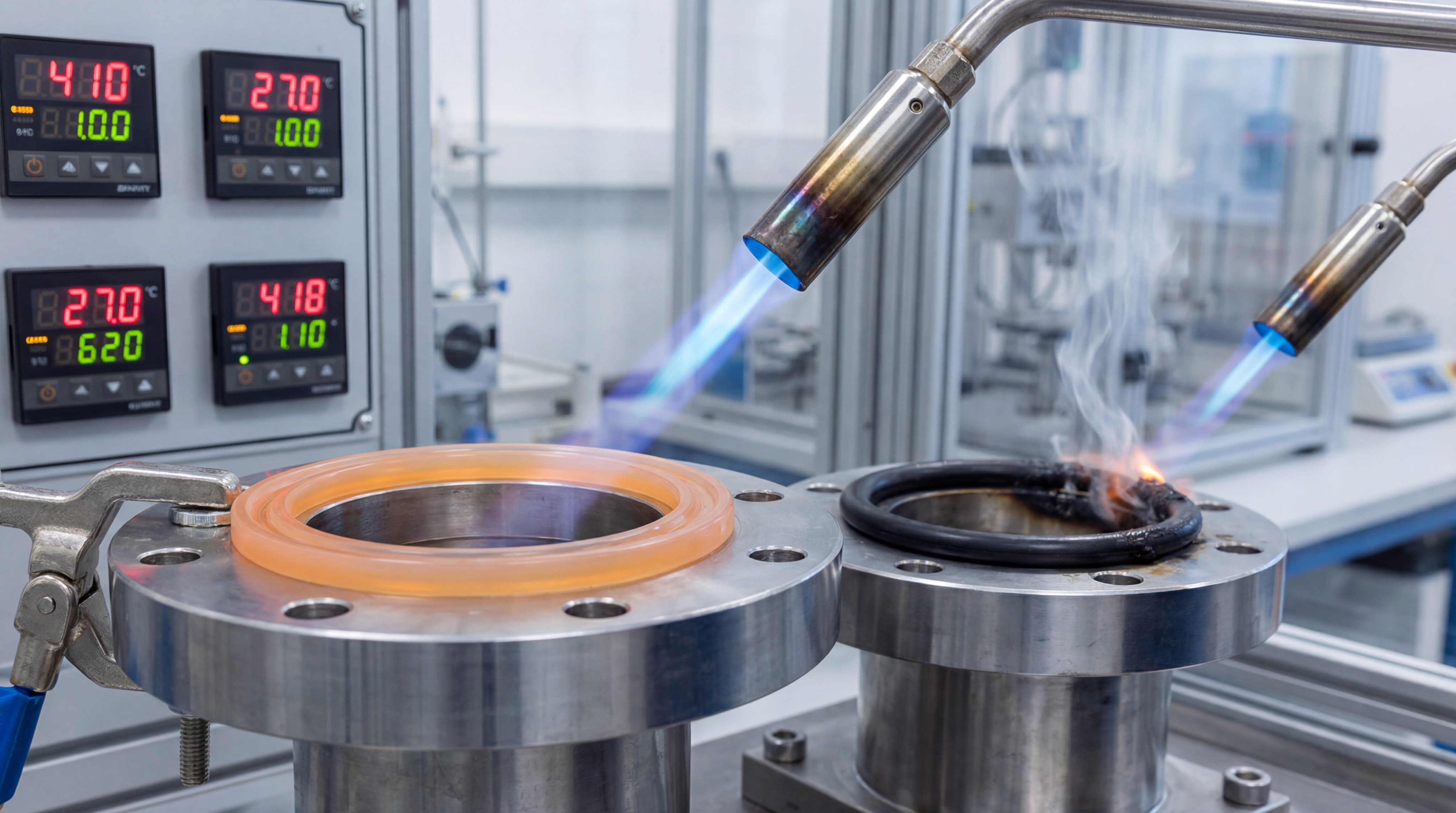
In the context of Silicone vs Rubber: What’s the Difference for Industrial Buyers, silicone is the undisputed leader for high-heat environments. Silicone can withstand constant exposure to temperatures up to 230°C, whereas natural rubber begins to melt or char at around 80°C. For LSR communication parts, this thermal stability is non-negotiable for maintaining signal integrity.
High-Temperature Stability of Silicone
Silicone retains its flexibility and elasticity even when subjected to extreme freezing or blistering heat. The best part?
- It maintains properties from -60°C to +230°C.
- It is flame retardant in specific formulations.
- It does not emit toxic fumes when heated.
Chemical Compatibility and Oxidation Resistance
While rubber swells and degrades when exposed to oils or ozone, silicone remains largely inert. You will find that silicone’s resistance to oxidation makes it perfect for outdoor applications away from heavy petroleum. However, keep in mind that neither is perfectly resistant to concentrated acids without specific additives.
| Condition | Rubber Performance | Silicone Performance |
|---|---|---|
| Heat Max | ~80°C | ~230°C + |
| Ozone | Poor (Cracks) | Excellent |
| Oil | Moderate | Poor (unless Fluorosilicone) |
Key Takeaway: Choose silicone for any application where temperature fluctuations exceed the limits of standard organic polymers.
How Do Physical Properties Impact Industrial Performance?
Understanding Silicone vs Rubber: What’s the Difference for Industrial Buyers requires a look at mechanical strength versus environmental resilience. Natural rubber is unmatched in tensile strength and tear resistance, making it the “tough” choice for heavy machinery. Conversely, silicone is preferred for precision parts that must keep their shape over trillions of cycles.
Tensile Strength and Elasticity Comparison
Natural rubber can be stretched significantly further than silicone without snapping. Here is why:
- High intra-molecular friction provides “rebound.”
- It absorbs kinetic energy more efficiently.
- It is the standard for heavy-duty tires.
Abrasion Resistance and Compression Set
Silicone excels in compression set resistance, meaning it bounces back to its original shape after being squeezed. If you are designing seals for protective sleeves, you need that “recall” to prevent leaks. Silicone’s smooth surface also resists sticking, though it is more prone to tearing than rubber.
| Property | Natural Rubber | Silicone |
|---|---|---|
| Tear Strength | Excellent | Fair/Good |
| Vibration Damping | High | Moderate |
| Compression Set | Moderate | Excellent |
These mechanical trade-offs define whether a material is suited for a moving engine part or a stationary gasket.
Why Choose Silicone for Medical and Food-Grade Uses?
When discussing Silicone vs Rubber: What’s the Difference for Industrial Buyers, the conversation shifts to safety and purity for sensitive sectors. Silicone is naturally hypoallergenic and does not contain the proteins found in natural rubber that cause “latex allergies.” This makes silicone the gold standard for medical grade silicone parts and neonatal care.
Biocompatibility and Hypoallergenic Properties
Silicone does not support the growth of bacteria and is resistant to most sterilization methods. The best part?
- It is non-reactive with human tissue.
- It contains no plasticizers (like BPA).
- It is odorless and tasteless for food contact.
Meeting FDA and ISO Regulatory Standards
Manufacturing for the mother and baby care market requires strict adherence to FDA and ISO 13485 standards. silicone is easier to certify because it doesn’t “leach” chemicals into its environment. You can rely on its purity for everything from bottle nipples to surgical seals.
| Standard | Natural Rubber | Silicone |
|---|---|---|
| FDA Food Grade | Possible (with additives) | Inherently Compliant |
| USP Class VI | Rare | Common |
| Latex-Free | No | Yes |
Key Takeaway: Silicone is the only viable choice for applications involving human contact, food processing, or medical devices.
When Is Natural Rubber the Superior Choice for Industry?
Identifying Silicone vs Rubber: What’s the Difference for Industrial Buyers involves knowing when to save money. Natural rubber is the king of high-abrasion, high-friction environments where the material is expected to be “beaten up.” If you are lining a mining chute or making a conveyor belt, the synthetic heat resistance of silicone is a waste of resources.
Heavy-Duty Applications and Rebound Resilience
Natural rubber has high internal friction, allowing it to dampen vibrations better than almost any synthetic. Look:
- It is used in automotive engine mounts.
- It serves as the base for industrial shock absorbers.
- It provides superior grip for rollers.
Cost-Effective Solutions for General Sealing
For simple indoor applications where temperatures are stable, natural rubber offers a much lower “cost-per-unit.” You don’t always need the “space-age” properties of silicone for a simple plumbing washer. It remains a staple in the construction and logistics industries for and inexpensive gaskets.
| Application | Best Material | Reasoning |
|---|---|---|
| Tire Treads | Rubber | Abrasion Resistance |
| Engine Mounts | Rubber | Vibration Damping |
| Window Seals | Silicone | UV Resistance |
This comparison shows that natural rubber still holds a dominant place in the mechanical and structural sectors.
What Are the Cost Implications of Silicone vs Rubber?
In the study of Silicone vs Rubber: What’s the Difference for Industrial Buyers, the initial price tag is only half the story. Natural rubber raw materials are generally cheaper, but silicone’s longevity can lead to a lower Total Cost of Ownership (TCO). For example, protective sleeves made of silicone may last five times longer than rubber ones in outdoor sun.
Initial Raw Material Costs and Tooling
The procurement of silicone remains higher due to the complex refining process of silica. Here is why:
- Silicone requires specialized catalysts (Platinum or Peroxide).
- Cleanroom manufacturing adds to silicone’s overhead.
- Rubber is a commodity influenced by agricultural cycles.
Long-Term Performance and Maintenance ROI
If you have to shut down a factory line to replace a $5 seal, the $20 silicone version is actually cheaper than the $2 rubber version. Silicone’s ability to resist “setting” or cracking means fewer maintenance intervals. You are paying for reliability and the peace of mind that the part won’t fail prematurely.
| Pricing Factor | Natural Rubber | Silicone |
|---|---|---|
| Material Cost | Low | High |
| Lifespan | Short/Medium | Long |
| Maintenance | Frequent | Minimum |
Key Takeaway: Evaluate your budget based on service life and downtime costs rather than just the initial purchase price.
Which Material Provides Better Sealing and Durability?
Longevity defines Silicone vs Rubber: What’s the Difference for Industrial Buyers for outdoor infrastructure. Silicone is virtually unaffected by sunlight, rain, or snow. Rubber, when exposed to these same elements, will eventually develop cracks—a phenomenon known as “dry rot”—leading to seal failure and leaks.
Gasket Performance in Harsh Environments
Silicone remains soft and pliable in temperatures where rubber turns into a rock. The best part?
- It maintains a tight seal at -50°C.
- It doesn’t stick to mating surfaces over time.
- It offers excellent electrical insulation properties.
Weathering, UV, and Ozone Resistance Factors
Ozone in the atmosphere attacks the double bonds in organic rubber, causing it to perish. Because silicone is inorganic, those double bonds don’t exist, making it immune to ozone “cracking.” This makes it the preferred material for high-voltage insulators and exterior architectural seals.
| Environmental Factor | Rubber | Silicone |
|---|---|---|
| Direct Sunlight | Cracks/Fades | No Change |
| Cold Snap | Becomes Brittle | Stays Flexible |
| Ozone Exposure | Rapid Failure | Immune |
This resilience ensures that parts used in industrial solutions perform consistently for decades.
How Do Manufacturing Processes Differ for These Materials?
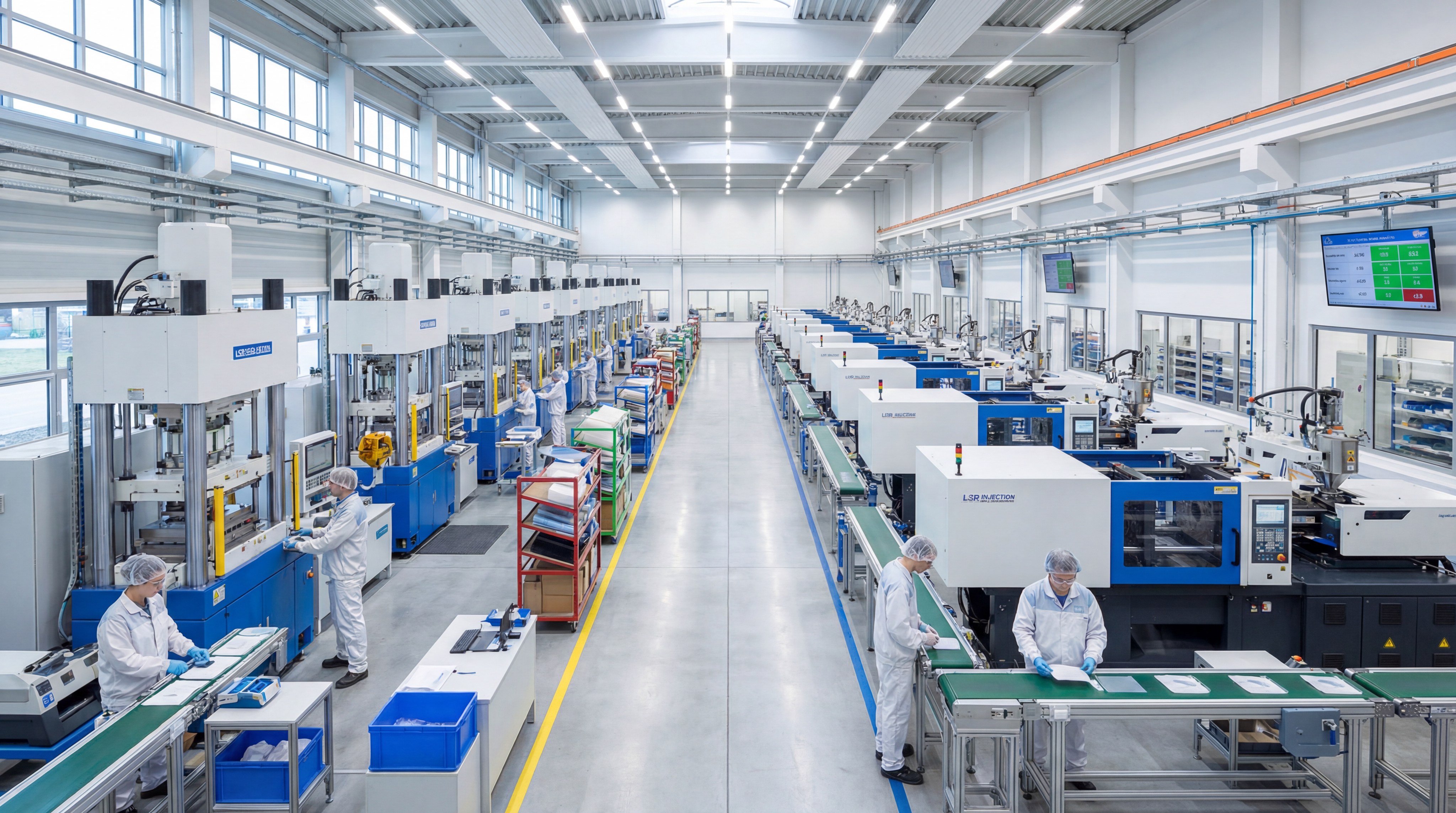
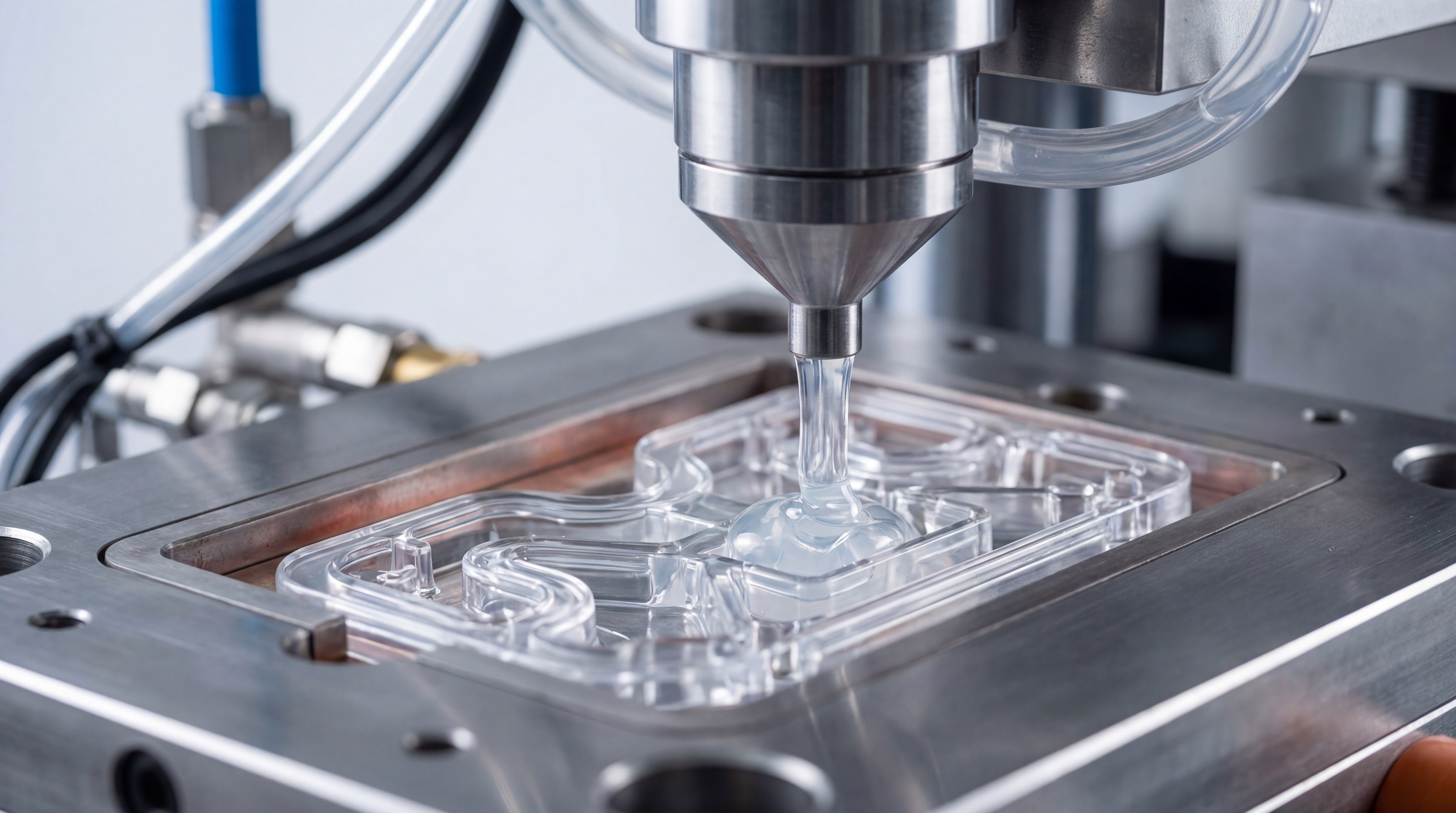
The technical execution of Silicone vs Rubber: What’s the Difference for Industrial Buyers centers on the molding technique. Rubber is typically processed via compression molding with sulfur vulcanization. Modern silicone manufacturing, however, often utilizes Liquid Silicone Rubber (LSR) injection for high-precision, high-volume production.
Liquid Silicone Injection vs. Compression Molding
LSR injection molding is a closed-system process that allows for incredibly intricate designs. Look:
- It enables rapid cycle times (seconds, not minutes).
- It produces flash-less parts, reducing waste.
- It is perfect for LSR communication parts.
Precision Engineering for Complex Geometries
Because LSR is a liquid until it enters the heated mold, it can flow into tiny, complex cavities that solid rubber cannot reach. This allows you to design parts with thinner walls and more detail. If your project requires overmolding—where silicone is bonded directly to plastic or metal—silicone is far more versatile than traditional rubber.
| Process Property | Compression (Rubber) | LSR Injection (Silicone) |
|---|---|---|
| Labor Intensity | High | Low (Automated) |
| Part Precision | Moderate | Very High |
| Setup Cost | Lower | Higher |
Key Takeaway: Use LSR injection molding when your project demands high precision, cleanliness, and large-scale automation.
What Are the Environmental Impacts of Silicone and Rubber?
Sustainability is a growing priority in Silicone vs Rubber: What’s the Difference for Industrial Buyers. Natural rubber is a renewable bio-resource, while silicone is a long-lasting synthetic. While silicone is not biodegradable, its extreme durability means fewer parts need to be manufactured and thrown away over time.
Biodegradability of Natural Rubber
Natural rubber is compostable under specific industrial conditions because it is a plant product. Here is why:
- It returns to the earth at the end of its life.
- It has a lower initial carbon footprint from production.
- Sustainable harvesting supports local ecosystems.
Recyclability and Carbon Footprint of Synthetics
Silicone doesn’t break down in landfills, which can be an environmental drawback. However, it can be down-cycled into silicone oils or used as a clean-burning fuel source in specialized incinerators. Its “green” value lies in its longevity; a silicone part that lasts 20 years is often more sustainable than 10 rubber parts that last 2 years each.
| Metric | Natural Rubber | Silicone |
|---|---|---|
| Renewable | Yes | No (Silica is abundant but non-renewable) |
| Biodegradable | Yes | No |
| Durability | Moderate | High |
This comparison helps procurement officers align their material choices with corporate ESG (Environmental, Social, and Governance) goals.
How to Choose the Right Material for Your Specific Project?
The final decision on Silicone vs Rubber: What’s the Difference for Industrial Buyers comes down to a careful audit of your operating environment. You must ask whether the part will be exposed to heat, sun, or aggressive chemicals. If the answer is “yes” to any of those, silicone is likely the safer, more durable investment.
Evaluating Environmental Stress Factors
Check your operational parameters before ordering. The best part?
- Knowing the minimum and maximum temperature.
- Identifying if the part will be outdoors.
- Determining if food or skin contact is required.
Prioritizing Regulatory vs. Mechanical Needs
If the application is a mechanical bumper for a warehouse, choose natural rubber. If the application is a seal for a high-tech wearable, choose silicone. Balancing these needs ensures you don’t over-engineer a simple part or under-engineer a critical component that could cause a product recall.
| Selection Driver | Recommended Material |
|---|---|
| High Friction/Toughness | Natural Rubber |
| High Heat/Purity | Silicone |
| Budget/Standard Use | Rubber |
Key Takeaway: Map your material choice to the most extreme condition the part will face, not just the “average” use case.
FAQ
Can I use natural rubber for high-heat medical applications?
No. Natural rubber cannot withstand the high temperatures required for autoclave sterilization and lacks the biocompatibility required for medical use-cases.
What’s the best material for outdoor cable insulation?
Silicone is the best choice because it does not crack under UV exposure and maintains its dielectric strength even during extreme weather changes.
Can I recycle silicone parts?
Yes, silicone can be ground down and used as filler in new products or chemically recycled into silicone lubricants, though industrial recycling centers are required.
What’s the best way to reduce costs on silicone parts?
Utilizing Liquid Silicone Rubber (LSR) injection molding for high volumes is the most effective way to reduce the per-unit cost through automation.
Can I bond silicone to metal?
Yes, silicone is excellent for overmolding and can be bonded to various substrates, including stainless steel and high-performance plastics, using specific primers.
Conclusion
Choosing between silicone and natural rubber is a strategic decision that balances physical toughness against environmental resilience. While natural rubber remains the powerhouse for heavy-duty mechanical tasks, silicone offers the purity, thermal range, and durability required for modern high-tech and medical industries. At HuaLin Silicone, our vision is to provide precision-engineered solutions that bridge the gap between material science and industrial necessity. To find the perfect elastomer for your next project, contact us today for an expert consultation.