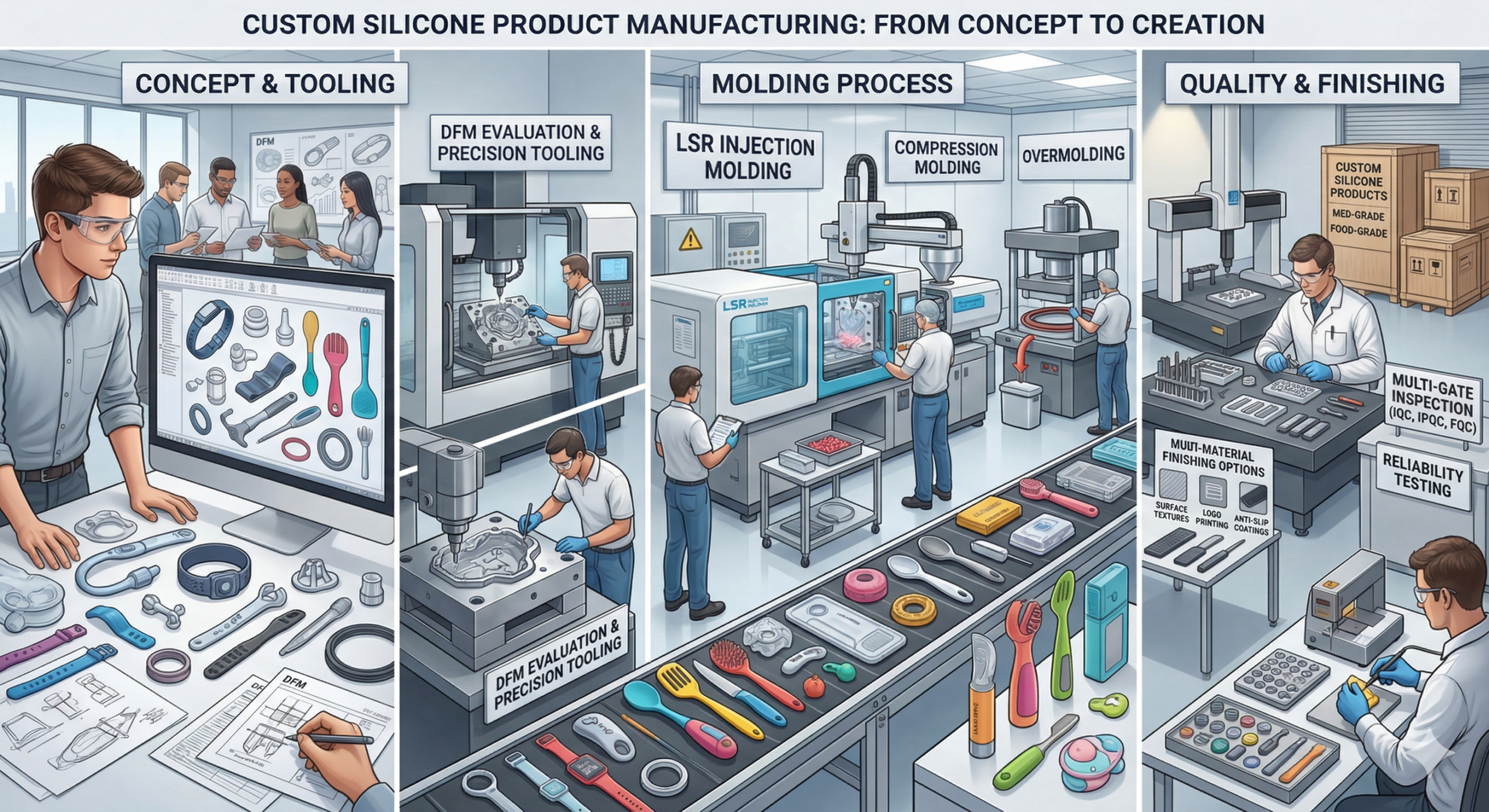
The process of taking a custom silicone product from concept to creation involves a structured journey through technical evaluation, precision tooling, material compounding, and scalable mass production. Many B2B buyers experience significant production bottlenecks when initial designs fail to account for manufacturing constraints, leading to stalled timelines. These delays agitate project budgets and increase the risk of poor-quality batches that can damage your brand’s reputation through field failures. A streamlined manufacturing process serves as the definitive solution, integrating expert engineering with advanced molding techniques to ensure your Custom Silicone Products are delivered with total consistency.
How Do You Start a Custom Silicone Product Design?
You begin the design phase by conducting a comprehensive technical evaluation that translates your creative ideas into manufacturable blueprints for Custom Silicone Products. This stage is critical for identifying potential molding risks before they become expensive physical defects.
Initial Technical and DFM Evaluation
Design for Manufacturing (DFM) is the first gate you must pass to ensure your part can be molded efficiently. Our engineers analyze your 2D and 3D files to suggest optimizations that reduce cycle times and material waste.
And that’s not all.
- Technical feasibility reviews.
- Identification of parting lines.
- Analysis of material flow paths.
Key Takeaway: Early DFM evaluation prevents costly redesigns and ensures your project stays on schedule from day one.
Optimizing Wall Thickness for Manufacturability
You must maintain consistent wall thickness to prevent sink marks and uneven curing during the molding process. Proper thickness ensures the structural integrity of the final component while optimizing material usage.
Here is the kicker:
- Preventing air traps.
- Enhancing curing speed.
- Reducing deformation risks.
Key Takeaway: Balanced wall thickness leads to faster production cycles and higher part quality across the entire batch.
Identifying Critical Functional Requirements
What are the specific environments your product will face? You need to define parameters like temperature resistance, chemical exposure, and tactile feel to guide the engineering team.
The best part?
- Determining shore hardness.
- Selecting seal geometries.
- Mapping stress points.
Key Takeaway: Clear functional definitions ensure the final product performs reliably in its intended real-world application.
| Phase | Focus Area | Primary Benefit |
|---|---|---|
| DFM Review | Geometry Check | Risk Mitigation |
| Optimization | Wall Consistency | Cycle Speed |
| Requirements | Environment | Reliability |
This initial engineering phase establishes the foundation for a defect-free manufacturing lifecycle.
Why Is Rapid Prototyping Essential for Your Project?
Rapid prototyping is essential because it allows you to validate the physical performance and aesthetic appeal of Custom Silicone Products before committing to high-cost production molds. It bridges the gap between digital models and mass-market reality.
Validating Fit and Function with 7-Day Samples
You can verify assembly tolerances and functional grip by testing physical samples within a week. This rapid feedback loop allows for immediate design adjustments without significant financial loss.

Make no mistake:
- Hands-on testing.
- Assembly verification.
- Material feel approval.
Key Takeaway: Prototyping allows you to catch fitment issues early, ensuring your final assembly is seamless.
Reducing Risk Before Full Tooling Investment
High-volume molds are a significant investment that you should only authorize after successful prototype validation. Testing with bridge tooling or 3D-printed molds saves you from expensive steel modifications later.
But wait, there’s more.
- Lower upfront costs.
- Faster design iterations.
- Proof of concept.
Key Takeaway: Minimizing financial risk during development protects your project budget for the scale-up phase.
How Do Prototype Iterations Save Long-Term Costs?
By refining your design through multiple prototype stages, you eliminate hidden failure modes that only appear in physical parts. You ensure that mass production starts with a mature, optimized design.
And that’s just the beginning.
- Reducing scrap rates.
- Optimizing gate placement.
- Refining surface textures.
Key Takeaway: Investing in iterations now prevents massive waste and rework costs during high-volume production.
| Metric | Prototype Stage | Production Stage |
|---|---|---|
| Lead Time | 7 Days | 25+ Days |
| Tooling Cost | Low | High |
| Change Risk | Minimal | Significant |
Prototyping serves as a critical insurance policy against design flaws and assembly failures.
How Does In-House Tooling Improve Production Speed?
In-house tooling improves production speed by removing the middleman and allowing engineers to fabricate molds for Custom Silicone Products directly on-site. This integration ensures that design changes are reflected in the hardware almost immediately.
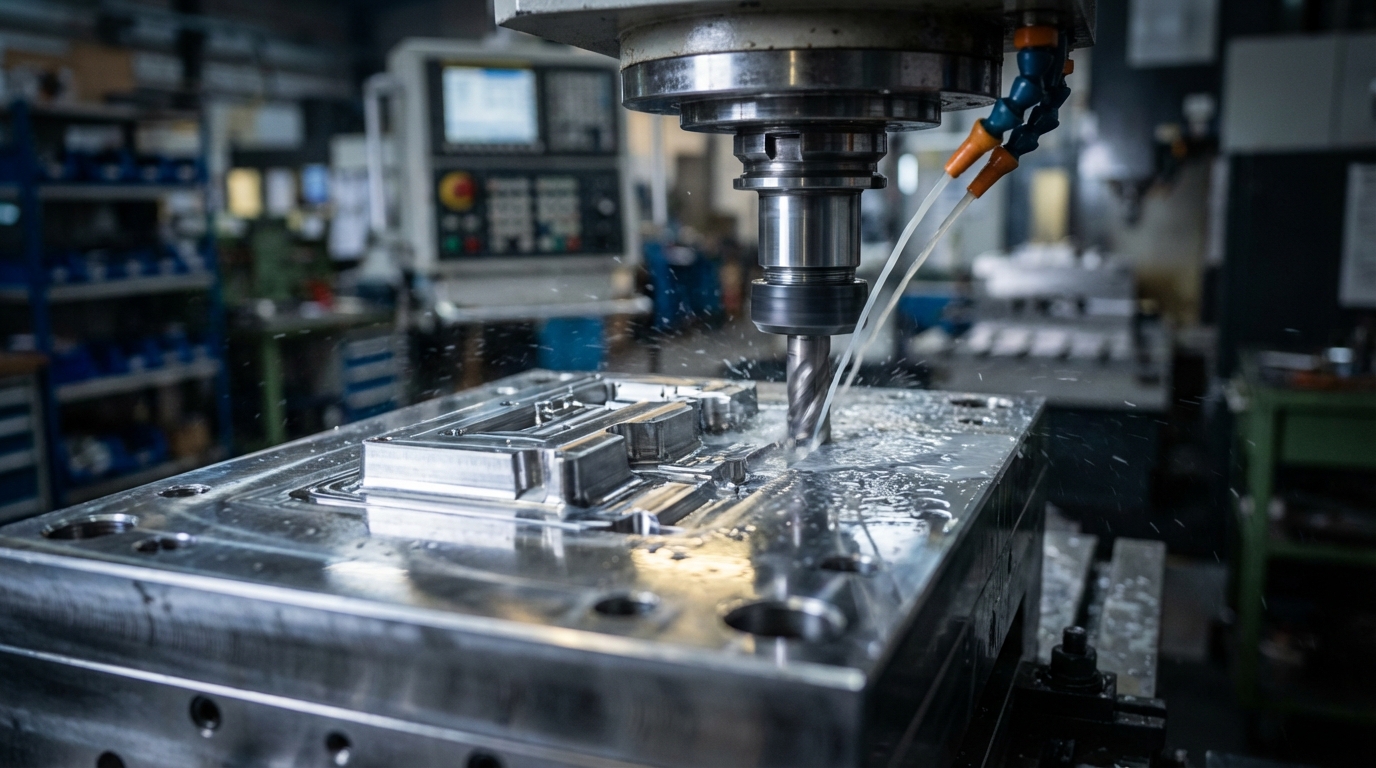
Precision CNC Machining and EDM Processes
You benefit from high-precision steel molds carved by automated CNC machines and Electrical Discharge Machining. These technologies allow for the creation of intricate details that manual processes simply cannot match.
You might be wondering:
- High dimensional accuracy.
- Superior surface finishes.
- Durable steel construction.
Key Takeaway: Precision tooling ensures that every molded part matches your original CAD specifications perfectly.
Achieving 48-Hour Tooling for Fast Iterations
When you need to move quickly, specialized tooling centers can produce functional molds in as little as 48 hours. This speed is vital for meeting tight market windows and responding to urgent design updates.
The best part?
- Rapid mold fabrication.
- Immediate sample runs.
- Flexible design updates.
Key Takeaway: Accelerated tooling reduces your time-to-market, giving you a significant competitive advantage.
Ensuring Proprietary Design and IP Protection
You keep your sensitive intellectual property safe by keeping the entire mold-making process under one roof. Without external vendors, the risk of design leaks or unauthorized replication is virtually eliminated.
Here is the kicker:
- Secured data transfer.
- On-site mold storage.
- Restricted access protocols.
Key Takeaway: In-house tooling provides the highest level of security for your proprietary designs and trade secrets.
| Tooling Type | Precision Level | Best For |
|---|---|---|
| CNC Milled | High | Complex Geometries |
| EDM | Ultra-High | Micro Features |
| Prototype | Standard | Initial Testing |
Integrated tooling capabilities drastically compress the development timeline while maintaining strict quality control.
Which Silicone Material Best Fits Your Requirements?
Selecting the right material for Custom Silicone Products depends on your specific performance criteria, including environmental resistance and regulatory compliance. You must match the material grade to the final application to ensure longevity.
Liquid Silicone Rubber vs. Solid Compounds
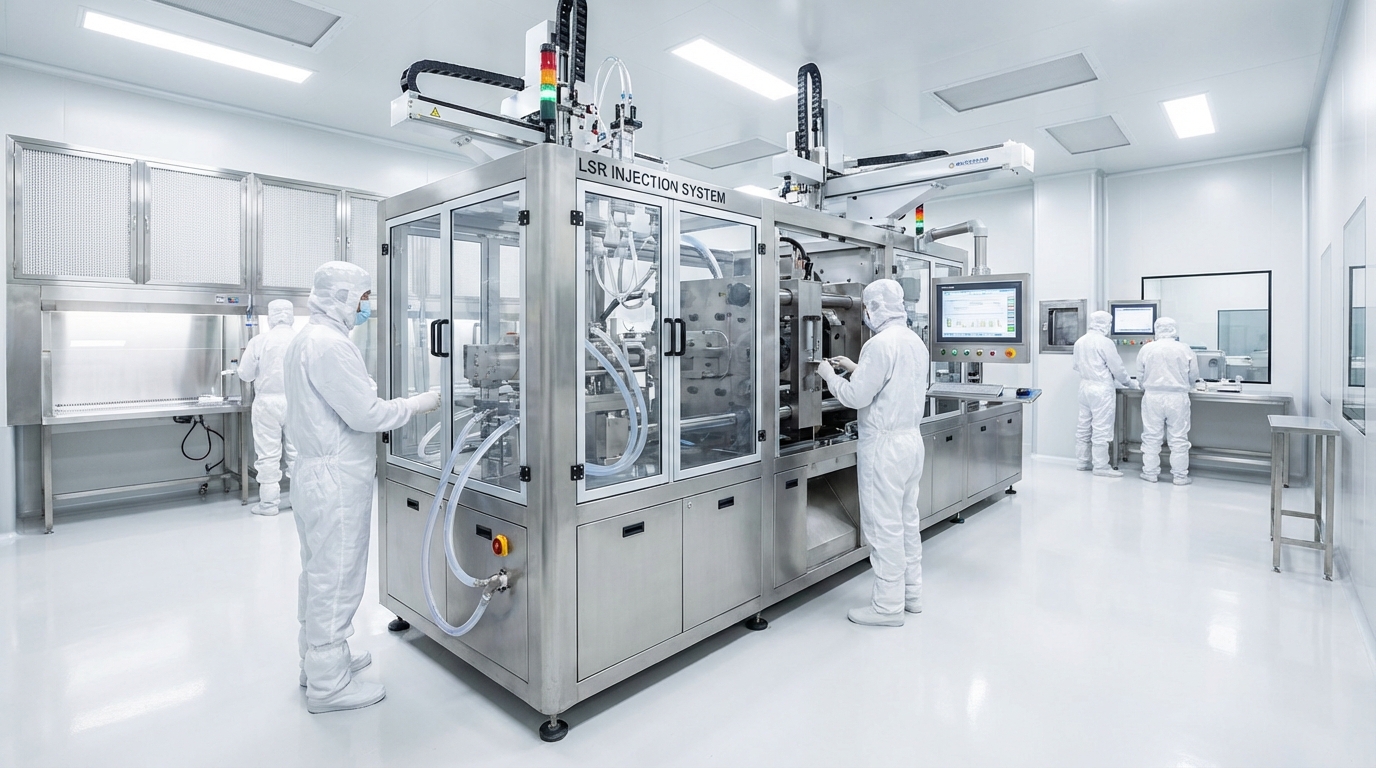
You should choose Liquid Silicone Rubber (LSR) for high-precision, automated molding, while solid compounds are better for simpler shapes. LSR offers better purity and consistency for sensitive applications like healthcare.
But that’s not all.
- High-purity LSR.
- Durable solid rubber.
- Application-specific compounds.
Key Takeaway: Choosing the right material form factors determines both the cost and the precision of your final part.
Meeting FDA, LFGB, and ISO 13485 Standards
Are your products destined for the medical or food industries? You must use certified raw materials that comply with global safety standards to ensure user health and market entry.
The best part?
- Food-grade safety.
- Biocompatible grades.
- Traceable supply chains.
Key Takeaway: Compliance-ready materials simplify the certification process and build trust with your end-users.
Selecting the Right Durometer for Performance
You need to select the correct shore hardness, or durometer, to achieve the desired flexibility or rigidity. This choice affects everything from the tactile feel to the sealing capability of the component.
Here is the kicker:
- Soft touch (10A-30A).
- Standard flexibility (40A-60A).
- Rigid support (70A-80A).
Key Takeaway: Accurate durometer selection ensures your product feels right and functions correctly under pressure.
| Grade | Compliance | Typical Use |
|---|---|---|
| Food Grade | FDA / LFGB | Kitchenware |
| Medical Grade | ISO 13485 | Surgical Parts |
| Industrial | RoHS / REACH | Seals & Gaskets |
Correct material selection is the most significant factor in the long-term performance of silicone components.
Is LSR Molding Right for High-Precision Components?
LSR molding is the premier choice for Custom Silicone Products that require exceptional detail and microscopic tolerances. It uses a liquid injection system that fills complex mold cavities with unmatched accuracy.
Maintaining Tight Tolerances Down to ±0.05mm
You can achieve incredibly precise dimensions that are impossible with standard rubber molding techniques. This level of accuracy is vital for waterproof seals and interlocking electronic components.
Make no mistake:
- Micro-precision molding.
- Consistent wall sections.
- High repeatability.
Key Takeaway: Tight tolerance control ensures your parts fit perfectly every time, reducing assembly scrap.
Automated Flash-Free Injection Molding Benefits
LSR machines operate on automated cycles that minimize manual labor and produce flash-free parts. This means you get a cleaner product that requires no secondary trimming.
And that’s not all.
- Reduced labor costs.
- High-speed production.
- Minimal material waste.
Key Takeaway: Automation lowers the unit cost while improving the aesthetic quality of your precision components.
Scalable Production for Complex Geometries
Does your design include undercuts or thin membranes? LSR molding is uniquely suited for complex shapes that need to maintain structural integrity at scale.
Here is the kicker:
- Complex internal structures.
- Multi-cavity efficiency.
- High-volume stability.
Key Takeaway: LSR is the most scalable solution for complex, high-volume projects requiring high purity.
| Feature | LSR Injection | Traditional Molding |
|---|---|---|
| Tolerance | ±0.05mm | ±0.20mm |
| Automation | Full | Partial |
| Cleanliness | High | Standard |
LSR technology is the gold standard for high-performance components in the medical and electronics sectors.
When Should You Choose Silicone Compression Molding?
You should choose compression molding for Custom Silicone Products when you are producing medium volumes or parts with large, simple cross-sections. It is a robust and cost-effective manufacturing route for various industrial parts.
Cost-Effective Production for Simpler Geometries
You can lower your initial investment by using compression molding for items like protective sleeves or flat gaskets. The tooling is generally less complex and more affordable than injection molding.
But wait, there’s more.
- Lower tooling investment.
- Competitive unit pricing.
- Simple mold maintenance.
Key Takeaway: Compression molding provides a high return on investment for projects with straightforward designs.
Handling Larger Parts and Custom Hardness Ranges
You benefit from the ability to mold oversized components that might not fit in standard injection machines. This process also allows for easy adjustments to material hardness during the run.
You might be wondering:
- Oversized part capacity.
- Flexible hardness options.
- Custom color blending.
Key Takeaway: This process offers the versatility needed for diverse industrial and consumer product lines.
Why Use Vacuum Vulcanization for Stable Curing?
Vacuum vulcanization removes trapped air from the mold, ensuring that your parts are free from internal bubbles. This results in a much more stable and durable final product.
The best part?
- Bubble-free parts.
- Improved tensile strength.
- Consistent material density.
Key Takeaway: Vacuum-assisted molding ensures that even the simplest parts meet high durability standards.
| Factor | Compression | LSR Injection |
|---|---|---|
| Tooling Cost | Low to Medium | High |
| Part Size | Large Possible | Small to Medium |
| Geometry | Simple | Complex |
Compression molding remains the workhorse of the industry for larger formats and cost-sensitive projects.
How Does Overmolding Enhance Product Functionality?
Overmolding enhances your Custom Silicone Products by bonding silicone directly to other materials like plastic or metal. This creates a unified part that combines the strength of a rigid substrate with the soft touch of silicone.
Permanent Bonding of Silicone to Plastic or Metal
You can create multi-material parts without the need for screws or external fasteners. The bond is achieved through chemical adhesion or mechanical interlocking, ensuring the silicone never peels away.
And that’s just the beginning.
- Seamless integration.
- Enhanced grip.
- Shock absorption.
Key Takeaway: Permanent bonding improves product longevity by preventing delamination in the field.
Multi-Material Integration for Smart Wearables
For wearable technology, you need to combine rigid electronics housings with flexible, skin-safe straps. Overmolding allows you to achieve this in a single, high-performance manufacturing step.
Bucket brigade: The best part?
- Waterproofing electronic seals.
- Ergonomic comfort.
- Biocompatible surfaces.
Key Takeaway: Integrated designs allow for smaller, sleeker, and more durable wearable devices.
Eliminating Secondary Adhesives in Assembly
By molding the silicone directly onto the base part, you remove the need for messy glues and manual assembly stages. This simplifies your supply chain and reduces potential points of failure.
Here is the kicker:
- Streamlined assembly.
- Consistent bond quality.
- Lower labor costs.
Key Takeaway: Reducing assembly steps lowers your total cost of ownership and improves production throughput.
| Combination | Benefit | Common Application |
|---|---|---|
| Silicone + Plastic | Soft Grip | Handheld Tools |
| Silicone + Metal | Heat Shielding | Kitchen Utensils |
| Silicone + PCB | Waterproofing | Wearable Tech |
Overmolding is a powerful engineering tool that adds significant value and functionality to modern product designs.
What Finishing Options Perfect the Product’s Feel?
Finishing options are what give Custom Silicone Products their final personality and functional surface properties. You can choose from a variety of coatings and textures to match your specific branding requirements.
Custom Surface Textures and Anti-Slip Coatings
You can specify matte, gloss, or even leather-like textures to enhance the user’s grip. Anti-slip coatings are particularly useful for medical instruments and consumer electronics.
Bucket brigade: Make no mistake:
- Enhanced tactile feel.
- Improved safety/grip.
- Aesthetic differentiation.
Key Takeaway: The right surface finish improves user satisfaction and elevates the perceived value of your product.
Durable Legend Printing and Laser Marking Methods
How do you ensure your logos and instructions never fade? You can use high-durability screen printing or permanent laser marking to keep branding crisp even after heavy use.
The best part?
- Wear-resistant markings.
- High-contrast logos.
- Chemical resistance.
Key Takeaway: Permanent marking ensures that critical safety information and branding remain legible for the life of the product.
Can Specialized Coatings Prevent Surface Aging?
You can apply UV-resistant or anti-dust coatings to keep your silicone parts looking new. These treatments prevent the “sticky” feel often associated with lower-grade silicone products over time.
Here is the kicker:
- Anti-static properties.
- UV yellowing resistance.
- Dust and lint repulsion.
Key Takeaway: Surface treatments extend the aesthetic life of your product, protecting your brand’s reputation.
| Finish Type | Purpose | Durability |
|---|---|---|
| Matte Texture | Tactile Feel | High |
| Pad Printing | Branding | Medium |
| UV Coating | Aging Protection | High |
Secondary finishing transforms a standard molded part into a premium, market-ready product.
How Is Quality Guaranteed Across Mass Production?
Quality for Custom Silicone Products is guaranteed through a rigorous, multi-stage inspection system. You must ensure that the first part of a production run is identical to the ten-thousandth part.
Multi-Gate Inspection: IQC, IPQC, and FQC
You benefit from a quality system that checks materials at the door, monitors parts on the line, and verifies every carton before shipment. This layered approach catches defects at their source.
Make no mistake:
- Raw material verification.
- Real-time process monitoring.
- Final visual standards.
Key Takeaway: Layered inspections ensure that only 100% compliant parts ever reach your warehouse.
Reliability Testing for Durability and Aging
Does your product need to withstand thousands of flex cycles or extreme heat? You can request environmental and mechanical testing to validate long-term performance.
The best part?
- Flex and fatigue testing.
- Thermal aging validation.
- Chemical resistance checks.
Key Takeaway: Rigorous testing proves that your product can survive the harshest real-world conditions.
Batch Traceability and Compliance Documentation
You receive full documentation that tracks every part back to its original material batch and production date. This is essential for regulated industries like automotive and medical manufacturing.
Here is the kicker:
- Lot number tracking.
- Material COA records.
- Audit-ready documentation.
Key Takeaway: Complete traceability provides peace of mind and simplifies regulatory compliance for your business.
| Inspection Gate | Timing | Objective |
|---|---|---|
| IQC | Pre-Production | Material Purity |
| IPQC | During Molding | Dimensional Stability |
| FQC | Post-Production | Aesthetic Perfection |
A robust quality management system is the only way to ensure long-term production stability.
What Are the Final Steps to Market Readiness?
The final steps for Custom Silicone Products involve post-processing, assembly, and logistics. You need a partner who can handle the entire scope from the mold to the final export shipment.
Precision Die-Cutting and Adhesive Application
You can have specialized adhesives, such as 3M tapes, pre-applied to your parts for easy installation. Precision die-cutting ensures these adhesives match the part geometry perfectly.
Bucket brigade: And that’s not all.
- Custom adhesive backing.
- Precise edge trimming.
- Ready-to-install parts.
Key Takeaway: Pre-applied adhesives reduce your final assembly time and improve bond reliability.
Custom Assembly and Professional Packaging
Why manage multiple vendors when you can have your parts assembled and packaged in one place? You can receive your products in retail-ready packaging or custom bulk containers.
The best part?
- Multi-part assembly.
- Branded retail packaging.
- Protective shipping inserts.
Key Takeaway: Integrated assembly and packaging services reduce your overhead and simplify your logistics.
Global Logistics and Export Documentation Support
You need a manufacturing partner who understands international shipping and customs requirements. Professional export support ensures your goods move across borders without unnecessary delays.
Here is the kicker:
- Secure global shipping.
- Customs clearance support.
- Accurate export paperwork.
Key Takeaway: Reliable logistics support ensures your products arrive on time and in perfect condition, wherever you are.
| Service | Value Added | Target |
|---|---|---|
| Die-Cutting | Functional Interface | Assembly Speed |
| Packaging | Brand Identity | Market Ready |
| Logistics | Supply Chain | Global Reach |
Completing the final mile of manufacturing ensures your product is truly ready for the end consumer.
*
Conclusion
Navigating the transition from concept to creation for Custom Silicone Products requires more than just a manufacturer; it requires a strategic partner. We solve the common problems of manufacturing bottlenecks and quality drift by offering an integrated process that covers everything from initial DFM evaluation to global logistics. By focusing on precision tooling, material compliance, and rigorous multi-gate inspections, we help you eliminate production risks and accelerate your time-to-market. Whether you are developing smart wearables or medical-grade components, our streamlined workflow ensures that your design intent is perfectly preserved in every batch.
Take the next step in your development journey and contact us today to receive a free engineering evaluation and a customized quote for your project. Our team is ready to transform your complex designs into high-performance physical products that protect your brand’s reputation. Together, we will build a future where innovation and manufacturing excellence are seamlessly combined to bring your vision to life on a global scale.
Custom Silicone Products Manufacturing FAQs
Can I request a DFM review before committing to tooling?
Yes, you can receive a free engineering and Design for Manufacturing (DFM) evaluation within 24 hours of submitting your drawings. This helps identify potential molding risks and cost-saving opportunities before any financial commitment is made.
What’s the best molding process for high-volume precision parts?
Liquid Silicone Rubber (LSR) injection molding is the best choice for high-volume precision parts. It offers superior dimensional stability, automated flash-free production, and the high purity levels required for medical and electronic applications.
How do I know if my design is suitable for overmolding?
You can consult with our engineers who will evaluate the substrate material and bond area. We look for opportunities for mechanical interlocking or recommend specific primers to ensure a permanent, failure-proof bond between the silicone and other materials.
Can I get medical-grade certifications for my production batches?
Absolutely, as we operate under ISO 13485 standards and use raw materials that comply with FDA and LFGB requirements. We provide full material traceability and compliance documentation with every production run to support your regulatory needs.
What is the typical lead time for custom tooling and samples?
For urgent projects, you can receive functional tooling in as little as 48 hours, with initial samples following shortly after. Standard production tooling and sample validation typically take between 7 to 15 days depending on part complexity.