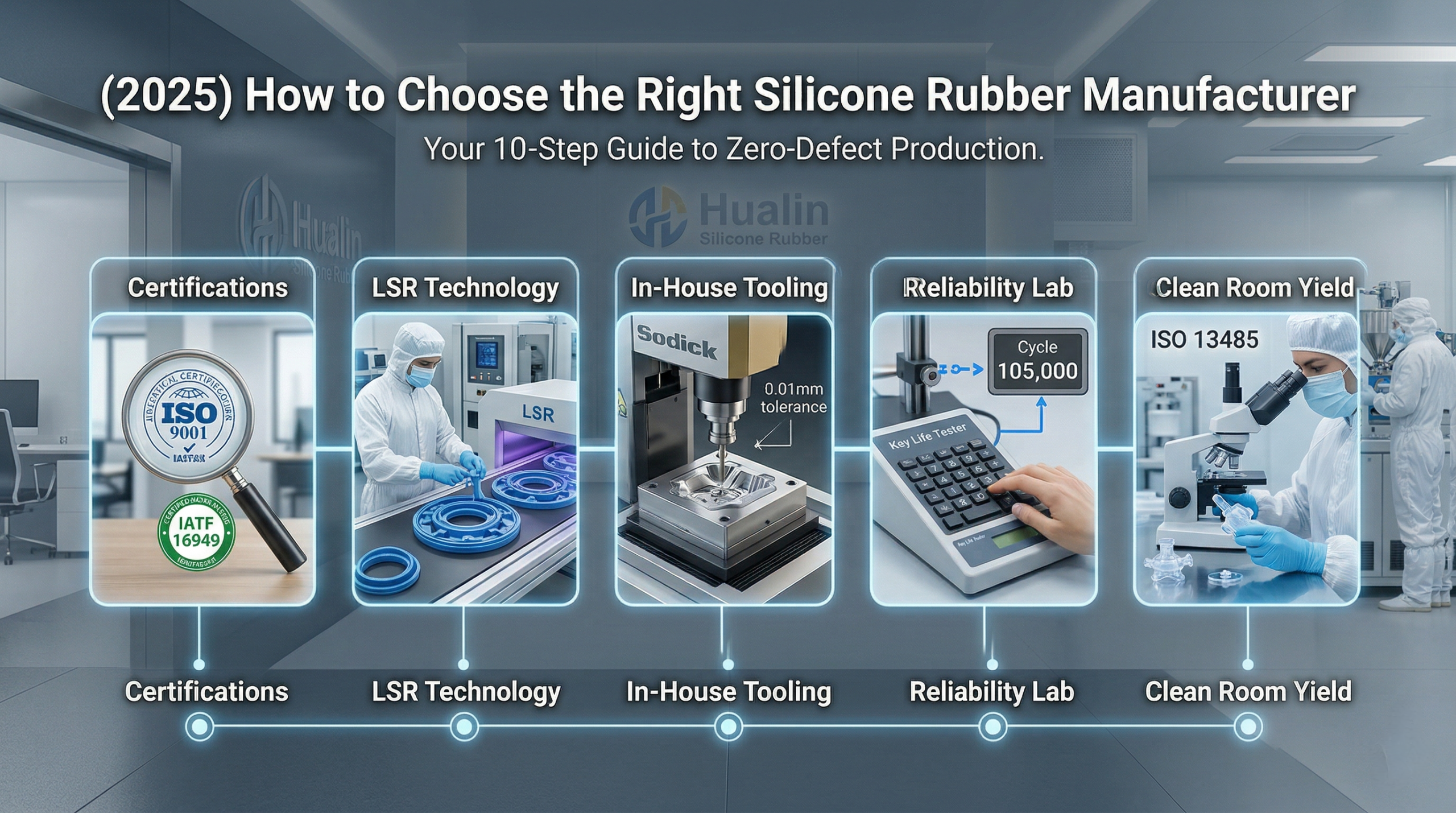
Selecting the best partner involves evaluating their technical certifications, production capacity, and historical quality consistency to ensure your project scales without manufacturing defects. Finding a reliable production partner is often the difference between a successful product launch and a costly recall. Here’s the deal: we have spent years refining high-precision liquid silicone rubber (LSR) and solid silicone processes to help global brands achieve zero-defect production.
Imagine you are weeks away from a major product launch when your current supplier informs you that the seals are leaking due to inconsistent material hardness. The frustration of missed deadlines and wasted capital begins to mount as you scramble for a replacement. What’s the real story? You need a manufacturer that provides transparency and precision from the start. This guide offers a clear roadmap on how to choose silicone manufacturer so you can secure a partner that values your brand’s reputation as much as you do.
1. Why is checking certifications the first step in how to choose silicone manufacturer?
You should verify certifications first because they serve as an objective benchmark for a factory’s quality management and safety standards. ISO 9001 and IATF 16949 are not just plaques on a wall; they represent a commitment to documented processes and continuous improvement. Believe it or not, many “factories” are actually trading companies without these credentials.
Does the factory hold industry-specific standards?
A manufacturer must possess the specific certifications required for your niche, such as ISO 13485 for medical devices or IATF 16949 for automotive parts. You might be wondering why this is so critical for your specific project. Without these, your product might not pass regulatory audits or safety inspections in your target market.
- ISO 13485 for medical-grade silicone reliability.
- IATF 16949 for automotive-grade sealing components.
- ISO 14001 for environmental management compliance.
How do certifications impact long-term product quality?
Certifications ensure that every batch of silicone produced meets a predictable standard of excellence and safety. This is where it gets interesting because a certified factory is required to have a traceability system in place. If a defect occurs, you can trace the issue back to the raw material batch or the specific machine operator.
| Certification | Industry Focus | Primary Benefit |
| ISO 9001:2015 | General Manufacturing | Consistent quality management |
| IATF 16949 | Automotive | Risk management and defect prevention |
| ISO 13485 | Medical | Biocompatibility and safety control |
Analyzing these credentials helps you filter out high-risk suppliers before they can jeopardize your supply chain integrity.
Key Takeaway: Verifying certifications ensures the factory operates under a globally recognized framework of accountability and safety.
2. How does production capacity affect how to choose silicone manufacturer?
Choosing a manufacturer requires assessing if their machinery and labor force can handle your peak order volumes without sacrificing lead times. A factory with only a few machines might offer a lower price but will fail you during the holiday rush. Ready for the good part? Proper capacity planning prevents stockouts and keeps your customers happy.
Can the facility handle both LSR and solid silicone?
You need to know if the factory has a diverse range of equipment, such as LSR injection machines and vacuum vulcanization presses. The best part is that having both capabilities allows you to source different types of parts from a single, trusted vendor. It simplifies your logistics and ensures material compatibility across your entire product line.
- LSR machines for high-precision, liquid silicone parts.
- Vacuum vulcanization machines for high-volume solid rubber.
- Automatic spraying lines for surface treatments and coatings.
Is the workforce stable enough for mass production?
High employee turnover can lead to inconsistent quality, as new workers may not understand the nuances of your specific molds. Check this out: a stable team of over 200 skilled employees indicates a healthy corporate culture and reliable output. You want a partner where the expertise stays on the factory floor, not one that is constantly retraining.
| Equipment Type | Quantity Available | Production Output |
| LSR Injection (85T-120T) | 12 Sets | 2M pcs/week (Precision parts) |
| Vacuum Vulcanization (250T) | 36 Sets | 140K pcs/day (Standard buttons) |
| Mixing Machines | 3 Sets | 2000 kg/day (Material prep) |
This equipment list demonstrates a manufacturer’s ability to scale from small pilot runs to massive global distributions seamlessly.
Key Takeaway: Strong production capacity guarantees that your manufacturer can grow alongside your business without causing delivery delays.
3. Why is an in-house tooling workshop a game changer?
An in-house tooling shop allows for faster mold modifications and significantly lower costs for the end customer. When the mold and the part are made in the same building, communication errors between the designer and the machinist disappear. Here is the kicker: it can shave weeks off your development timeline.
How does internal tooling speed up your NPI?
In-house CNC machining centers like those from Roders enable rapid prototyping and immediate adjustments if the initial samples aren’t perfect. You’ll be surprised at how much time is wasted when a factory has to ship a mold across town for a simple fix. Integration means the engineering team can walk over to the machine shop and solve problems in real-time.
- Roders CNC centers for high-precision German engineering.
- Sodick Mirror EDM for superior surface finishes on molds.
- Slow-speed wire cutting for complex, intricate part geometries.
Does it reduce the overall cost of ownership?
While the initial mold fee might seem standard, the long-term savings on mold maintenance and repairs are substantial. It’s no secret that external tool shops charge for every minor adjustment or cleaning. A manufacturer with its own shop usually includes basic maintenance to keep the production line running smoothly.
| Tooling Machine | Country of Origin | Precision Level |
| Roders CNC | Germany | Ultra-High Precision |
| Sodick EDM | Japan | Mirror Finish Quality |
| Wire Cutting | Japan/Standard | Intricate Detail Accuracy |
This technical infrastructure proves the manufacturer has invested in the high-end technology required for complex industrial applications.
Key Takeaway: In-house tooling provides the agility and precision needed to move from concept to market faster than the competition.
4. What role does a clean room play in silicone quality?
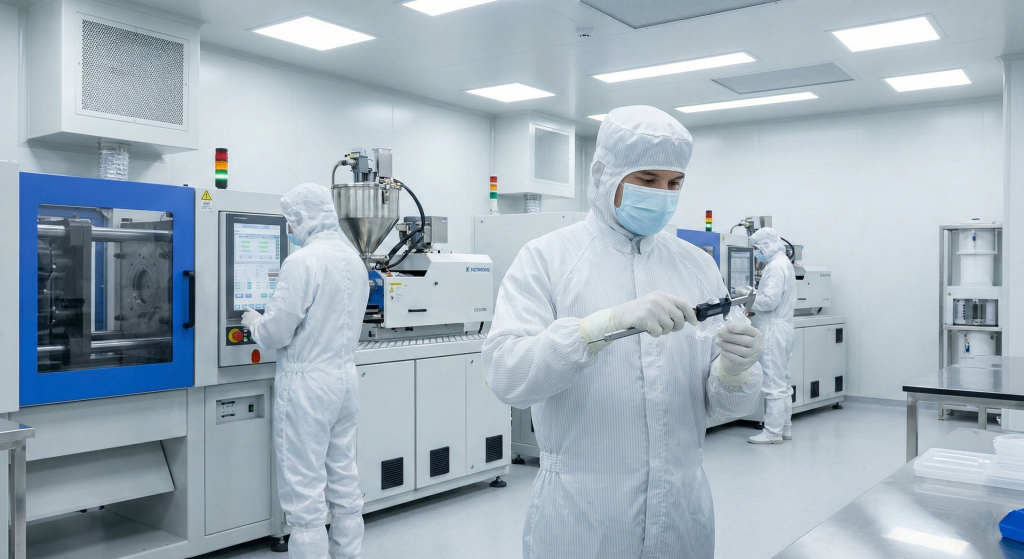
A clean room environment is essential for preventing dust and contaminants from ruining the appearance or function of your silicone parts. For medical or high-end consumer electronics, even a tiny speck of dust can lead to a rejected batch. Wait, there’s more: a Class 100k Clean Room shows a high level of operational discipline.
Is a clean room mandatory for your industry?
If you are producing medical components, wearable tech, or baby products, a controlled environment is non-negotiable for safety. Think about it: would you want a baby teether or a medical valve produced in a dusty, open-air workshop? The clean room ensures that the material remains pure and free from environmental pollutants during the curing process.
- Air filtration systems to remove airborne particles.
- Strict gowning procedures for all factory floor personnel.
- Controlled humidity and temperature for material stability.
How does it improve the yield of cosmetic parts?
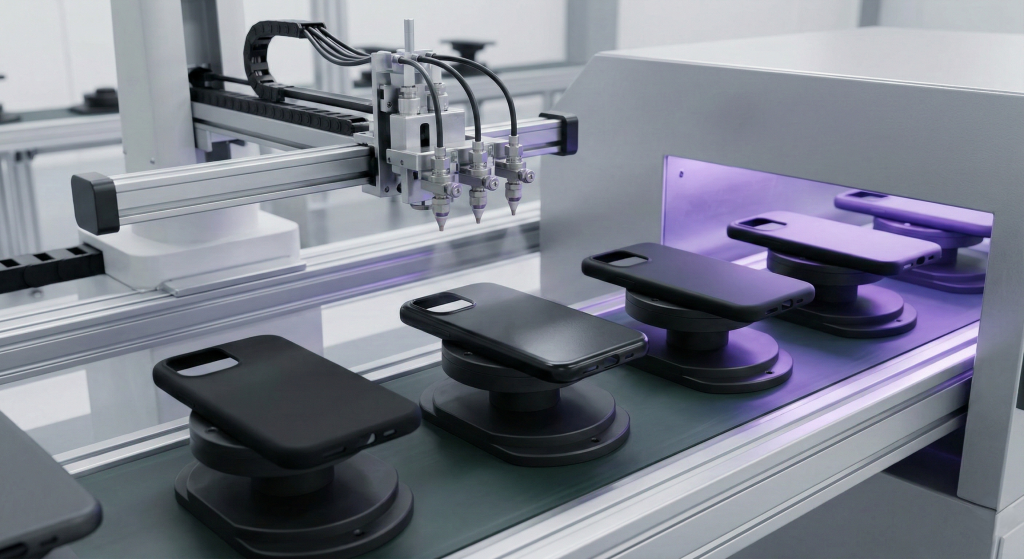
For products like phone cases or VR goggles, surface imperfections are the primary cause of customer returns. The truth is that most surface defects happen during the cooling or spraying phase. By using a clean room and automatic spraying lines, a manufacturer can achieve a near-perfect aesthetic finish every time.
| Feature | Clean Room Standard | Benefit to You |
| Particle Control | Class 100,000 | Zero visible contaminants |
| Environment | Temperature Controlled | Consistent material curing |
| Process | Isolated Production | Prevents cross-contamination |
Maintaining a sterile production environment is a clear indicator that the manufacturer prioritizes high-end market requirements.
Key Takeaway: Clean room manufacturing is the only way to ensure the purity and aesthetic perfection of high-sensitivity silicone products.
5. How do you evaluate the raw material supply chain?
A manufacturer is only as good as the raw silicone they put into their machines, so you must audit their material sources. You should ask whether they use food-grade or medical-grade LSR from reputable global suppliers like Dow or Wacker. Let’s get down to business: using cheap, unbranded silicone leads to odors and structural failures.
Are material safety data sheets (MSDS) provided?
You must insist on seeing RoHs, REACH, and FDA reports for every batch of material used in your project. You might be wondering if these documents are actually verified during the manufacturing process. A reputable partner will provide a “Certificate of Analysis” (COA) to prove the material meets your exact specifications.
- FDA and LFGB compliance for kitchenware and baby items.
- Biocompatibility testing for skin-contact wearable devices.
- Flammability ratings for automotive and electronic components.
Can they customize silicone properties for you?
Sometimes standard silicone isn’t enough, and you need specific Shore A hardness or high-temperature resistance. Here is the deal: a top-tier manufacturer has in-house mixing equipment to create custom silicone compounds tailored to your needs. This flexibility allows you to optimize the part’s performance without switching materials mid-project.
| Material Property | Testing Method | Application |
| Hardness | Durometer (Shore A) | Feel and flexibility |
| Tensile Strength | Pull Testing | Durability and stretch |
| Compression Set | Heat Aging | Sealing performance |
Reliable material sourcing ensures your product is safe for consumers and durable enough to withstand its intended environment.
Key Takeaway: Deep transparency in the material supply chain protects your brand from safety recalls and performance issues.
6. Why is a reliability lab essential for choosing a partner?
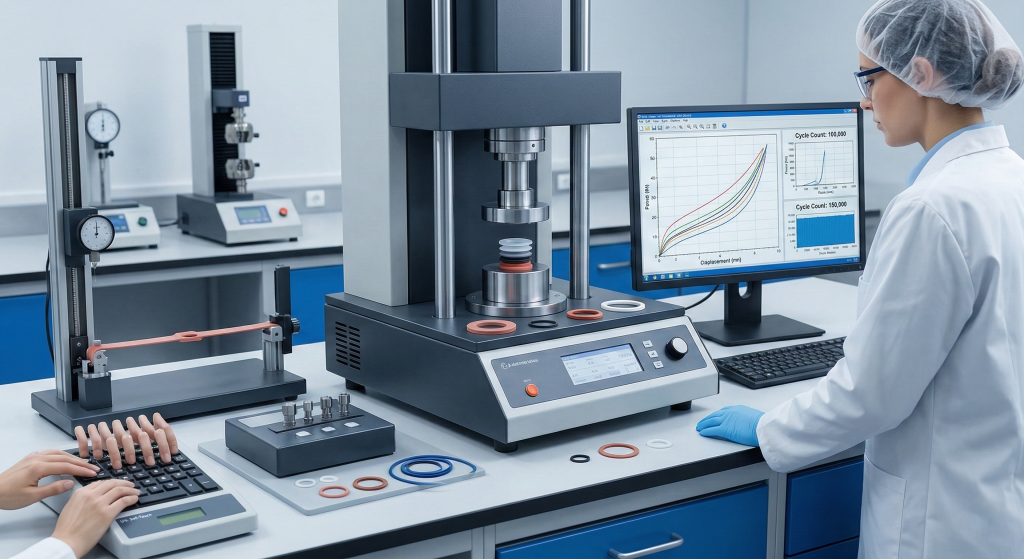
A reliability lab confirms that your silicone parts will survive real-world conditions like extreme heat, friction, or chemical exposure. You shouldn’t have to hire a third-party lab to verify every production run if the factory is properly equipped. What’s the catch? Many factories claim to test but lack the actual machinery to do it.
What kind of mechanical testing is necessary?
You need to know how the buttons or seals will perform after 100,000 cycles of use. This is where it gets interesting because a dedicated Key Life Tester can simulate years of wear in just a few days. If the manufacturer lacks this equipment, they are simply guessing about the lifespan of your product.
- Key Life Testers for button and keyboard durability.
- Tensile machines to measure the breaking point of silicone.
- RCA Abrasion Testers to ensure printed logos don’t rub off.
Can they simulate harsh environmental conditions?
Silicone is often used because of its weather resistance, but you need data to prove it works for your application. Ready for the good part? Programmable Temp & Humid chambers allow engineers to see how parts react to tropical heat or freezing cold. This prevents “field failures” where products warp or degrade once they reach the customer.
| Lab Equipment | Quantity | Purpose |
| Mechanical Testers | 37 Sets | Comprehensive durability data |
| Optical (OGP/2.5D) | 6 Sets | Precision dimensional inspection |
| Environmental Chambers | 3 Sets | Weather and chemical resistance |
A fully equipped lab turns “quality” from a vague promise into a measurable data point that you can trust.
Key Takeaway: A dedicated reliability lab provides the empirical evidence needed to guarantee long-term product performance and safety.
7. How do post-processing capabilities add value?
Post-processing includes everything from UV coating and silk-screen printing to final assembly and custom packaging. A “one-stop shop” reduces your overhead by eliminating the need to coordinate with multiple vendors for a single product. Believe it or not, shipping parts between multiple factories often introduces more defects than the molding process itself.
Why does UV modification matter for silicone?
Silicone is naturally “tacky,” which means it attracts dust and feels sticky to the human hand. Check this out: a UV modification line applies a smooth, soft-touch coating that makes the product feel premium and stay clean. This is a critical step for high-end consumer electronics like earbuds or smartwatches.
- Automatic and manual spraying lines for various finishes.
- Silk-screen and pad printing for clear, durable logos.
- UV curing for a dust-resistant, high-quality surface feel.
Can the manufacturer handle final assembly?
If your product consists of silicone overmolded onto plastic or metal, the factory should handle the entire assembly. It’s no secret that managing a complex bill of materials is easier when one partner takes full responsibility. Look for a manufacturer that offers secondary operations like adhesive lamination and manual assembly.
| Service | Equipment Type | Output Capacity |
| UV Modification | UV Coating Line | 200K pcs/day |
| Logo Printing | Auto-Pad Printing | High-speed accuracy |
| Die Cutting | Automatic Punching | Precision gasket shapes |
Choosing a partner with integrated secondary services streamlines your production and ensures a consistent look and feel across all components.
Key Takeaway: Integrated post-processing saves time and money while ensuring the final product meets your aesthetic standards.
8. Does the manufacturer have experience in your specific industry?
Industry-specific experience means the manufacturer already understands your unique pain points, whether they are medical regulations or automotive tolerances. A factory that mainly makes cheap toys might struggle with the precision required for a waterproof SIM tray. The truth is that specialized knowledge prevents rookie mistakes in mold design and material selection.
Have they worked with reputable global brands?
A list of partners like Huawei, Lenovo, or JBL is a strong indicator of a factory’s ability to meet rigorous corporate standards. You might be wondering if your smaller project will get the same attention as these tech giants. Usually, a factory that can satisfy a Fortune 500 company has the systems in place to handle any professional client efficiently.
- Consumer Electronics (smartphones, wearables, VR).
- Medical Devices (valves, masks, control panels).
- Automotive (waterproof seals, wire harnesses).
How do they approach DFM (Design for Manufacturing)?
An experienced partner won’t just take your file and hit “start”; they will provide a DFM report to point out potential molding issues. Think about it: catching a draft angle error or a thin wall in the design phase saves thousands of dollars in mold rework. You want a manufacturer that acts as a consultant, not just a service provider.
| Industry Segment | Key Requirement | How Experience Helps |
| Smart Wearables | Skin-safe / Aesthetic | Expertise in biocompatible LSR |
| Medical Tech | Sterility / Precision | ISO 13485 clean room workflow |
| E-Cigarettes | Heat resistance | Specialized food-grade compounds |
Evaluating past projects helps you determine if the manufacturer’s “DNA” aligns with your product’s quality requirements.
Key Takeaway: Deep industry experience reduces project risk by applying proven solutions to your specific manufacturing challenges.
9. What is the importance of automated inspection?
Human inspectors get tired, but CCD (Charge-Coupled Device) cameras can spot a 0.1mm defect at high speeds without missing a beat. For high-volume orders, automated inspection is the only way to guarantee a low PPM (Parts Per Million) defect rate. Wait, there’s more: data from these machines can help optimize the entire production line.
How does CCD inspection improve your bottom line?
By catching defects early, the factory avoids shipping bad parts and reduces the cost of wasted materials. Here is the deal: automated systems can check for dimensions, color consistency, and surface burrs simultaneously. This level of scrutiny ensures that only perfect parts reach your assembly line, preventing your own production delays.
- CCD inspection machines for high-speed visual checks.
- OGP automatic image measuring for 3D dimensional accuracy.
- 2.5D and 2D testers for flat part verification.
Is manual inspection still necessary?
While machines are great for speed, skilled human inspectors with microscopes are still needed for complex aesthetic audits. You’ll be surprised at how a hybrid approach—combining AI-driven cameras with expert manual QC—results in the highest quality. A top manufacturer uses a multi-stage inspection process before any goods leave the warehouse.
| Inspection Type | Technology Used | Target Defect |
| Automated | CCD Cameras | Size, shape, large flaws |
| Precision | OGP / 2.5D | Critical tolerances (+/- 0.01mm) |
| Manual | 16+ Microscopes | Surface texture and minor burrs |
Advanced inspection technology proves that a manufacturer is committed to a “zero-defect” policy rather than just doing the bare minimum.
Key Takeaway: Automated inspection is vital for maintaining high quality at scale, protecting your brand from costly assembly line failures.
10. How do communication and logistics impact the partnership?
A factory can have the best machines in the world, but if they don’t answer your emails or understand your shipping requirements, the project will fail. You need a dedicated account manager who speaks your language and understands international trade terms. Ready for the good part? Clear communication turns a vendor into a true strategic partner.
Do they offer DDP or FBA shipping options?
For e-commerce brands, a manufacturer that can ship directly to Amazon warehouses or your local 3PL is a massive advantage. You might be wondering how much complexity this removes from your daily operations. It means you don’t have to deal with customs brokers or freight forwarders yourself, saving you hours of administrative work.
- English-speaking project managers for clear technical discussions.
- ERP systems to provide real-time updates on your order status.
- Experience with international logistics and customs documentation.
How responsive is their engineering support?
When a problem arises during production, you need an answer in hours, not days. The best part is that an integrated “industry and trade” company usually has a faster response loop than a traditional factory. They understand the urgency of the global market and prioritize keeping your project on track.
| Communication Tool | Frequency | Purpose |
| ERP System | Real-time | Order and inventory tracking |
| DFM Report | Pre-production | Design optimization suggestions |
| Weekly Progress | Per Project | Timeline and milestone updates |
Effective communication and flexible logistics ensure that the high-quality parts you ordered actually arrive when and where you need them.
Key Takeaway: Professional communication and logistical support are the “soft skills” that ensure your manufacturing project runs without friction.
Conclusion
Mastering how to choose silicone manufacturer requires a balanced look at technical certifications, in-house tooling capabilities, and automated quality control. We have shown that a partner with integrated services—from mold design to final UV coating—can significantly reduce your time-to-market while maintaining the highest safety standards. By following this 10-step framework, you can avoid the common pitfalls of inconsistent material quality and communication breakdowns that plague many offshore partnerships.
At Dongguan Hualin, we are dedicated to being the high-precision partner that helps your brand lead its industry. Whether you are developing life-saving medical devices or next-generation consumer electronics, our IATF 16949-certified facility and Class 100k clean room are ready to exceed your expectations. Our vision is to empower global innovation through silicone excellence, ensuring every component we touch is a benchmark for quality. To start your journey toward a defect-free supply chain, contact us today for a comprehensive DFM review of your next project.
FAQ
Q1: How do I know if a manufacturer is truly an LSR expert?
Check if they have at least 10+ dedicated LSR injection machines and if they hold an ISO 13485 certification, which is the gold standard for high-precision liquid silicone molding.
Q2: Can I get custom colors for my silicone products?
Yes, professional manufacturers use Pantone matching systems and in-house mixing equipment to ensure your silicone parts perfectly match your brand’s color requirements.
Q3: What’s the best way to verify a factory’s claims?
Request a live video tour of their facility or a sample of a previous “similar project” to verify their surface finish quality and the precision of their tooling.
Q4: How do I know if the silicone is safe for food contact?
Always ask for the specific FDA or LFGB test reports for the raw material batch being used; a reliable partner will provide these without hesitation.
Q5: What is the typical lead time for a new silicone mold?
For a manufacturer with in-house tooling, the typical lead time is 15 to 25 days, depending on the complexity of the part and the surface finish requirements.